Introduction
It is critical for all Americans to be active, informed citizens by participating politically. Political participation, defined as any voluntary action taken to influence public policy decisions, can take many forms, including voting, emailing elected officials, or advocating for change through protest. It is particularly beneficial for adolescents to participate in politics, given that political participation is correlated with higher grades, stronger personal identity, and alleviated depressive symptoms among youth (Akiva et al., 2017). Additionally, when young people are politically involved, they are more likely to grow into civically engaged adults. Moreover, the involvement of youth in politics is critical not only to benefit themselves but also society at large.
For an adolescent to participate politically, they must possess a few key skills, including critical thinking, sociopolitical knowledge, and empathy. Psychology professor Jean Twenge underscores the necessity of critical thinking – the ability to understand and evaluate opposing ideas with a critical lens – in political participation. Strong critical thinking skills, as Twenge explains, allow youth to better understand and analyze complex political issues. In addition, having a comprehensive knowledge of history, government, and current events is important to make informed policy decisions. Empathy is another crucial skill, as it enables one to understand and value the perspectives of others (J. Twenge, 2018). These three skills are proven catalysts of political participation.
Interestingly, past research has shown that many of these skills are correlated with reading. Reading activates regions of the brain involved in critical thinking, empathy, and creativity (Tamir et al., 2015). Overall, reading equips adolescents with the necessary competencies to be politically active. Despite this connection, there have been few studies examining the direct correlation between reading habits and political participation in adolescents.
Literature Review
Importance of Political Participation Among Youth
Political participation, defined as any voluntary action intended to influence policy decisions, is highly important. Active engagement with politics ensures that all citizens’ voices are heard and the values of democracy are upheld (Moeller et al., 2018). Engagement in politics by adolescents is especially valuable, as it brings significant benefits to both the adolescent and society. First, active engagement with politics can facilitate personal growth in adolescents. An article written by the United Nations Children’s Fund showed that involving youth in the process of political decision-making encouraged resilience, facilitated a strong civic identity, and eased the transition to adulthood (UNICEF). A study by Olga Fliaguine, a psychology professor at the University de Québec, confirmed UNICEF’s results. Fliaguine discovered that civic engagement is positively correlated with a stronger personal identity and alleviated depressive symptoms. Political participation is also associated with stronger academic performance, including higher grades and improved problem-solving skills (Fliaguine et al., 2024)
Political participation also amplifies young voices. A study spearheaded by Akiva, a professor at the University of Pittsburgh, revealed that political participation helped youth who felt marginalized or silenced at school find their voices. After attending a political event, one teenager explained, “[I] feel like I have a place to be so I can speak my mind, and I did youth organizing because I feel like nobody could really hear us” (Akiva et al., 2017). Many other students in the study similarly noted that involvement in politics allowed them to feel not only comfortable but confident in speaking up about issues they cared about.
When youth feel that their voices matter, they are more likely contribute positively to the world around them. The power of youth to create change in communities is often underestimated. Butler, professor at Michigan State University, claims, “Students should not be seen as empty vessels, who are apathetic to the world around them. Instead, they should be seen as investigators and problem-solvers, as individuals who are invested in the communities in which they live…].” In stating this, Butler challenges the commonly accepted notion that youth exert no influence on society and instead characterizes them as changemakers.
The change created by young voices is often revolutionary, leading to change spanning generations. In Scotland, for example, youth involvement led to the creation of a new government health improvement agency. In Tanzania, youth councils contributed to drastic changes in budget spending. Finally, in Germany, youth-led climate protests increased electoral support for the Green Party (UNICEF, 2025). Clearly, youth engagement has the potential to spark profound change in society and politics.
Skills Necessary to Participate Politically
Being politically active requires a few key skills. Adolescents must have strong critical thinking skills, comprehensive sociopolitical knowledge, and empathy. These skills are important to help facilitate political participation among adolescents. Adolescents must be able to think critically about current events in order to participate in politics. Zaino, an expert at Miami University, explains the importance of analytical thinking and questioning for political participation. The researcher claims that for youth activists to “deepen their political self-education,” they must undergo “a process of questioning dominant ideologies.” (Zaino & Conner, 2024). Thinking, reasoning, and questioning are critical skills for young activists.
In addition to critical thinking, sociopolitical knowledge is important to be politically involved. Sociopolitical knowledge is defined as a thorough understanding of current events, history, and social movements. Maintaining a proficient level of sociopolitical knowledge can help to protect democracy and foster trust between citizens and government (Padilla et al., 2020). Finally, young activists should be empathetic. The previous skills – critical thinking and sociopolitical knowledge – give youth the ability to identify current problems and evaluate potential solutions. Empathy, on the other hand, is important for youth to truly feel the struggles of other communities. If an adolescent aims to confront food insecurity, for example, they must first understand what it means to come home to an empty dinner table. Empathy incites anger, passion, and other strong emotions that drive youth to transform their thoughts into tangible action.
Relationship between Reading and Political Skills in Youth
Reading cultivates the same skills necessary for political participation. By reading novels, adolescents are exposed to a diverse array of perspectives and ideas. Books “act as a doorway to information, expanding people’s horizons and allowing them to consider various viewpoints” (Agustina et al., 2024). This simple leisure activity has the power to cultivate skills of critical thinking, empathy, and activism in adolescents.
Researchers generally agree that reading is associated with improved critical thinking. A study conducted at Universitas Negeri Yogyakarta in Indonesia proves that stronger reading habits are linked to increased critical thinking skills in high school students. Data analysis revealed a Pearson Correlation value of 0.976, indicating a very strong correlation between reading and critical thinking (Agustina et al., 2024). This suggests that students who read more frequently are more likely to be deep, critical thinkers.
Reading also builds empathy; in particular, culturally relevant and multicultural texts foster a deeper understanding of others. Culturally relevant texts are works that reflect the experiences, values, and backgrounds of their readers. For students in rural Texas, a culturally relevant text may be Tomás and the Library Lady, a 1997 memoir surrounding the same region of Texas they call home (Johnson et al., 2024). Rather than simply affirming identity, culturally relevant texts equip readers with the framework to critically examine their experiences and the systems that shape them.
Multicultural texts are similarly associated with greater empathy. Johnson, a professor of education at the University of Virginia, extends upon Will’s findings by investigating the relationship between multicultural texts and empathy. Multicultural literature cultivates empathy by exposing students to diverse perspectives and traditions they may not encounter within their own lived experience. In a qualitative interview conducted at the Reich College of Education, a student shared, “I do not recall reading much literature geared toward African Americans… as a white child I never really thought about it because I already had books that I could relate to” (Colby & Lyon, 2004). After reading more novels centering African American characters, though, this student’s perspective was wholly transformed. Multicultural literature is therefore not only important to provide representation for minorities but also to allow non-minority students to understand and empathize with other communities.
Building upon the findings of Johnson, Diana Tamir, a psychology professor at Princeton University, conducted a study evaluating the relationship between reading and social cognition, the psychological component of empathy. Through analysis of fMRI scans, Tamir found that readers possess greater social-cognitive abilities than non-readers due to the influence of reading on neural networks involved in simulating social content social. Moreover, books can cultivate social cognition and empathy in readers, which may increase the likelihood that they will be engaged in politics.
Finally, several studies have identified a more direct relationship between reading and political participation in adults. One study examined the extent to which reading literature influenced individuals’ decisions to become activists. 63% of respondents cited one or more novels as playing a significant role in shaping their identity as an activist, reflecting the power of literature to impact readers’ ways of thinking and questioning (Zaino & Conner, 2024). Although this study examined adults rather than teenagers, it raises questions whether a similar correlation exists between reading and political participation in youth.
Historical Correlation between Reading and Political Participation
Historically, there has been a relationship between reading and political participation. The trends in reading habits of youth and their engagement with politics have closely mirrored each other, with both declining significantly in recent years.
From the late 1970s to the present day, reading rates among U.S. adolescents have plummeted. The percentage of 12th graders who read a book or magazine daily dropped from almost 70% to approximately 15% in only three decades (J. M. Twenge et al., 2019).
Alongside the sharp decline in reading, political participation has also declined. Political participation in youth peaked at 27% in 1977-1978 and has steadily declined since. Trust in the government also deteriorated: 61% trusted political officials in 1986 while only 31% did in 1994 (Syvertsen et al., 2011). This suggests a significant decline in political participation among youth.
Although the patterns in reading and political participation share many parallels, they have mainly been studied separately. Few studies have studied the direct relationship between reading and political participation. Of these few studies, there are almost none centering adolescents. To address this gap in the body of knowledge, the question being studied is: to what extent are the reading habits of adolescents (ages 13-18) in the Lower Hudson Valley associated with participation in politics and activism? The researcher hypothesized that stronger reading habits would be correlated with greater political participation.
Methodology
To explore this question, an online correlational survey was utilized. The procedure was approved by the Institutional Review Board and determined to be ethical and non-invasive. To minimize the risk of emotional discomfort, all participants were made aware of available mental health and wellness resources.
Before selecting this method, two other potential methods were considered: causal comparative research and content analysis. Causal-comparative research seeks to identify a causative relationship between an independent and dependent variable. This methodology was ultimately determined to be insufficiently aligned with the research goals, as past literature did not indicate the potential existence of a causal relationship between reading and political participation. Content analysis was also examined. This approach would have involved analyzing whether the contents of books identified as influential by students in past studies contribute to the formation of adolescents’ civic identity. Content analysis was not selected because the scope of the research question did not encompass an examination of the specific aspects of books that led students to be politically active.
The method chosen, correlational research, exhibited the strongest alignment with the research goals. A study conducted by Twenge, a psychology professor at San Diego State University, demonstrated a clear decline in reading among adolescents (J. M. Twenge et al., 2019). Over a nearly identical timeframe, civic engagement and political interest among youth have declined, according to an article written by senior researcher Syvertsen (Syvertsen et al., 2011). When situating these two articles in the broader context of the body of knowledge, it becomes apparent that a correlation may exist between reading and political participation among youth. Therefore, it was the most logical to utilize a method that measured the extent to which a correlation exists between these two variables.
Within correlational research, several sub-methods exist. A correlational survey was selected for several reasons. First, it allowed the researcher to gather data from a large sample size. Additionally, the survey provided quantitative data, which is necessary to measure correlation. Finally, utilizing a standard set of questions reduced any bias that may have been present in an interview or experiment.
To solicit participants, an email was sent to a high school in the Lower Hudson Valley asking if any students were interested in participating. Additionally, the researcher spoke to several classes at the high school to further raise awareness about the study. The researcher presented to students in English, French, and Social Studies classes.
All interested students were given an informed consent form. They were notified that participation was entirely voluntary, no identifiable data would be recorded, and they may choose to stop participating at any point. Upon submitting the signed consent form, participants received the survey, along with a unique, randomized Participant-ID Number to ensure anonymity.
At the beginning of the survey, basic demographic information was collected. This included age and gender. Following these questions, the survey consisted of three main sections: Media Consumption, Demonstrated Participation in Politics or Activism, and Objective Civic Knowledge (OCK).
The first section was Media Consumption. Participants were asked about the frequency and duration that they read books which were not assigned by their teachers. The goal of this was to determine an estimate of the amount of time the participant reads for leisure. Next, participants were asked to report the factors that motivated them to read or not read on a given day, as well as the three genres they read most often. These questions offered a more comprehensive insight into the reading habits of participants beyond simply how often they read. Finally, participants were prompted to identify how often they read the news and the sources of their news consumption.
The second section focused on Demonstrated Participation in Politics or Activism. This section was modeled on a survey conducted at the Center for Information & Research on Civic Learning and Engagement (CIRCLE) at Tufts University. Similarly to the CIRCLE survey, the measure included civic indicators, electoral indicators, and indicators of political voice (Keeter et al., 2002). One question addressed volunteerism as a civic indicator, and another question inquired about the participant’s likelihood of voting in the future as an electoral indicator. The next two questions asked about endorsing a political candidate or speaking up about politics, both indicators of political voice.
These items represented dimensions of civic engagement feasible to measure among adolescents. Because participants were below voting age, likelihood of voting was used rather than past voting behavior. Questions about endorsing a candidate and speaking about politics captured expression accessible to adolescents, while volunteerism represented civic engagement outside political activities. Certain CIRCLE indicators, such as financially endorsing a campaign, were excluded because they were less applicable to adolescents. Together, these items provided a measure of participation across civic, electoral, and political voice activities rather than treating participation as one behavior.
To calculate the total scores for civic, electoral, and vocal indicators, the researcher equated each answer with a point value. For example, for the question, “How likely are you to vote in the future?” students who answered “Extremely likely” would receive 4 points, while those who answer “Not at all likely” would receive 1 point. The same system was applied to all questions testing indicators of political participation. Participants could receive a total score ranging from 4, least active in politics, to 16, most active in politics.
Finally, the third section was Objective Civic Knowledge (OCK). Initially, the researcher was planning on selecting either participation in politics or civic knowledge to study. However, through continued research and discussion, it became apparent that the two were deeply related to one another. As a result, both sections were included.
These objective questions were taken from the Civics Section of the National Assessment of Educational Progress (NAEP). Through a search on the NAEP’s website, the researcher retrieved a list of 96 civics questions ranging in difficulty from an 8th grade level to a 12th grade level. The questions were sourced from exams administered in 2006 and 2022.
To decide which of these 96 questions to include, the researcher prioritized choosing questions adhering to the civic education content standards outlined by the New York State Department of Education (NYSED). These standards included: “the structure and functioning of government, law, and democracy at the federal, state, local, and school levels,” “civil and educational rights and responsibilities guaranteed by the U.S. Constitution,” “history, geography, economics, and current events within our country”, and “the importance of civic rights and responsibilities” (Civic Readiness Initiative, n.d.). These categories were utilized for their clarity, comprehensiveness, and alignment with survey sections in past studies. Using these guidelines, the researcher selected 6 questions from the list of 96 questions to include in the survey. Each of the NYSED civic education content standards was tested in at least one question.
Results
Overall, 32 respondents participated in the survey. These participants ranged from 14 to 18 years old. Both males and females participated, although 82% of participants were female.
To analyze the results, DataClassroom was utilized (DataClassroom, n.d.). Two main statistical tests were used: linear regressions and t-tests. Linear regressions were used to model relationships between numerical scores, while t-tests were utilized to analyze whether a statistically significant difference existed between two groups. ANOVA was also utilized to compare three or more populations; however, the results from this statistical test were not significant.
Before analyzing the results, the researcher calculated two important scores: Reading Habits Score and Total Political Participation Score. The Reading Habits Score was calculated using answers from the Media Consumption Section: frequency of reading, duration of reading, number of different motivations to read, and number of different genres read. To quantify reading habits, the researcher equated each answer with a point value and calculated the totals. For example, reading daily was equivalent to 5 points, while never reading was given a value of 0 points. The Total Political Participation Score was simply the total of the following scores: electoral indicator score, civic indicator score, and indicator of political voice score.
Next, the researcher first examined whether a relationship existed between these two variables. Contrary to the researcher’s prediction, data analysis did not reveal stronger reading habits to be associated with greater reported political participation. The relationship was not statistically significant (b = 0.121, R2 = 0.0658, n = 31, p = 0.16, 95% CI [-0.053, 0.295]).
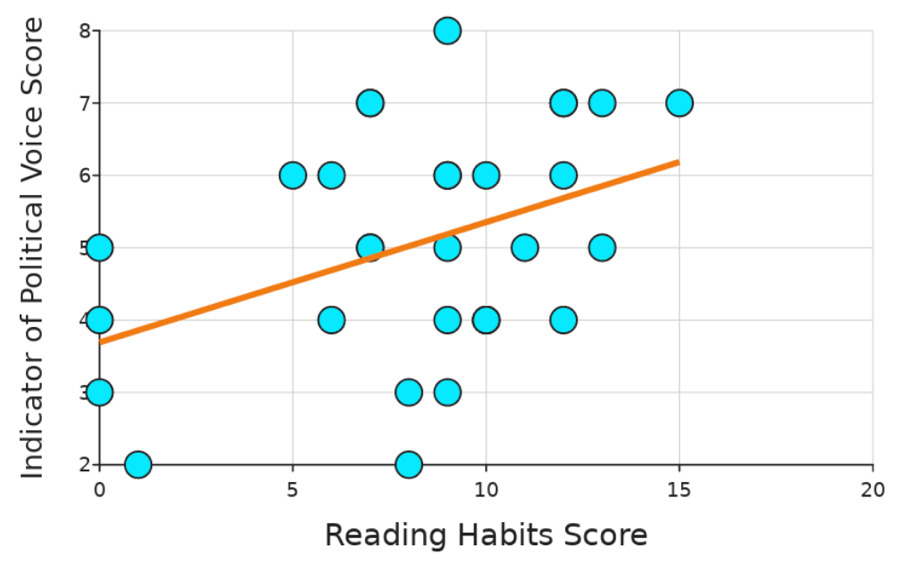
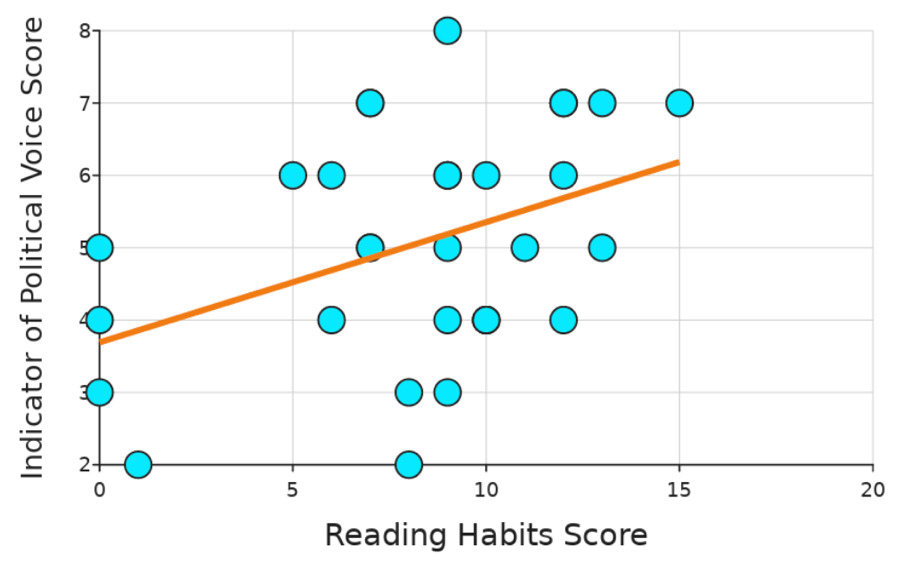
Figure 1 compares the participants’ Reading Habits Score with their Indicator of Political Voice Score. Although reading habits were not significantly associated with the overall political participation score, the researcher examined one component of political participation more specifically: indicators of political voice. Political voice was measured as a participant’s likelihood of speaking up about a political issue or endorsing a candidate. The researcher tested this relationship using a linear regression and found a statistically significant positive relationship between reading habits and political voice (b = 0.166, R2 = 0.165, n = 31, p = 0.02, 95% CI [0.024, 0.308]). This finding is consistent with the hypothesis that greater frequency and duration of reading are associated with stronger political voice.
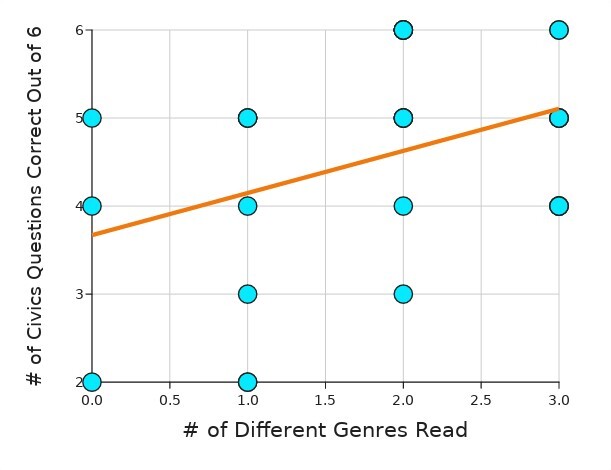
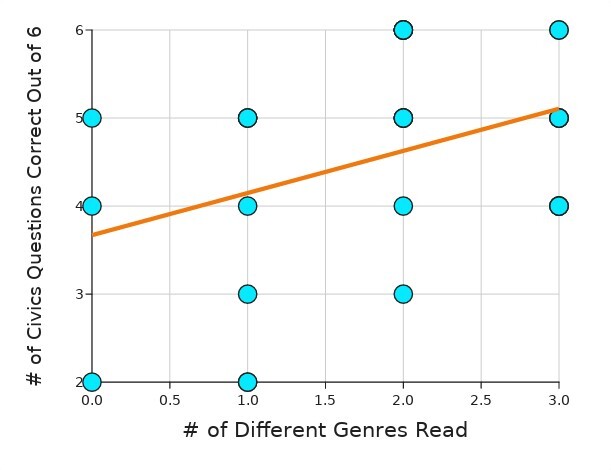
Figure 2 compares the number of different genres read with the number of civics questions participants answered correctly. The researcher expected this relationship to be significant, as previous literature has indicated that greater diversity in the types of books read is associated with greater critical thinking (Zaino & Conner, 2024). Using a linear regression, this relationship was determined to be in alignment with the previously established pattern. The relationship was statistically significant, indicating that participants who read a greater number of genres tended to answer more civics questions correctly (b = 0.479, 95% CI [0.047, 0.911], R2 = 0.151, p = 0.03, n = 31).
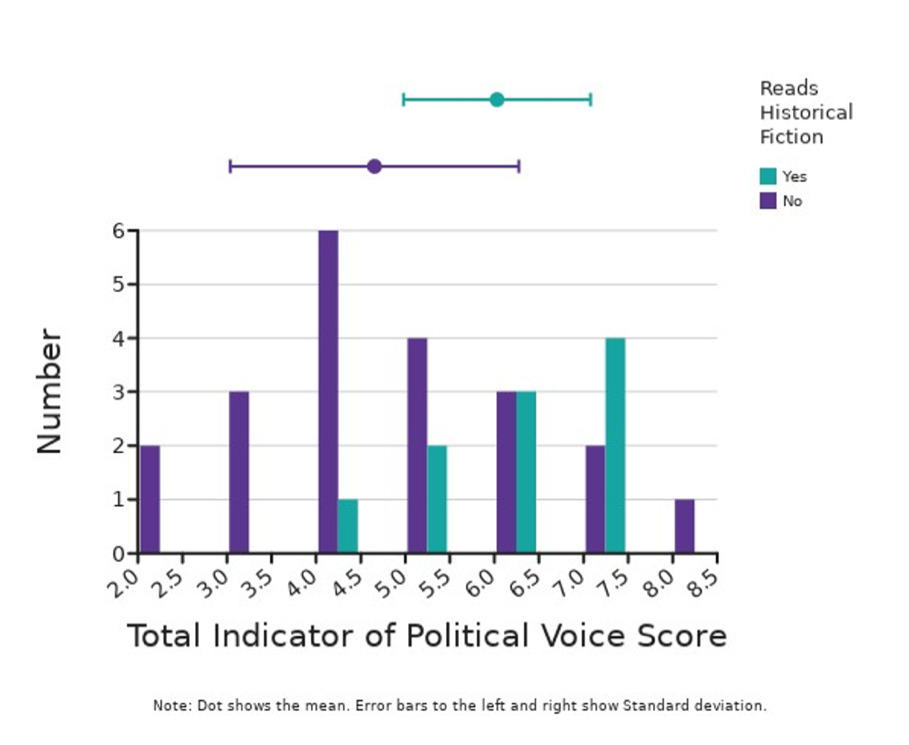
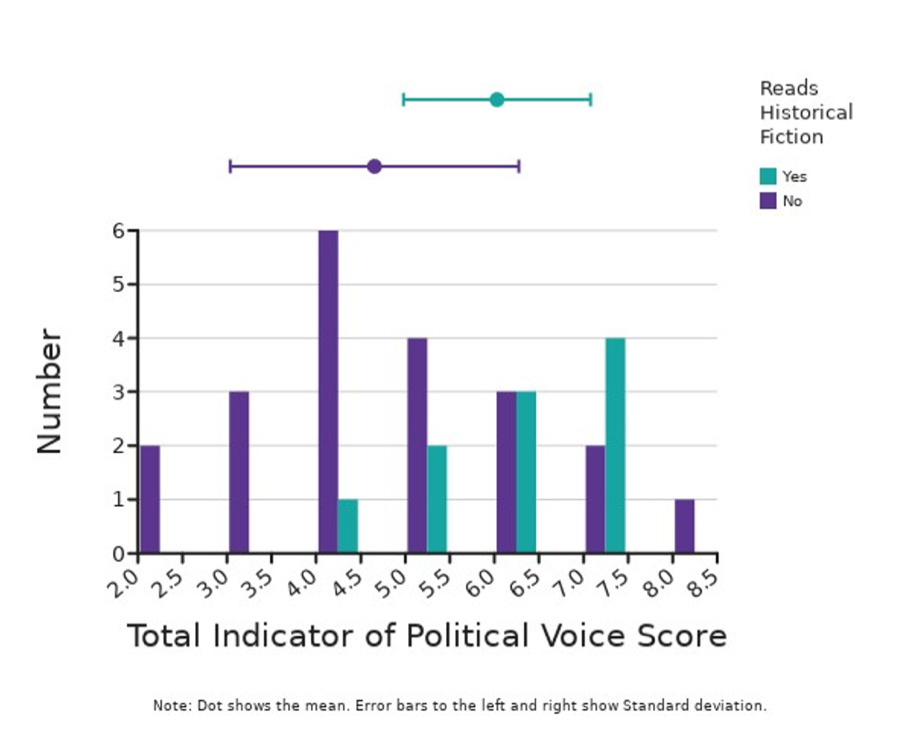
Figure 3 shows the relationship between reading historical fiction and the participants’ total of political voice score. Participants indicated the three genres they read most often from the following choices: “Fantasy or Science Fiction,” “General Fiction,” “Nonfiction,” “Historical Fiction,” and “Graphic Novels.” Participants were also given the option to enter another genre, or to select, “I do not read often.” 32.2% of respondents indicated that historical fiction was one of the three genres they read most often. Based on previous studies and background knowledge, the researcher expected that participants who selected “Historical Fiction” would exhibit greater participation in politics and activism. The researcher analyzed Figure 3 using an independent-samples t-test and found that participants who read historical fiction had significantly higher political voice scores than participants who did not (M = 6.00, SD = 1.054 vs. M = 4.62, SD = 1.63; t(29) = 2.80, p = .01).
Discussion
The results suggest that reading habits are associated with some forms of political and civic engagement, but not others. Although the Reading Habits Score was not significantly associated with total political participation, it was significantly associated with political voice. Participants with higher Reading Habits Scores, which incorporated reading frequency, duration, motivations, and genre diversity, tended to report greater willingness to speak about political issues or endorse a candidate. This finding is consistent with the hypothesis that stronger reading habits are associated with greater political expression. The relationship between reading and political voice aligns with Agustina et al. (2024), who found that reading exposes students to diverse ideas. Reading may expose adolescents to information and perspectives that provide opportunities to develop and express political opinions, although the correlational nature of this study does not establish that reading causes greater political voice.
Genre diversity was also associated with civic knowledge. Participants who reported reading a greater number of genres tended to answer more civics questions correctly. This finding is consistent with previous research suggesting that exposure to different types of texts may be related to critical thinking and broader knowledge (Zaino & Conner, 2024). Because the Literature Review identified critical thinking as an important skill for political participation, this relationship may help explain why greater genre diversity was also associated with higher civic knowledge. Reading across genres may expose students to different perspectives, subjects, and ways of interpreting information, which could help explain this relationship.
Historical fiction showed a separate relationship with political voice. Participants who identified historical fiction as one of their three most-read genres had significantly higher political voice scores than those who did not. Historical fiction often places readers in social and political contexts, which may provide opportunities to consider issues such as power, inequality, conflict, and social change. However, this finding should be interpreted cautiously because the study measured whether historical fiction was among participants’ most-read genres rather than how frequently or deeply they read it.
Several relationships were not statistically significant. Most notably, Reading Habits Score was not significantly associated with total political participation. This finding differs from research discussed in the Literature Review showing that adults reported literature as contributing to their decisions to become activists (Zaino & Conner, 2024). One possible explanation is that the present study measured several forms of participation together, while previous research focused more specifically on activism. Reading may therefore relate more closely to certain forms of engagement, such as political expression, than to participation across electoral, civic, and vocal activities as a whole. Other factors, including age, educational experiences, access to civic opportunities, and personal interest in politics, may also contribute to differences in political engagement.
Additionally, reading more frequently is not necessarily correlated with greater civic knowledge. On the other hand, as age increases, civic knowledge scores increase by a significant margin. This indicates that OCK may be more related to age than reading habits. Considering that many of the skills tested in the questions are taught in higher level courses such as Advanced Placement United States History (APUSH), which are often only available to juniors or seniors, it makes sense that age influences Objective Civic Knowledge.
Overall, these findings suggest that the relationship between reading and political and civic development may be more specific than initially hypothesized. In particular, reading habits were associated with political voice, while genre diversity was associated with civic knowledge, and historical fiction was associated with political voice. Because this study was correlational, these relationships should not be interpreted as evidence that reading causes greater civic knowledge or political engagement.
Conclusion
These conclusions suggest that policymakers should explore placing a renewed emphasis on encouraging adolescents to read frequently and diversely. Potential approaches could include increasing funding for public libraries and expanding the diversity of literature available in high schools. These initiatives represent potential educational and policy interventions that warrant further evaluation, particularly in larger and more representative studies. Encouraging strong reading habits may help support the development of high schoolers as future civic leaders, problem-solvers, and engaged citizens.
There are several notable limitations to this research study, the most prominent being the limited and potentially unrepresentative sample. While the researcher initially intended to reach 50 participants, only 32 participants were reached. Additionally, the sample was drawn from a single high school through convenience sampling. Students who volunteered may have already had stronger reading habits or greater interest in politics than students who did not participate, creating potential selection bias. The sample also included a disproportionately high percentage of females and 16-year-olds. Therefore, the findings should be viewed as preliminary evidence rather than results that can be generalized to adolescents broadly. Future research should include participants from multiple schools and a greater range of ages, genders, socioeconomic backgrounds, and academic tracks.
Another limitation is the reliance on self-reported data. Participants reported their own reading frequency, duration, motivations, genre preferences, and political behaviors, which may not always accurately reflect their actual behaviors. Participants may have misremembered their responses or reported behaviors they viewed as socially desirable. Additionally, because much of the data was collected through the same survey instrument, common-method bias may have contributed to observed relationships between variables.
The study’s cross-sectional design also limits the conclusions that can be drawn from the results. Because data were collected at one point in time, the study cannot determine whether reading habits precede changes in political or civic engagement. Other factors may also influence both reading habits and political or civic outcomes. Academic achievement, socioeconomic background, parental political engagement, school curriculum, and access to books could all contribute to these relationships but were not fully controlled for in this study.
A further limitation concerns the measurement of the study’s variables. The Reading Habits Score and Total Political Participation Score were constructed specifically for this study by combining multiple measures. While these composites allowed broader patterns to be examined, they may not capture the full complexity of reading habits or political participation. Similarly, the limited number of civics questions used to measure OCK may not fully represent participants’ overall civic knowledge.
Finally, participants’ previous educational experiences may have influenced their civic knowledge scores. Because the survey mainly sampled juniors and seniors, most participants had taken advanced history or politics courses, such as APUSH. Students who read more frequently may also be more likely to enroll in advanced courses, achieve higher academically, or have greater access to educational resources. Thus, differences in educational experiences may have contributed to the observed relationship between reading habits and OCK scores.
Future research is necessary to continue exploring this relationship. While this study focused solely on diversity of reading genres, future studies may want to examine whether diversity of authors read is associated with political participation. Additionally, it would be interesting if future researchers examined the role of critical thinking in mediating this relationship. Another direction for research is to explore includes exploring the most effective methods to mitigate factors deterring adolescents from reading, such as lack of free time, a short attention span, and social media addiction.