Introduction
Artificial intelligence (AI) has undeniable promise as a technological advancement that will spur changes across many aspects of the economy. The AI industry reached $244 billion in 2025, and with an annual growth rate of 27.7%, it is projected to hit $827 billion by 2030 (Leichter, 2025). ChatGPT, for instance, quickly amassed an estimated 100 million monthly users within two months of its launch in 2022 (Hu, 2023). AI remains unparalleled in its capabilities and becomes more precise by the second. The concept of a rising tide lifts all boats has long served as an optimistic aphorism for technological progress and innovation. However, as AI proliferates, there’s an increasingly widespread fear surrounding its distributional and job displacement effects on the labour market, and what the implications may be for income inequality (Acemoglu, 2024; Felten et al., 2021; Rockall et al., 2025). Understanding whether these fears are justified requires situating AI within the broader trajectory of automation. Automation is defined as the technical process by which capital is substituted for human labour to perform certain tasks; in the past, automation has often exacerbated income inequality by devaluing routine work (Autor, 2015). Yet, society has experienced numerous waves of automation for the past two centuries which have evidently not left human labour obsolete (Autor, 2015). Over the 1900s and 2000s, the share of the workforce in agriculture had fallen by 38% as a result of machinery, and more recently, “when a computer (or robot) processes a payroll, alphabetizes a list…it replaces a task that a human once did” (Autor, 2015). AI is the newest wave of automation; its potential for labour substitution is unprecedented, inevitable, and difficult to predict (Acemoglu, 2024). This tension is particularly acute in Singapore’s labour market. Occupations in Singapore are among the most exposed to AI globally, with 77% of workers employed in highly exposed occupations (Khan, 2024). As a result of Singapore’s highly stratified labour markets, institutional management, and high proportion of workers in exposed occupations, Singapore’s economy likely experiences occupational exposure less uniformly (Khan, 2024). This study will contribute to the emerging body of research surrounding AI by quantifying its unpredictable impacts and spotlighting patterns of income inequality in Singapore. For the purposes of this study, AI is defined as the “[technological] capability of non-human machines or artificial entities to perform, task solve, communicate, interact, and act logically as it occurs with biological humans,” encroaching on more than manual, task-based work (Zúñiga et al., 2023).
Literature Review
Much of the concern surrounding AI can be attributed to the theoretical ambiguity and highly context-dependent nature of this particular wave of automation (Georgieff, 2024). Over time, there have been multiple theories that seek to explain the economic mechanisms of automation.
Katz and Murphy (1992)’s Skill-Biased Technological Change (SBTC) theory posits that technological advancements are inherently complementary towards high-skilled workers and substitute low-skilled workers. Correspondingly, Xu (2018) found that the increasing skill premium, the wage gap between high and low-skilled workers, can be accounted for by waves of automation. Under this paradigm, technology acts as a multiplier for the skilled and devalues the labour of manual and clerical tasks. The SBTC theory points to a fundamentally substituting nature of AI. In spite of its success in explaining many decades of data, researchers found that the SBTC theory failed to explain why middle-income jobs were collapsing while low and high-income occupations were growing, a phenomenon known as occupational polarisation (Card & DiNardo, 2002). The assumption of a linear relationship between skill and success is also evidently disputed by newer waves of automation, particularly AI, which replicates capabilities in sectors that were once believed to be immune.
These limitations of the SBTC theory prompted the emergence of the Routine-Biased Technological Change (RBTC) theory, which reconceptualized technological impact by shifting attention from skills to task composition—that is, the specific mix of tasks that make up a job—as articulated in the ALM hypothesis (Autor, 2015; Autor et al., 2003). The RBTC theory postulates that occupations can be classified according to the extent to which their tasks are easily automated, using the Routine Task Intensity (RTI) measure. Since middle-income occupations such as administrative assistants, bank tellers, and clerical workers were composed predominantly of routine tasks, they were the first to be automated. Acemoglu and Autor (2010) identified a hollowing out of the income distribution, where workers displaced from the middle were pushed to the ends. Labour market polarisation, as seen from the effects of the RBTC theory, is a central cause of contemporary income inequality.
While Autor’s RBTC explained the past twenty years, the advent of AI marks a departure from the logic of routine. AI has become firmly entrenched into society with the unique ability to navigate non-routine cognitive domains (Acemoglu, 2024; Felten et al., 2021). Traditional automation was blind to tasks requiring human judgment; AI, however, excels at them. For the first time, the high-skill jobs that have always been augmented by technology were subject to the displacement effect (Chen et al., 2024). In this scenario, the task composition of production shifts toward capital, reducing the demand for labor in those areas and lowering wages. That being said, if the volume of occupations was merely shrinking, human labour would be close to obsolete by today. History is replete with examples of the creation of new occupations and the reinstatement effect, which counteracts the displacement effect (Autor & Restrepo, 2019). During the nineteenth century, while certain tasks were increasingly automated, technological progress simultaneously reinstated demand for labour in newly created occupations. These ranged from industrial and technical roles to supervisory and financial positions (Chandler, 1977; Mokyr, 1992). Whether AI leads to a net increase in income inequality depends largely on the extent of the displacement of old tasks and the reinstatement of new ones. If the rate of displacement exceeds the economy’s ability to create new labor-intensive tasks, the result will be a widening of the income gap as productivity gains fail to translate into wage growth. Quantifying the impact of AI requires a move towards the AI Occupational Exposure (AIOE) metric, developed by Felten et al. (2021). Unlike the RTI, which focuses on the repetitiveness of a job, the AIOE measures the susceptibility of professional, cognitive, and creative tasks to AI capabilities (Felten et al., 2021).
AI will likely impact the labour market and the livelihoods of many. Past research has already examined the impact of occupational exposure to AI on income inequality in Western contexts and suggests that AI exposure is positively correlated with productivity but weakly associated with wage growth for the median worker (Georgieff & Hyee, 2022). This divergence in productivity and compensation reflects a decoupling, whereby the surplus generated by AI accrues disproportionately to capital owners and a narrow segment of highly complementary labour. Moreover, AI exacerbates income inequality through scale effects. Firms that successfully integrate AI benefit from increasing returns to scale, enabling them to consolidate market power and suppress labour’s bargaining position (Autor et al., 2020). In this environment, wage dispersion widens not only across occupations but also within them, as a small subset of workers enjoy benefits while the majority experience stagnant or declining real wages. Without intentional intervention, AI risks entrenching inequality by weakening middle-income employment and constraining the future of upward mobility (Autor & Restrepo, 2019).
Singaporean Context
Singapore, in fact, has a high readiness for AI because of its well-developed economy and highly skilled workforce that “excel[s] across all indicators of the IMF’s AI Preparedness Index (AIPI)” (International Monetary Fund, 2024). Despite extensive research, however, Singapore-oriented studies remain scarce. Existing literature is largely concentrated in Western contexts, where labour markets differ significantly from Singapore’s economy (Khan, 2024). Thus, findings from these contexts cannot necessarily be generalised to Singapore’s economy.
This gap is particularly salient given Singapore’s high exposure to AI. Approximately 77% of Singapore’s workforce is employed in occupations with high AI exposure (Khan, 2024). Paradoxically, this high exposure reflects Singapore’s own economic success: a small, knowledge-intensive economy, it has deliberately cultivated a workforce heavily comprised of PMETs (Professionals, Managers, Executives, and Technicians) who now make up 67.3% of employed residents (Ministry of Manpower, 2024). The concentration of high-skill labour is a product of Singapore’s tripartite labour model, in which the government, employers, and unions work closely to manage wages and productivity (Ho, 2021). Singapore’s long-term trajectory therefore, hinges on its institutional response.
Singapore’s government has largely been positively receptive to AI. The National AI Strategy 2.0 (NAIS 2.0) and the $400 million Enterprise Workforce Transformation Package signal the government’s effort to tilt the balance in favor of the reinstatement effect (Ministry of Manpower, 2025). Nevertheless, as the digital economy’s share of GDP rose to 18.6% in 2024, the pressure on the Gini coefficient remains high (IMDA, 2025). Given these structural differences, extrapolating results from Western economies risks overlooking the inequalities unique to Singapore. Singapore, therefore, is a critical area of study in occupational exposure to AI and income inequalities.
Methodology
This study employs a quantitative computational approach to analyse the relationship between AI occupational exposure and income inequality in Singapore’s labour market. In order to quantify occupational exposure to AI, this study is grounded in the task-based view of technological transition as developed by Felten, Raj & Seamans, which maps the functional overlap between evolving AI applications and human labor requirements (Felten et al., 2021). The method is structured around the construction of a consolidated master dataset that merges occupational ability scores from the O*NET Database with observed economic outcomes in Singapore (Khan, 2024; O*NET Online, 2020).
The study adopted the AI Occupational Exposure (AIOE) index developed by Felten, Raj, and Seamans (2021) to measure occupational exposure to AI and examine its predicted implications for income inequality. The AIOE is preferred over routine-based measures like the RTI because it directly tracks AI’s growing presence in cognitive domains (Autor, 2015; Felten et al., 2021). Rather than classifying jobs by how routine they are, the AIOE index evaluates the extent of overlap between AI applications across multiple sectors and the human capabilities required for a given occupation, thereby assessing the degree to which AI can replicate tasks critical to each occupation (Felten et al., 2021).
The AIOE provides standardized scores for 774 occupations based on the O*NET classification. The scores are derived by mapping 10 AI application domains (e.g., image recognition, speech recognition) against 52 human abilities.
AIOEi=52∑j=1(Lij×Iij)×(10∑k=1Ajk)
AI Occupational Exposure (AIOE) for occupation i.
Adapted from Felten et al., 2021.
-
j: Represents one of the 52 human abilities defined by the O*NET database.
-
k: Represents one of the 10 AI applications identified in the study.
-
: The level (scale of 1-7) of ability j required for occupation i.
-
: The importance (scale of 1-5) of ability j for occupation i.
-
: The AI-to-ability matrix score, which measures how much an AI application k can perform or assist with human ability j.
For any given occupation j, the AIOE score is calculated as a weighted sum of the importance and level of abilities required for that job, multiplied by the AI progress scores across all ten applications. I accessed Felten, Raj, and Seaman’s (2021) computed AIOE scores through their publicly available GitHub repository. For this study, previous waves of automation are not treated as fundamentally distinct from AI; both will be conceptualized as expanding the share of tasks performable by capital, and are accordingly represented as a single continuous variable in the analysis.
To construct the consolidated dataset, I relied on the Singapore Standard Classification of Occupations (SSOC) database, the official occupational taxonomy maintained by Singapore’s Ministry of Manpower, and the Occupational Information Network (O*NET) labour database developed by the United States Department of Labor and the standard source for occupational ability data (Ministry of Manpower, 2025; O*NET Online, 2020). Since the AIOE measure is reported at the 6-digit SOC (U.S.) level, whereas SSOC is aligned to the International Standard Classification (ISCO), a crosswalk is required to ensure compatibility between the two systems.
Given the mappings, I conducted a multi-step crosswalk: from SSOC to ISCO, and ISCO to O*NET using Python. The SSOC 2020 is largely a localized derivative of ISCO-08, meaning the first four digits of an SSOC code often correspond directly to an ISCO-08 minor group. After establishing title-level equivalence, the corresponding SSOC and O*NET occupational codes were identified to enable subsequent merging with the AIOE. The crosswalk often encounters 1:M (one-to-many) mapping conflicts, where a single Singaporean occupation group (SSOC) corresponds to multiple U.S. specialized roles (O*NET-SOC) with varying AIOE scores. AIOE scores were aggregated using a simple average in these cases to represent multiple matches.
All steps, such as the extraction of AIOE values and correlation with wage data, are conducted using these standardised codes. In order to determine income inequality, wage information was obtained from the Ministry of Manpower’s 2024 percentile wages released on 7 August 2025. The database reports average wages at the occupation level using SSOC codes, and includes measures of central tendency (25th percentile, 50th percentile, and 75th percentile). In the final dataset, each occupation is represented by a pairing of SSOC and O*NET, its corresponding AIOE, and the aggregated wage data. Figure 1 shows a sample representation of the dataset’s structure.
Statistical Analysis
To examine the relationship between AI occupational exposure (AIOE) and income inequality, the study relied on OLS regression models and a one-way analysis of variance (ANOVA). The regression models were used to estimate a comparative relationship between occupational exposure and income inequality (Creswell & Creswell, 2018). Additionally, a one-way ANOVA was conducted to determine if wage variation between different exposure levels is statistically significant compared to the variance within them. The categorical groups compared were the broad industry sectors defined by the SSOC.
Assumptions in Methodology
The primary assumption of this research is task invariance, which posits that the latent ability requirements, such as inductive reasoning or information ordering, for a specific 6-digit O*NET codes are functionally equivalent across different geographic and economic jurisdictions (Georgieff & Hyee, 2022). While localized industry practices in Singapore may vary, this study assumes that the core composition of professional occupations is globally standardized. To mitigate the risk of geographic task drift, the study connects the model with Singapore-specific wage data, ensuring that while the exposure is calculated via U.S. benchmarks, the economic outcome is measured within the environment of Singapore. Furthermore, the model assumes a monotonic relationship between AI progress and occupational exposure, implying that as the cumulative score of the ten AI application domains increases, the pressure on human labor within that occupation increases in a consistent direction. It is also assumed that the ISCO-08 framework serves as a valid intermediary for the SSOC-O*NET bridge, and that the truncation of 5-digit SSOC codes to their 4-digit ISCO minor groups equivalents preserves sufficient specificity for an accurate merge. In terms of the 1:M mappings, the study employs a simple average, employing no measure of relative importance due to the opacity of the SSOC and lack of access to task-level information. Finally, the instrumentation assumes a homogeneity of AI integration across firms within the same SSOC category, allowing the model to capture the average effect of AI exposure across the sector and providing an economy-wide view of the impact on income inequality.
Results
The analysis of Singapore’s 538 occupations reveals a statistically significant and positive relationship between AI occupational exposure and monthly wages. While the rising tide of AI exposure is associated with a baseline wage premium across the labor market, the distribution of this premium is highly unequal.
As seen in Figure 2, the ten occupations with the highest AI occupational exposure (AIOE) score are almost exclusively managerial and analytical. Budgeting and Financial Accounting Managers and Audit Managers tied for the highest potential exposure (1.446), closely followed by other technical occupations such as Statisticians and Actuaries (1.440). Conversely, the ten occupations with the lowest AI occupational exposure (AIOE) scores were concentrated in manual and service-oriented sectors. Hand Launderers recorded the lowest exposure score (-1.950), with Landscape Workers and Construction Labourers also exhibiting negative AIOE scores.
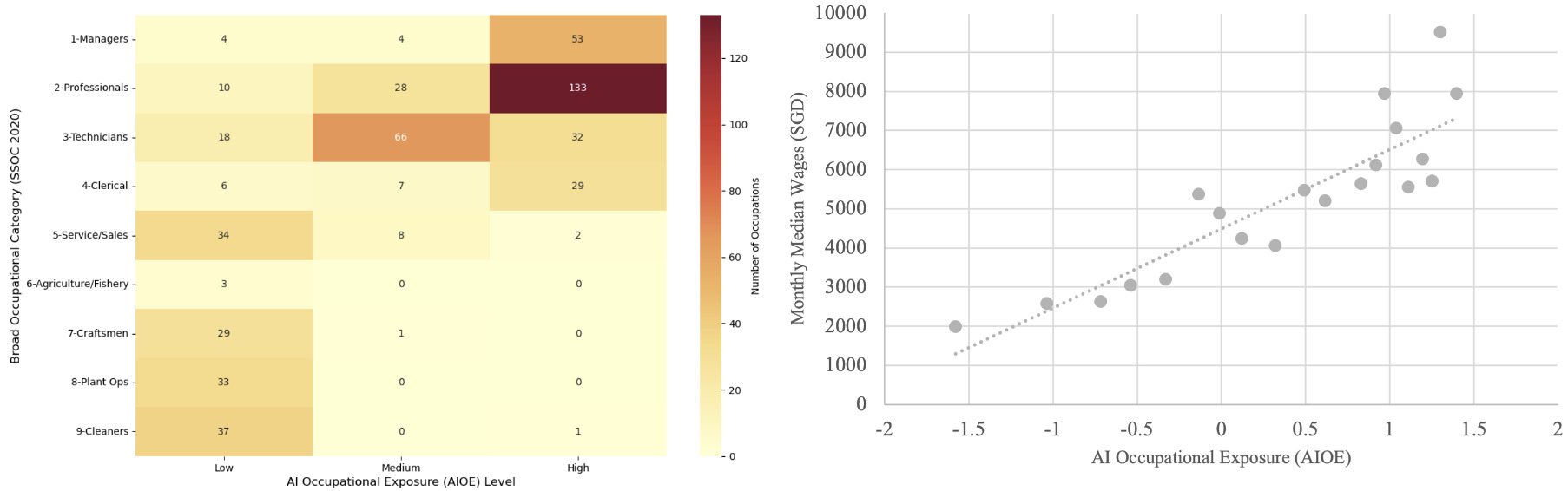
The occupational exposure heatmap in Figure 3 illustrates the concentration of AI exposure in SSOC’s broad categories. As seen from the dark maroon, the “Professionals” category sees 133 professional occupations and 53 managerial occupations classified at a high exposure level. Visually, this supports that in Singapore, AI occupational exposure is disproportionately concentrated within the PMET (Professional, Managerial, Executive, and Technician) workforce.
____correlation_between_aioe_and_monthly_median_wage_(b).png)
Figure 3 (B) also depicts a linear, positive relationship between income levels and AI exposure. The mean AIOE score rises monotonically across income quintiles, starting at -0.643 for the bottom 20% of earners in Q1, and peaking at 1.021 for the top 20% of earners (Q5). In other words, occupations with high wages are more exposed, where high exposure corresponds to a higher susceptibility to AI than lower-wage occupations.
The baseline OLS regression identifies a statistically significant AI wage premium (p < 0.001), where an AI wage premium refers to the marginal increase in predicted monthly earnings associated with a one-unit increase in the AI Occupational Exposure (AIOE) index. The AIOE coefficient of 2024.55 represents that for every one-unit increase in the AIOE, the predicted mean monthly wage rises by $2024.55 SGD. Additionally, the R2 value of 0.341 indicates that 34.1% of the variation in median wages across the dataset is attributable to AI exposure alone.
-
The coefficient for the 25th percentile (P25) is $400.57.
-
The coefficient for the 75th percentile (P75) is $1,536.31.
This nearly quadrupled increase in the coefficient between low and high earners suggests that the financial rewards of AI exposure are disproportionately concentrated at the top.
A one-way ANOVA further shows that between sectors variance was highly significant (F = 75.147, p < 0.001), and within sector variance accounts for 46.81% of the total sum of squares. Nearly half of the wage variation in Singapore occurs between occupations within the same sectors.
In summary, both the linear regression analyses and ANOVA affirm that high occupational exposure to AI is positively associated with monthly wages to a statistically significant level, but likely has a comparatively disproportionate effect and clearly exacerbates income inequality. The returns to AI exposure accumulate at the top, where lower-wage occupations, already less exposed, benefit least.
Discussion
The findings in relation to the AI wage premium are in line with the Skills Biased Technological Change (SBTC) theory by Katz and Murphy (1992) and Xu (2018), which posits that technological shifts inherently complement high-skilled workers by devaluing manual tasks. Although paradoxically, high-skilled and high-wage workers experience the highest levels of exposure and susceptibility for automation, their potential exposure to AI isn’t completely representative of realised exposure (Moravec, 1991; Agrawal, 2010). High exposure means that AI has a high capability to take over the occupation, but it is not synonymous with unemployment. In fact, high exposure often leads to augmentation, while occupations with low exposure have little to no potential for augmentation given the nature of their tasks (Katz & Murphy, 1992; Moravec, 1991; Xu, 2018; Agrawal, 2010). Although occupations at higher incomes are predicted to experience higher exposure, technology inherently has a reinstatement effect that counteracts the displacement effect, and this must be noted while considering these findings. AI may function as a complement to workers in these occupations by increasing speed, scale, and productivity, while still preserving the need for human judgment and decision-making. By contrast, lower-income occupations with lower measured exposure may appear insulated from automation in the short run, yet may remain disadvantaged since they’re largely unable to capture any of the productivity gains associated with the adoption of AI. As a result, these workers may not face displacement presently, but they may experience relative wage stagnation as other sectors, those at high exposures, continue to benefit. That being said, though, more efficient integration of AI does point to a higher likelihood of automation at higher levels of occupations. With a nearly four-fold difference between the P75 premium ($1,536.31) and the P25 premium ($400.57), the findings are consistent with AI functioning as a multiplier for occupations already possessing high-level oversight and cognitive capabilities. In this sense, while the 25th percentile may remain stagnant, individuals at the 75th percentile are better positioned to leverage the National AI Strategy 2.0 and upskilling programs like SkillsFuture, which subsidize the integration of AI for the professional class. This affirms Autor et al. (2020)'s assertion that technology integration often leads to income inequality, where only a narrow segment of highly complementary labour captures the majority of productivity gains. Thus, my results substantiate studies that see exacerbated income inequality as a result of higher AIOE.
However, these findings challenge the traditional assumptions of Routine-Biased Technological Change (RBTC). While Autor, Levy, and Murnane (2003) argued that automation primarily targets middle-income earners, Figure 2 (A) shows that the highest exposure is concentrated in high-wage earners who are “Professionals.” This is particularly salient due to Singapore’s high concentration of PMETs. Much of the prior research has contrarily pointed to the hollowing out effect, where entry-level occupations are replaced, and higher-level occupations are preserved; this study only confirms Acemoglu (2024) and Felten et al. (2021)’s warnings that AI has moved into cognitive realms that were once thought to be immune. The high within-sector variance (46.81%) in the ANOVA further demonstrates the existence of inequalities within professions.
Furthermore, the rise in AIOE scores across income quintiles is in line with the displacement and reinforcement effects proposed by Autor and Restrepo (2019). High wage earners in Singapore experience, theoretically, the highest potential displacement, but due to the cognitive task load, they are also currently receiving the highest financial rewards. Singapore places a significant emphasis on knowledge-intensive occupations, which also financially protects positions at high wages more than those at low wages.
The widening gap between the 25th and 75th percentiles makes it clear that AI is not a rising tide that lifts all boats. In a labour market already characterized by high specialisation, the almost quadrupled higher premium for top earners implies a decoupling of productivity and compensation for the lower quintiles. Those at the top 20% of the workforce may be better positioned to effectively leverage AI to scale their expertise, but manual and service workers, who lack the cognitive tasks to automate, are unlikely to benefit from the productivity gains of AI.
Conclusions & Future Direction
Despite the statistical significance of the findings, a few technical constraints must be addressed. The reliance on task invariance, as detailed in the Method, means that task-level data isn’t necessarily aligned to the true tasks being performed in Singaporean occupations. Recently, however, in January of 2026, the Singapore Management University launched the ResWorks Institute, where professors are working on developing a reproducible AI exposure index using information from local job postings for Singapore (Singapore Management University, 2026). This means that, soon, task-level data will be available for Singapore as well, and a similar study can be replicated to more closely model occupational exposure. Secondly, the use of a simple arithmetic average for the 1:M mappings (e.g., matching one SSOC code to three O*NET codes) was an approach employed because of the lack of granular, task-level frequency data for the Singaporean workforce. Since the O*NET is a task-based database, and the SSOC is only a classification, the data surrounding occupations and tasks is far more opaque in Singapore. As a result of the nature of the data, no measure of relative importance could be applied.
It must be recognised that variables such as education, managerial responsibilities, credentials or managerial responsibilities were not considered, and thus the observed relationship between AIOE and wages should not be interpreted as causal.
The findings of this study also only point to the potential exposure of AI on Singapore’s economy, and not the realised AI exposure. While the study points to a strong statistical relationship between exposure and income, it cannot confirm that these higher wages are a direct result of AI actually being used in those roles. Many companies remain hesitant to integrate AI due to fears of mass unemployment and data security (Khan, 2024). The predicted impacts are purely theoretical, based on task-level data. Because AI is not adopted at many firms, an occupation with a high occupational exposure to AI at a firm that hasn’t adopted AI remains immune. Singapore, specifically, has been more positively receptive to this wave of automation than others; however, adoption is still minimal.
Other researchers may want to consider AI exposure in terms of workflows. Existing literature focuses on mapping individual tasks to latent capabilities; however, workflows represent a more holistic unit of analysis that captures how tasks are sequenced and interdependent. Future researchers should explore scenarios where a portion of a workflow can be automated, with others requiring human intervention. Incorporating firm-level adoption data could help clarify the gap between theoretical exposure and realized exposure, specifically within Singapore’s SMEs, which may lack the capital to integrate the AI capabilities identified in the AIOE index.
A further dimension of inequality may emerge before individuals enter the labour market. This study measures occupational exposure once workers are already situated within the economy; however, increasing AI integration into education raises the possibility that inequality may emerge during human capital concept. As such, the concept of AI Educational Exposure (AIEE) should be considered: the extent to which students’ learning and cognitive development are mediated by AI. Unlike the AIOE, which measures the overlap between AI capabilities and occupational capabilities, AIEE could distinguish between AI use that augments the development of human capabilities and use that substitutes for their development. The effects of AI, here, may depend less on the frequency of use than how it is used. AI can complement learning by providing feedback, generating alternate perspectives, or assisting with problems after independent attempts. Conversely, routinely delegating writing, research or critical evaluation to AI may reduce opportunities for the repeated practice through which these capabilities develop. If complementary use strengthens human capabilities while substitutive use weakens their development, differences in human capital could emerge before individuals enter occupations. These differences may subsequently affect workers’ ability to benefit from AI. An individual with strong independent reasoning and problem-solving capabilities may be better positioned to evaluate, direct, and improve AI-generated outputs, allowing AI to function as an augmentative technology rather than a substitute for their skills. An AIEE measure could examine the proportion of cognitive tasks delegated to AI, the extent to which students retain independent responsibility for reasoning, and whether AI is used primarily for augmentation or substitution. These measures could then be studied alongside longitudinal indicators of cognitive and academic development.
As the digital economy grows to comprise nearly 20% of Singapore’s GDP, the risk of a decoupled labour market becomes acute. Singapore should continue pursuing initiatives like GovTech, National AI Strategy 2.0, and SkillsFuture to support its workforce.
Conflicts of Interest
The author declares no competing financial interests, institutional conflicts, or personal relationships that could have inappropriately influenced or biased the framing, analysis, or execution of this research article.