
Introduction
Despite extensive research linking education to public opinion and life outcomes, the relationship between educational attainment and individuals’ attitudes toward social welfare and government redistribution remains poorly understood. Central to this inquiry is the tension between whether schooling serves as a liberating force that fosters support for social equity and resource redistribution or a legitimizing force that reinforces meritocratic ideologies despite structural barriers.
These competing perspectives have been brought to the forefront by the recent judicial decision against affirmative action (AA). Originating in the 1960s, AA functioned as a federal policy to redress discrimination against underrepresented minority groups in higher education and employment on the belief that institutional racism and classism denied a level playing field (Skrentny, 1996). In recent years, however, the policy has been challenged by the rising popularity of meritocratic ideology. The Supreme Court’s 2023 ruling in Students for Fair Admissions v. Harvard ended race-conscious admissions, replacing structural intervention with merit as the basis of college admissions (Students for Fair Admissions v. Harvard, 2023). This decision is not merely the product of a conservative Court; it also legitimizes a broader ideological formation among highly educated individuals who view their status as earned “by studying hard” rather than structural advantage (Ma, 2025). This view, in turn, diminishes public support for redistributive policies and social equity.
The end of AA in college admissions has been reinforced by other legislative policies targeting diversity, equity, and inclusion (DEI) initiatives. President Trump’s recent executive orders terminated DEI programs across the federal government (The White House, 2025), while state lawmakers in Texas, Florida, North Carolina, and elsewhere have defunded DEI offices, prohibited mandatory diversity training, and restricted identity-conscious hiring and admissions (Alfonseca, 2024).
In this context, understanding how education shapes meritocratic beliefs and redistributive attitudes is more urgent than ever. Yet existing research offers no empirical or theoretical consensus. The following sections review the evidence, outline competing theoretical perspectives, and identify the gaps.
Research on educational attainment and support for government redistribution has produced paradoxical findings: higher education increases recognition of structural inequality, yet does not produce stronger support for redistributive policy. The American public has historically attributed poverty to individual moral failings rather than structural conditions (Feagin, 1975). Subsequent research established that education is one of the strongest predictors of structural attributions for poverty, and that it consistently reduces prejudice and increases social liberalism more broadly (Kluegel & Smith, 1986; Marquis et al., 2025; Pascarella & Terenzini, 1991).
Such structural explanations of poverty, however, do not necessarily translate into support for redistributive government programs. The highly educated may simultaneously endorse structural accounts of economic hardship while opposing social welfare or redistributive policies for reasons of fiscal concern, skepticism about program efficacy, discomfort with policies framed as penalizing success, and beliefs about the perceived deservingness of welfare recipients (Attewell, 2022; Bobo, 1991; McCall, 2013).
Scholars have offered several explanations for this seeming paradox. Cross-national survey evidence shows that education produces two distinct and partially opposing political effects: it increases social liberalism, including tolerance and sympathy toward welfare recipients, while intensifying economic conservatism among those who occupy advantaged positions within society (Cavaillé & Trump, 2015). Individuals above the median income tend to oppose redistribution due to concerns about financial losses from taxes (Meltzer & Richard, 1981). Because education is strongly correlated with income, the highly educated tend to have higher income, which may mediate the relationship between education and redistributive support (Finseraas, 2009). Institutional contexts also play a role in these dynamics. For example, a cross-national study documents that whether education liberalizes or legitimizes depends on the level of income inequality in a given country: in high-inequality countries, education legitimizes inequality and obscures its structural causes, whereas in low-inequality countries, advanced education fosters structural awareness (Liu & Wang, 2025).
These mixed findings reflect competing theoretical perspectives on the role of education in stratified societies. One school of thought holds that schooling reveals structural inequality and cultivates support for redistribution (Freire, 1970); the other holds that schooling legitimizes unequal outcomes and fosters meritocratic values (Bourdieu & Passeron, 1990).
From a structural perspective, education is a liberalizing force that teaches individuals to recognize systemic inequalities, such as structural barriers rooted in class, race, and group membership, rather than focusing solely on individual or personality factors (Phelan et al., 1995). Modern university curricula often explicitly deconstruct meritocracy and document how institutions reproduce racial and class hierarchies across generations (Bowles & Gintis, 1976). As students shift from individualistic to macrostructural explanations of poverty and success, they may become more supportive of government intervention to redress inequality.
An alternative perspective argues that education reinforces meritocratic beliefs, the idea that success reflects individual effort rather than structural advantage (Guimond & Palmer, 1989). Schooling legitimizes unequal outcomes by framing them as fairly earned, representing the shift from “aristocracy” to “meritocracy,” where elites justify their status not by “bloodline” but by “demonstrated excellence” (Karabel, 2005). By framing academic attainment as a proxy for hard work and talent, schooling reinforces the belief that success is achieved through individual agency rather than structural advantage. Consequently, highly educated individuals may come to view government intervention as unfair and as undermining a merit-based system.
The mixed findings reviewed above suggest that the relationship between education and redistributive preferences is not fixed; rather, it is shaped by ideological beliefs and institutional context. Also, the structural and meritocratic perspectives are not mutually exclusive; they may operate simultaneously on different individuals.
Despite these debates, several gaps remain in this body of work. First, the literature often treats education as a linear path toward liberalism, ignoring the pre-existing worldviews students bring with them. This overlooks self-selection and the possibility that education simply equips individuals to justify their existing biases (Hout, 2012; Jackman & Muha, 1984; Marginson, 2011). Second, while prior work has documented conditional effects of education across national contexts (Liu & Wang, 2025), it has largely overlooked individual-level moderators, such as whether the effect of education on redistributive attitudes depends on individuals’ meritocratic beliefs. Third, most studies rely on short-term data, failing to capture whether the relationship between education and redistributive preferences has shifted over time.
This study addresses these gaps through a more nuanced analysis by testing whether education’s effect on redistributive attitudes is conditional on meritocratic beliefs (defined here as one’s attribution of success to luck versus hard work). Specifically, I test the following hypotheses:
-
Main Effect of Education:
Hypothesis 1a (structural perspective): Education will be positively associated with support for government redistribution.
Hypothesis 1b (meritocratic perspective): Education will be negatively associated with support for government redistribution.
-
Main Effect of Meritocracy:
Hypothesis 2: Individuals who attribute success to hard work will show lower support for redistribution than those who attribute success to luck.
-
Interaction Effect between Education and Meritocratic Beliefs:
Hypothesis 3: The effect of education is conditional on meritocratic beliefs. Education will increase support for redistribution among those who attribute success to luck (structural perspective) and decrease support among those who attribute success to hard work (meritocratic perspective).
Methods
The data are drawn from pooled samples of the GSS spanning 1984 to 2024 (N = 14,899). The GSS is a nationally representative, cross-sectional survey of non-institutionalized U.S. adults. Since its inception in 1972, it has been one of the most reliable sources for tracking long-term social/political attitudes and behavior in American society, with recent waves (including 2022 and 2024) incorporating multi-mode data collection (web, phone, and face-to-face) to improve response rates. The final sample includes 14,899 respondents after deleting missing data on all variables.
The key dependent variable is support for government redistribution, operationalized as a composite index averaging five items (Cronbach’s α = .75), with higher values representing stronger support. The five items are: The government should:
-
help improve the living standards of Blacks (labeled as “Black”),
-
see to it that people have help in paying for doctors and hospital bills (labeled as “Sick”),
-
improve the standard of living of all poor Americans (labeled as “Poor”),
-
do even more to solve our country’s problems (labeled as “Country”),
-
reduce the income differences between the rich and the poor (labeled as “Wealth”).
For each item, respondents rated Likert scales from strong opposition to strong support (0–4 for the first four items and 0–6 for the last item).
Educational attainment was measured as a 5-point ordinal scale of the highest degree earned: 0 = less than high school, 1 = high school degree, 2 = associate degree, 3 = bachelor’s degree, and 4 = graduate degree. Meritocratic beliefs were measured by the question: “Some people say that people get ahead by their own hard work; others say that it is more a matter of luck or help from other people. Which, in your opinion, is more important?” Two dummy variables were created to capture whether individuals attribute success to “hard work” or “both,” using “luck” as the reference category. Interaction terms between educational attainment and meritocratic beliefs were also constructed to test whether education functions as a “neutralizer” or an “intensifier” of these beliefs in shaping attitudes toward government redistribution.
Controls included age (in years), gender (male vs. female), race (Black, other race, vs. White), marital status (married, other, vs. single), self-identified social class (1 = lower class; 2 = working class; 3 = middle class; 4 = upper class), employment status (part-time, unemployed, other, vs. full-time), family income (logged household income with multiple imputations), political party identification (0 = strong Democrat; 1 = weak Democrat; 2 = independent Democrat; 3 = independent; 4 = independent Republican; 5 = weak Republican; 6 = strong Republican), and region (Northeast, Midwest, West, vs. South).
I first presented descriptive statistics and plotted trends in redistributive attitudes and meritocratic beliefs over time. To test the hypotheses, I estimated ordinary least squares (OLS) regression, using the pooled GSS sample. The analysis began by estimating the main effects of educational attainment (Hypotheses 1a and 1b) and meritocratic beliefs (Hypothesis 2) on the redistribution index. I then introduced interaction terms between education and meritocratic beliefs to assess whether the relationship between schooling and policy attitudes is conditional on success beliefs (Hypothesis 3). Finally, I calculated marginal effects to visualize how the association between meritocratic beliefs and support for redistribution varies across levels of educational attainment.
Results
Table 1 displays weighted descriptive statistics for all variables. Support for government redistribution has a mean of 2.28 on a scale ranging from 0 to 4.4 (reflecting the average of four 0–4 items for “Black,” “Sick,” “Poor,” Country" and one 0–6 item for “Wealth”), placing it around the midpoint. Educational attainment has a mean score of 1.43, corresponding to an educational level between a high school degree and an associate degree. Meritocratic beliefs are highly skewed: 68% of respondents attribute success to hard work, 12% to luck, and 20% to both. The sample is evenly split by gender (50% male), predominantly White (81%), and includes a majority of respondents who are married (56%) or employed full-time (51%). The mean age is 45 years.
The plotted mean scores of redistributive support items across survey waves from 1984 to 2024 (results available upon request) suggest that trends in redistributive attitudes remain stable or decline through the 1990s and 2000s, then rise across all items after 2014. Specifically, support for government assistance to the sick consistently ranks highest throughout, reaching its peak in recent years. In contrast, support for assistance to Blacks ranks lowest among the four indicators, yet the trend shows a substantial rise from a low point in the early 2010s. Support levels for wealth equalization (right panel) follow a generally stable trajectory, with notable declines in 1994 and 2010, likely reflecting the recessions of 1991 and 2008. Over the last decade, all indicators have converged toward their highest levels, signaling a broad shift toward greater support for government redistribution.
Additional plotted trends in Americans’ beliefs about how people get ahead from 1984 to 2024 (results available upon request) indicate that throughout this period, a majority of respondents consistently identified “hard work” as the primary factor for getting ahead, with proportions remaining stable at approximately 60% to 70% before a noticeable downward trend during the COVID-19 pandemic and a rise afterward. The proportion attributing success to both “hard work” and “luck” is smaller but exhibits moderate temporal fluctuation. In contrast, attribution to “luck” alone remains the least common response and shows only limited variation over time (roughly 10–15%). These patterns suggest broad and consistent support for meritocratic explanations of social mobility.
Table 2 presents the OLS regression results predicting support for government redistribution across three nested models: Model 1 includes all demographic variables, with educational attainment as the key independent variable; Model 2 adds meritocratic belief variables; and Model 3 further introduces interaction terms between the two.
The results do not support Hypothesis 1a or 1b regarding the main effect of education. In Model 1, the coefficient of educational attainment is non-significant. While it reaches marginal significance in Model 2 (b = -.01, p < .10) after controlling for meritocratic beliefs, it becomes non-significant again in Model 3, indicating that education does not exert a robust, independent influence on redistributive preferences.
The results offer strong support for Hypothesis 2 regarding the main effect of meritocracy. Model 2 shows that respondents who attribute success to hard work (b = -.15, p < .001) or to a combination of luck and hard work (b = -.09, p < .01) are associated with significantly lower support for redistribution than those who attribute success to luck.
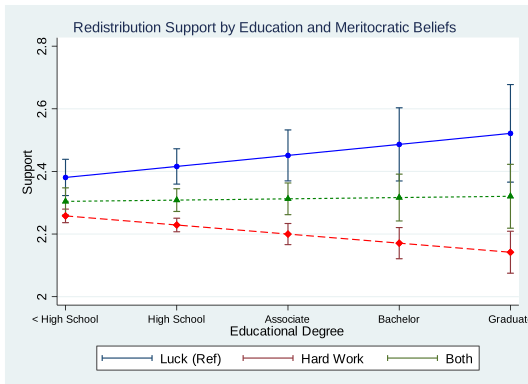
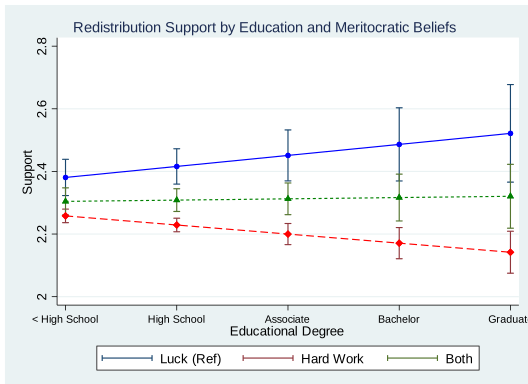
The findings also support Hypothesis 3, showing that the associations between education and redistributive attitudes differ significantly across those who attribute success to hard work and those who attribute success to luck. Specifically, Model 3 reveals a significant negative interaction between education and hard-work beliefs (b = -.06, p < .01). Among respondents who believe hard work determines success, higher educational attainment is associated with significantly lower support for redistribution than among those who attribute success to luck. In contrast, the interaction term between education and belief in both hard work and luck is not significant, indicating that the association between education and redistributive support for this group does not significantly differ from the luck reference group.
Figure 1 displays predicted support for government redistribution across levels of educational attainment, conditioned on meritocratic beliefs, as estimated in Model 3 of Table 2. It plots three lines with 95% confidence intervals for those attributing success to luck, hard work, or both. Among those who attribute success to luck, predicted support rises steadily with education. In contrast, among those who emphasize hard work, predicted support declines as education increases. For those attributing success to both, predicted support remains stable across educational levels. While group differences are minimal at the lowest educational levels, they diverge sharply as education increases, with the gap between luck and hard-work attributors reaching its largest at the graduate level. These patterns confirm the results from the interaction analysis that meritocratic beliefs moderate the relationship between education and redistributive preferences.
Several additional demographic and political patterns emerge in Table 2. Black and other non-White respondents report significantly higher support for redistribution than Whites, while male, older, and married individuals report lower support. Higher income and higher subjective social class are both associated with decreased support. Political orientation remains among the strongest predictors: stronger Republican identification corresponds to sharply lower support. Regional and employment statuses also matter: residents outside the South report higher support than Southerners, and unemployed individuals or those with other work statuses (homemakers, students, retirees) report higher support than full-time workers.
Discussion
The relationship between education and redistributive attitudes lies at the heart of critical debates about stratification and social justice, with implications for understanding how inequality functions and is reproduced across generations. Drawing on four decades of national data, this study reveals an intricate link between education and redistributive preferences conditioned upon meritocratic beliefs. On the one hand, the non-significant association of education with redistributive attitudes challenges the assumption that schooling linearly promotes liberal or progressive attitudes (Hout, 2012; Marginson, 2011). On the other hand, the significant negative association of meritocratic beliefs reaffirms a core tenet of the American Dream: believers in hard work may reject government redistribution as incompatible with meritocratic fairness. Most importantly, the interaction results demonstrate that education is not associated with a singular ideological outcome. Rather than acting as a uniform socializing agent, education may furnish individuals with cognitive and ideological resources to rationalize and intensify their views about merit and equity, suggesting that educational institutions and individual ideologies may intersect in shaping redistributive preferences.
The potential amplifying role of education can be interpreted through a Bourdieusian lens. Educational institutions are key fields for the conversion and legitimization of capital (Bourdieu & Passeron, 1990). For those with a meritocratic view, the process of educational attainment, such as navigating rigorous curricula, achieving high grades, and earning degrees, might serve to reinforce the notion that their status is personally earned. According to Jackman and Muha (1984, p. 751), the well-educated become the “most sophisticated practitioners” in defending their own ideologies and self-interests. Education could also strengthen the “moral boundaries” (Lamont, 1992) that people draw between those who deserve help and those who do not, making them more resistant to government redistribution. These theoretical insights align with Khan’s (2011) ethnographic work, which shows how elite education instills in students that inequality is a natural outcome of differential effort and skill, thereby legitimizing their own advantaged positions.
For individuals who are skeptical of meritocracy and who attribute success to luck rather than hard work, education appears to function in a markedly different way. Higher education may enhance social empathy, cognitive complexity, and critical thinking, deepening a structural understanding of inequality and fostering greater support for government intervention (Pascarella & Terenzini, 2005). It is also possible that these individuals are themselves beneficiaries of redistributive policies like public assistance or AA, thus considering themselves “lucky” and holding favorable views of such interventions. This interpretation aligns with research documenting that recipients of social programs develop more positive attitudes toward the welfare state (Campbell, 2012; Pierson, 1993).
The temporal trends documented in the descriptive analysis provide important social context. The recent rise in support for government redistribution, including the surge in support for assistance to Blacks after 2012, coincides with the rise of social movements such as Black Lives Matter and growing public awareness of structural racism (Bonilla-Silva, 2022). Yet this shift occurs alongside the persistent prevalence of meritocratic beliefs that attribute success to hard work. American public opinion appears to reflect a form of cognitive dissonance: increasing recognition of societal inequalities coexists with a durable commitment to individualist and meritocratic justifications for success (Hochschild, 1981; Kluegel & Smith, 1986). Education, rather than resolving this tension, may widen the ideological divide by sorting and intensifying competing worldviews.
These findings carry implications for policy and pedagogy. The interaction between education and meritocratic beliefs suggests that the ideological consequences of education deserve attention as policymakers reconsider AA and DEI programs. Curricula that expose students to structural analyses of inequality along with lived experience, such as service-learning programs, may help counter polarization and cultivate a more integrated understanding of merit and fairness (Apple, 2004; Freire, 1970). While these recommendations are informed by the findings, further research is still needed before stronger policy conclusions can be drawn.
This study has several limitations. The GSS’s cross-sectional design limits causal claims and makes it difficult to rule out self-selection effects. Individuals’ prior beliefs about merit and inequality likely shape not only whether they pursue higher education, but where and what they study. A student drawn to sociology may already be skeptical of meritocracy and encounter a curriculum that reinforces the significance of structural inequality, while someone drawn to business or economics may hold stronger market-oriented beliefs and find them similarly reinforced (Guimond & Palmer, 1989; Stuber, 2011). Students at elite private universities may likewise face different ideological influences than those at public regional or religious institutions. Moreover, political identity may develop and change in a dynamic way along with educational experiences (Jennings & Niemi, 1981). The interaction effects documented in this study may therefore partly capture the amplification of pre-existing beliefs rather than education’s independent influence.
Disentangling these processes requires complementary methods. Longitudinal data could track individuals before, during, and after key educational stages to better isolate the socializing effects of education from selection processes (Hout, 2012; Mayhew et al., 2016; Pascarella & Terenzini, 2005), while qualitative data, such as interviews or ethnographic work, could trace how self-selection operates and how specific institutional and disciplinary contexts shape redistributive attitudes over time (Khan, 2011; Stuber, 2011).
The meritocracy measure in this study is another caveat. Classifying respondents by whether they attribute success to hard work, luck, or both, though standard, is too broad. Meritocratic belief is better understood as a spectrum: one can acknowledge structural barriers while still crediting personal effort, or support redistribution while believing that reward should track merit (Feldman, 1988; Kluegel & Smith, 1986). These beliefs vary meaningfully across race, class, and education (Hunt, 1996). Future research should disaggregate this construct into sub-dimensions, such as attributions for poverty, perceptions of market fairness, and beliefs about structural opportunity, to better capture how different facets of meritocratic thinking shape redistributive preferences (McCoy & Major, 2007; Reyna et al., 2006).
Conclusion
In conclusion, findings from this study suggest that education may serve as a divider, not a unifier, of groups of people in their support of government redistribution. As AA, DEI, and other welfare programs recede, understanding the role of education in shaping redistributive attitudes has never been more timely. The conflict over social equity is increasingly concentrated among the highly educated themselves. Bridging, rather than deepening, these divides requires educational experiences that foster genuine engagement with structural inequality and a shared language for addressing injustice in a polarized society.