Introduction
Currently, an emerging large ethnic group in Hong Kong are South Asians. While they only make up about 1.4% of Hong Kong’s total population, they are the fastest growing ethnic minority community in Hong Kong (Census and Statistics Department, 2021). However, a major challenge South Asians face is harassment, particularly among teenagers. Despite Hong Kong’s global image as an inclusive hub, South Asian teens encounter a disproportionate amount of harassment and gender bias that threaten their safety, wellbeing and integration (Chong, 2022). This topic needs greater awareness as in a city that prides itself on diversity, if this harassment remains unchecked, it will create mental health challenges, exclusion, and other significant implications for a vulnerable community. This paper therefore examines the central topic of an analysis into the safety concerns, harassment, and gender bias among South Asian teenagers in Hong Kong. Specifically, it asks: “To what extent do South Asian teenagers in Hong Kong face harassment and gender bias, and how do these issues affect their safety and integration?”
Research in Hong Kong is already showing that teenagers are facing extremely high levels of bullying/harassment, with the University of Hong Kong citing that 30% of secondary students report being victims of bullying overall. The target data is scarce for South Asian teenagers, but it has been said that South Asian students face many ‘microaggressions’ and discrimination in school (Kwok, 2022). Not only this, but many South Asian students often attend local schools and face Chinese-language barriers and cultural insensitivity, leading to poor outcomes and exclusion (Legislative Council Secretariat, 2018). According to the South China Morning Post, South Asian teenage girls participating in sports “face elevated objectification compared to local peers, with media and fan focus often shifting to their bodies rather than athletic performance, heightening harassment risks”. The purpose of this paper is to systematically analyze the motivations and dynamics of safety concerns, harassment, and gender bias specifically affecting South Asian teenagers in Hong Kong. Its scope covers schools, sports, public facilities, and online spaces. This paper begins with some context and background information, then a literature review synthesizing existing research on this topic, followed by a methodology and results section detailing the setup and findings of the survey data. Finally, it will end with a discussion of the findings and implications they have and a conclusion summarizing contributions and future discussions.
Literature Review
Before reviewing existing research, it is important to define the main terms used in this study:
-
Harassment: Unwanted behavior, such as verbal abuse, physical abuse, or online hostility, that makes someone feel unsafe.
-
Gender bias: Unfair treatment or expectation based on gender.
-
Microaggressions: Everyday comments or actions that express prejudice or discrimination, often subtle but damaging
-
Objectification: Seeing a person primarily as a body or appearance, rather than as a person with abilities or character.
-
Cultural expectations: Rules or norms within families and communities that influence behavior (such as modesty, silence about certain topics, or pressure to conform).
A literature review on safety and harassment in teen populations shows how teens worldwide face significant safety threats from harassment including gender-based violence and cyberbullying, with minority youth experiencing even more risks due to intersecting vulnerabilities (Pérez-Albéniz et al., 2020). Extensive research showed that minority youth in many different nation states with various cultures faced heightened risks of discrimination and microaggressions, which often created long-term emotional harm. (Pérez-Albéniz et al., 2020). Furthermore, Pérez-Albéniz et al. argue that minority youth often face additional contextual risks such as discrimination and exclusion that shape both their likelihood of being bullied and the harm it causes. This adds to the idea that South Asian teenagers in Hong Kong may be subject to increased vulnerabilities as a result of ethnic minority status and cultural difference (Pérez-Albéniz et al., 2020). Also, a separate article from ScienceDirect details the prevalence of cyber-racism and how the internet can facilitate the expression of these racist views, demonstrating that online harassment can be amplified by the anonymity that allows racist behaviour to spread more easily and persistently (Citelli et al., 2018). Together, these two sources showcase the vulnerabilities South Asian youth are subject to, and how they are likely to encounter harassment across both digital and physical domains.
Moreover, existing research has examined how South Asian cultural norms shape the safety and harassment experiences of South Asian teenagers. Siddiqui & Ramaswamy (2018) explored how culture shapes risk and protection for Pakistani and Indian immigrant adolescents. It found how these culturally specific dynamics like stress, community pressure, religious involvement influence youth engagement in behaviours such as substance use and inform prevention efforts. Importantly, the study also stressed the need for creating a resilient and supportive community to mitigate the risks of harassment (Siddiqui & Ramaswamy, 2018). Additional research has also explored what Pakistani and Indian students believe are the reasons behind issues such as bullying and smoking. The students stated that parental and peer influence are the central drivers of these behaviours, while also saying certain cultural resources are protective, specifically strong religious beliefs and close parental monitoring that help keep teenagers away from crime and drugs (Rai & Fincham, 2016). These findings provide insight into why many South Asian teens may be reluctant to report harassment: cultural norms can be a protective factor, but also an obligation that can silence youth.
In RainLily’s survey of South Asian schoolgirls in Hong Kong it revealed how cultural norms around marriage, honour and modesty heighten gender biases, increasing the risks of sexual harassment and controlling behaviours whilst also making it a stigmatized topic in their community, effectively silencing victims (RainLily, 2018). Moreover, UNESCO’s From Insult to Inclusion report showcases that strict gender norms fuel the bullying and violence against LGBTI students across Asia-Pacific schools. The emotional abuse, harassment, and sexual violence that these students face severely damages their mental health, leads to lower academic achievement and causes safety concerns. The findings from this report serve to reinforce the idea that gender norms fuel harassment, and create greater emotional and physical damage to the students targeted. This report goes on to argue that the only way these school systems can move “from insult to inclusion” is if they confront these gendered stereotypes head on through policies, teacher training, and targeted support services for affected students.
Finally, a common phenomenon among many of the articles and papers available was that there are substantial gaps in the research available on South Asian teenagers in global diaspora communities. Citelli et al. state that while research on cyber-racism has grown in many fields, most existing reviews are only theoretical and there is no complete summary of all the empirical findings. This gap suggests that minority youth experiences, particularly in Asian contexts, remain under-documented, making studies like this one necessary (Citelli et al., 2018). Furthermore, Oguine et al. discuss how youth online safety has historically been centered on perspectives in the global north. The authors call for future work that amplifies the overlooked voices of the global south in order to be able to respond more fully to the risks the youth face online (Oguinn et al., 2025). This supports the need for more focused research on South Asian teenagers around the world, as their experiences are very rarely represented in global youth safety research.
Methodology
This study aims to examine how safety concerns, harassment, and gender bias manifest in the everyday lives of South Asian teenagers in Hong Kong. From this analysis, conclusions can be drawn to understand the patterns and dynamics driving these issues, and to assess their impact on the wellbeing and experiences of these youths. Within this broader aim, there are some key objectives to be reached.
The objectives of the research are as follows:
-
Acquire data through Google Forms for the South Asian teenagers and use Google Sheets to study and quantify the data.
-
Perform a quantitative comparison of the data collected between males and females
-
Perform a qualitative comparison of the short text-based answers given by the teenagers
To analyze the safety concerns, harassment, and gender bias among South Asian teenagers in Hong Kong, a structured online survey was conducted. Responses were collected from the target demographic (South Asian teenagers), and the aim was to understand their harassment experiences across sports, online environments, and public spaces. The survey contained questions on gender bias, cultural norms, and safety perceptions, and was distributed via Google Forms to the target demographic via community networks and social media platforms. Specifically, the survey link was posted on a Facebook group dedicated to the South Asian community, and also circulated on Instagram through peer sharing among youth.
Because most participants were recruited through online platforms, the sample might be biased towards the more active social media users or individuals who are more connected to South Asian youth circles in Hong Kong. Furthermore, the sample contained a majority of Indian and Pakistani respondents, likely reflecting the demographics of the online groups where the survey was posted. This suggests that these communities were more reachable through the recruitment method, and means that other South Asian groups might be under-represented.
This survey was designed with six sections: demographics, general safety perception, harassment experience and frequency, cultural norms and family expectations, and perceptions of gender bias in treatment and support. In the survey, multiple-choice, open-ended questions, and multi-select questions guaranteed both quantitative comparability and qualitative depth. The distribution of this survey occurred over three weeks, with 21 valid responses collected.
There was an even split between male and female participants, with 52.4% being female and 47.6% participants being male. Moreover, all of the teenagers are ages 16-18, currently reside in Hong Kong, and self-identify as South Asian. For this study, ‘South Asian’ was defined as individuals of Indian, Pakistani, Nepali, Bangladeshi, or Sri Lankan heritage. Most teenagers are either Indian (61.9% of participants) or Pakistani (19% of participants), with most being predominantly Indian.
To collect data from the teenagers, a form was sent out. To collect accurate and relevant data, these were the following questions were asked:
-
Student Demographics
-
What is your gender?
-
What is your ethnicity/race?
-
-
General Safety Perception
-
How safe do you feel in sports facilities? [ On a scale of 1 to 5, 1 being least safe and 5 being most safe]
-
How safe do you feel in public spaces? [ On a scale of 1 to 5, 1 being least safe and 5 being most safe]
-
How safe do you feel online (social media, messaging app, gaming)? [ On a scale of 1 to 5, 1 being least safe and 5 being most safe]
-
-
Harassment Experiences in Sports Facilities
-
Have you witnessed harassment happening to someone else?
-
If you have faced harassment, how often does it happen?
-
Did you report the harassment?
-
If you did not report the harassment then what was the reason?
-
What kind of harassment have you faced?
-
How often in any form do you feel you are being harassed?
-
-
Cultural Norms and Family Expectations
-
In your family, how acceptable is it to talk about harassment?
-
In your community, how acceptable to talk about harassment?
-
Have you ever changed your behavior due to cultural expectations?
-
-
Gender Bias
-
Do you believe that gender stereotypes influence how individuals are treated in sports settings? Why or why not?
-
Have you noticed differences in how male and female athletes are supported when facing harassment?
-
If you have faced harassment, do you think people are biased in the way they react based on your gender? (If you haven’t faced harassment, answer based on what you think)
-
The same questions were asked of all the teenagers to procure comparable and relevant data.
Qualitative - Thematic Analysis
In order to perform thematic analysis on the results, all the written responses were collected into one spreadsheet, and read multiple times to ensure familiarity with the data. From this spreadsheet key themes were then developed inductively, meaning they emerged from the participants’ words directly. Through this process 3 main themes were identified: 1) stigma or distrust that creates hesitance to report harassment; 2) gender stereotypes shaping treatment (especially in sports); and 3) cultural expectations that inform behavior. For example, one respondent explained: “I didn’t report the harassment as it was too much effort for no one to really care about it”. This quote shows how issues of stigma, gendered expectations, and cultural norms shaped the themes that emerged.
Quantitative - Descriptive stats
In order to analyse the statistical data, the number-based and multi-select answers were taken and collected, to then have graphs and pie charts made out of them. Google Sheets was used to create charts from the data and to create the spreadsheets for the data.
This paper discusses harassment and safety concerns among South Asian teenagers in Hong Kong, which can be a very sensitive topic for some. This topic, by nature, is very delicate and heavily stigmatized, but for the teenagers who have personally experienced abuse, there is the risk that even discussing it or filling out the form will retraumatize them.
There were many ethical considerations taken when collecting data. Firstly, at the start of the form in the introduction, it was explicitly stated that if the form was triggering, they did not have to answer, and that participation was totally voluntary. The form also required participants to share their emails, but this was just for response tracking, as all their responses remain completely confidential. Also, there was no directly identifying information asked (names, contact details…), and the survey questions used neutral phrasing to minimize distress and trauma.
Results
From the data collected, there are some clear trends shown that help answer the original research question.
Two of the harassment related questions asked to respondents were “Have you witnessed harassment happening to someone” and “Have you faced harassment”. The results were relatively similar for both of the questions with 81% of respondents saying yes to witnessing harassment and 71.4% of respondents answering yes to facing harassment. However, among those who reported facing harassment, frequency varied with how often they faced harassment. 45% of respondents said they faced it “sometimes”, 30% said they faced it “often” and 25% said rarely. Notably, none of the respondents who faced harassment reported the incident.
One of the questions asked on the survey was “What kind of harassment have you faced?”. This was asked using a checklist question so the respondents could choose as many options as they saw fit. The options offered were Online harassment, Physical harassment, Verbal harassment, None, and Other. What the results show is that the majority of these teenagers have faced verbal harassment, with 10 out of 21 respondents (47.6%) reporting it alone and an additional 3 (14.3%) experiencing it alongside online harassment. Verbal and physical harassment was less common (2 cases, 9.5%), while online-only (1 case) and none (1 case) were rarest. Overall, 15 of 21 respondents (71.4%) reported some form of harassment, underscoring its prevalence among the respondents in this study.
Nineteen out of twenty-one respondents (90%) agreed that gender stereotypes affect how people are treated in sports. From their explanations of the question “Do you believe that gender stereotypes influence how individuals are treated in sports settings?”, three main themes stood out. First, perceptions that women are inferior to men and that they are objects of desire are the basis for prejudice and limit opportunities, such as fewer chances to participate and coach. Second, different expectations for behaviour keep women from getting upset and acting out, while male aggression is seen as normal. Third, structural differences show up as fewer viewers and less access to resources for women.
Analysis of Likert-scale responses (1–5), with 1 indicating feeling least safe and 5 feeling most safe, revealed consistent gender-based disparities in perceived safety. Females reported a mean score of 4.0 for safety in sports facilities, compared to 4.2 for males. Perceptions of safety in public spaces were lower overall, averaging 3.5 for females versus 3.8 for males. Online safety elicited the starkest divide, with females averaging 2.9 and males 3.6. These patterns suggest heightened vulnerability perceptions among female respondents across physical and digital domains. However, given the small sample size, these patterns should be interpreted as indicative trends rather than statistically significant disparities.
Going into the yes or no questions, there was also a divide between female and male responses. For the question of whether they had witnessed harassment happening to someone, the male and female response was relatively similar, with 90% of females surveyed and 70% of males surveyed saying that they had witnessed harassment happening to someone. For if they have faced harassment, there was a much bigger disparity with 90% of females said yes while only 50% of men said yes. Furthermore, among the respondents who reported facing harassment they answered another question of how often it happens. Females reported higher average frequency than males on the 1-4 scale. Females had 44% at level 3+ (“often”), compared to 18% for males; males also had more low frequency reports, with 36% of males reporting 1 (rare/never) compared to 11% for females.
Females reported slightly lower perceived acceptability of discussing harassment in family settings, F= 2.67 compared to males, M = 2.6 on the 1–5 scale. Community acceptability showed a greater divide with Females = 2.9 vs. Males = 2.7. Overall the means indicated moderate openness for both domains (family 2.70, community 2.80), with responses predominantly clustered at 3 (“neutral”) across genders.
Across the short-answer items on harassment and gender in sports, female and male respondents described broadly similar patterns but with notable differences in emphasis and tone. Female participants frequently framed their experiences through themes of objectification, being seen as “inferior,” and social expectations to remain calm especially in sports settings and when responding to harassment. By contrast, male respondents were more likely to acknowledge gender bias as observers, noting that women are not taken as seriously and face lower sports visibility, while rarely situating themselves as direct victims of gendered mistreatment. Both groups recognized that gender stereotypes shape how athletes are treated and how harassment is responded to, but females more often described personal emotional impact and constraint, while some also gave personal examples. On the other hand, males tended to describe the issue in more detached terms. However, a similarity between male and female responses is when asked whether they reported the harassment they faced 100% of respondents said no, highlighting a universal barrier to conversation around this topic that transcends gender in this cohort.
.png)
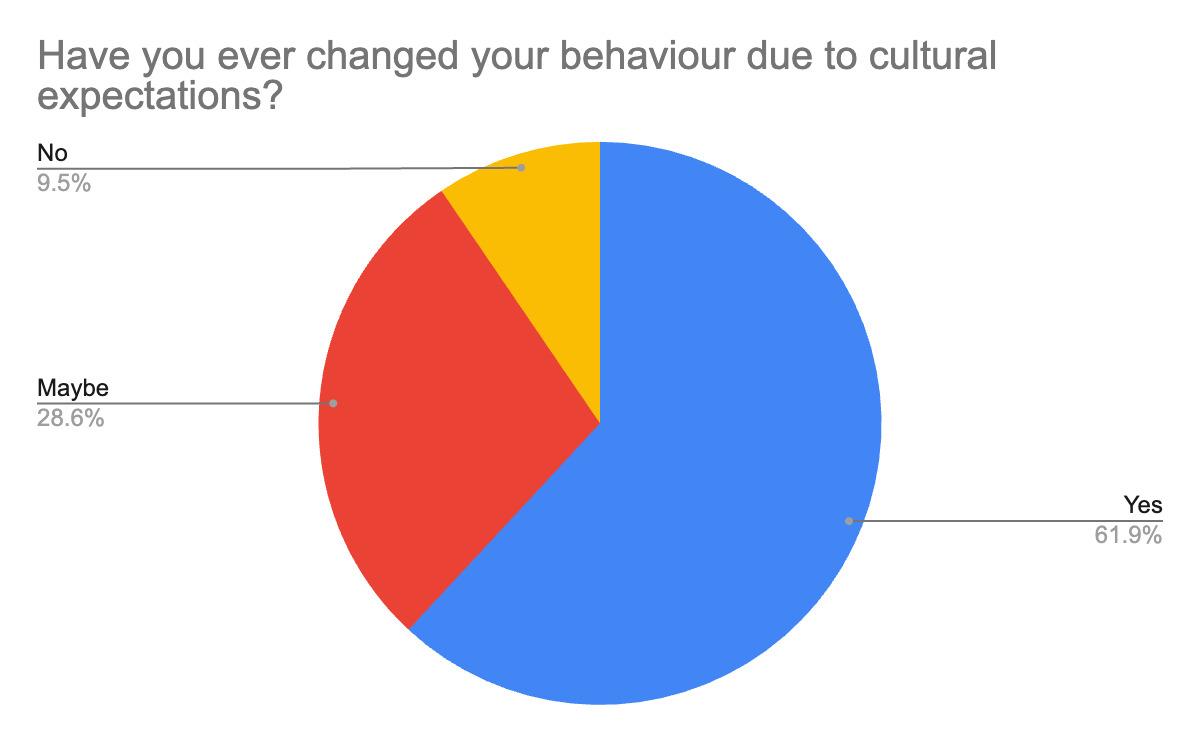
When asking respondents about whether or not they had ever changed their behaviour due to cultural expectation most respondents indicated that they had changed their behaviour due to cultural expectations. Out of the responses 62% answered “Yes”, 28% answered “Maybe” and 9% answered “No”. This suggests that clear or potential behaviour change in response to cultural expectations was reported by the large majority of participants.
In the two questions asked to respondents about how acceptable it is in your family and in your community to talk about harassment, the majority of respondents had similar answers. The average for the two questions was 2.61 and 2.81 (out of 5) respectively. This indicates most respondents feel a moderate level of acceptability rather than strong openness or complete taboo.
Through a quantitative analysis of the Likert-scale (1–5) items, where 1 indicated feeling least safe and 5 indicated feeling most safe, notable differences between the responses of male and female participants were identified.
Discussion
The survey results from this sample reveal how harassment (particularly verbal) pervades experiences among South Asian youth in Hong Kong, alongside cultural and gender barriers that stifle discussion and response to harassment, directly addressing the core research question on harassment manifestations and influencing factors. However, due to the small sample size of this paper, the results should be interpreted cautiously as they may not be fully representative of the wider population.
The high prevalence of harassment reported, with 81% witnessing harassment and 71.4% experiencing it firsthand demonstrates that harassment was a widespread issue among the respondents in this study. This finding aligns with prior research indicating that ethnic minority youth often face elevated risks of harassment and discrimination in multicultural urban settings (Lee & Wong, 2019; Verkuyten, 2016). Moreover, the fact that nearly half of the respondents reported experiencing harassment “sometimes” and 30% “often” underscores the chronic nature of these experiences rather than isolated incidents.
The predominance of verbal harassment, reported by 47.6% of respondents alone and 14.3% in combination with online harassment, highlights the centrality of verbal abuse as a mode of harassment. This is consistent with literature emphasizing verbal harassment as the most common form of bullying and discrimination faced by ethnic minority adolescents (Espelage & Swearer, 2003; Peguero, 2011). Because of the relatively low legal and social consequences, verbal harassment is often seen as an “easy” form of abuse (Mahmoudi et al., 2014), explaining why many respondents had faced this form of harassment. The relatively lower incidence of physical harassment and online-only harassment suggests that while physical violence and cyberbullying are present, verbal harassment remains the most frequent form of aggression in this context.
The absence of any reported formal incident reporting is a critical and concerning finding. It suggests a systemic barrier to addressing harassment, possibly rooted in cultural stigma or lack of trust in institutional support. This silence around reporting is echoed in studies of minority youth who often underreport harassment due to fears of social repercussions or cultural norms discouraging disclosure (Fisher et al., 2019; Yoon & Lee, 2010). Such underreporting perpetuates vulnerability and may contribute to the normalization of harassment (Smith et al., 2013).
With 62% of respondents answering that they had changed their behaviour due to cultural expectations, this shows the impact culture has on shaping behaviours. This high percentage suggests that for these respondents, cultural norms play a bigger role than personal preferences in shaping decisions/behaviour. Similar patterns appear in cross-cultural psychology studies, where conformity rates exceed 60% under social pressure (Asch, 1951).
While higher harassment rates among females were anticipated, the fact that 50% of the male respondents reported harassment is notable. This indicates that male respondents in this study were also vulnerable to harassment, challenging the commonly held assumption that harassment primarily affects females, highlighting the need for an intersectional perspective.
The data on gender bias reveal that 90% of respondents perceive gender stereotypes as influential in sports settings, with clear themes emerging around women’s perceived inferiority, and restricted behavioral expectations. This aligns with extensive gender studies literature documenting how sports remain a highly gendered domain where women face systemic disadvantages, including fewer opportunities and differential treatment (Cooky & Messner, 2018; Fink, 2015). Furthermore, Glazbrook et al. explains how women are portrayed as biologically inferior leading to perceptions that women’s athletics are less entertaining and deserving of resources; aligning with many of the survey responses.
These gendered differences likely emerge from cultural and societal expectations, where girls are often portrayed as inferior and are often told to minimize their reactions to situations. This pattern is consistent with the literature on gender stereotypes in sports and public space, where girls are told to be more disciplined and under closer scrutiny, while boys are given more license to express anger or aggression (RainLily, 2018; UNESCO, 2016).
Also, male respondents often described harassment with a detached tone, but females more often described personal emotional impact. This difference has implications for future interventions. If girls consistently feel less safe and limited in the ways they can respond to harassment, support programs should be put into place to address the harassment and the cultural pressures that silence them. Likewise, the tendency for boys to describe harassment at a distance suggests that boys might benefit from interventions that help them recognize and articulate their own experiences.
Conclusion
This paper investigated how safety concerns, harassment, and gender bias manifest in the everyday lives of South Asian teenagers, and the results show a clear and troubling problem. Through the data collected, it is obvious that harassment is not an uncommon disruption, but often a routine part of life for many respondents in this sample, and is faced most often in the form of verbal abuse. Moreover, the findings show that many South Asian teenagers navigate environments where discussion around harassment is constrained by stigma and formal reporting is rare, suggesting potential implications for their wellbeing and sense of belonging. It is important to keep in mind some limitations of this paper as well. This study is limited by a small sample size, meaning the findings cannot be generalized to all South Asian teenagers in Hong Kong. In addition, while the survey instructions asked all respondents to be truthful, there is no guarantee that all participants were truthful in their responses as some may have been uncomfortable disclosing certain experiences. Future studies could expand on this work through larger sample sizes, in-depth interviews or data comparison between different minority groups in Hong Kong. They could also examine the perspective of parents and policy-makers to identify systemic barriers. Conducting interviews with policy-makers would also be helpful as it would allow researchers to gain an important point of view, and understand this topic on a deeper level. Moreover, this research paper lacks comparisons across different age groups. Future studies could compare early teens versus older adolescents to see how safety concerns and gender expectations evolve over time.