Introduction
It took forty-eight hours to undo thirty-one years. On January 20 and 21, 2025, three executive orders signed by President Trump swept away the Biden administration’s climate and environmental-justice directives and, with them, Executive Order 12898 (Trump, 2025a, 2025b, 2025c). Signed in 1994, that order had been the backbone of federal environmental-justice policy ever since. Within three weeks, 171 environmental-justice and civil-rights staff were placed on leave and EJScreen, the agency’s mapping tool, was pulled from the EPA website (Environmental Data and Governance Initiative, 2025; EPA Press Office, 2025). Legally, none of this was surprising: a president can erase an executive order with the stroke of a pen. What was surprising was the speed and what it revealed about the foundations of a regime the movement had spent four decades building.
The speed exposed a paradox. By the 2020s the movement had won broad recognition for its argument. That environmental harm is a civil-rights problem had become a standard way the public, government, and academy framed it, displacing the older view of pollution as a purely technical matter (Wang, 2025). Even the administration that dismantled the regime built its case not on denying the harms but on attacking the order as an unlawful racial classification. Yet the structure built on that victory was fragile enough for one administration to undo. The movement won the contest over meaning and lost the contest over law: the puzzle this review takes up.
The environmental-justice literature is not organized to explain it. It falls into three broad traditions: one on how the movement formed and won its moral authority (Bullard, 1983, 1990, 1994; McGurty, 2007; United Church of Christ Commission for Racial Justice, 1987), a second on how the courts received its lawsuits and finally shut them out (Been, 1994; Cole & Foster, 2001), and a third on how the unequal distribution of harm has been measured and whether it has narrowed (Bullard et al., 2007; Mohai & Saha, 2006; Pastor et al., 2001). None treats the regime’s legal form as a primary object of study. Each takes its executive-order footing as fixed background. So the question the 2025 reversal poses falls between the traditions, not within any one: why was the movement’s victory so easy to destroy?
This comparative literature review argues that the gap is not accidental but structural, and that naming it changes how the field’s literature should be read. Where Wang (2025) explains how environmental justice became a successful movement, this review asks why that success never produced a durable law. It calls the missing piece “recognition without remedy,” borrowing from Nancy Fraser (1995, 1997) but pointing the idea toward the legal form of what a movement wins and whether that form survives a change of power. The evidence is already on the table. What is new is to read it against the field’s own organization, treating legal form as a variable rather than a given.
The argument runs in four steps: it reviews the three traditions and their shared blind spot, defines “recognition without remedy” against Fraser, tests the framework down the ladder of legal forms from South Africa’s constitution to the Houston record, then weighs alternatives and limits before directions for research and practice.
Methods
This critical literature review examines scholarship on the federal environmental justice regime from 1983, when Bullard’s first study appeared, through 2024, with primary legal and policy sources extended into 2025 to capture the dismantling of the federal environmental justice framework. Sources were selected based on three criteria: (1) their focus on the federal environmental justice regime; (2) their status as foundational or widely cited contributions within one of the field’s three dominant scholarly traditions; and (3) their substantive claims regarding how environmental disparities emerged, were litigated, measured, or persisted. Primary legal materials include judicial decisions from Yick Wo v. Hopkins (Yick Wo v. Hopkins, 1886) through Alexander v. Sandoval (Alexander v. Sandoval, 2001), the principal executive orders shaping federal environmental justice policy (Biden, 2021; Clinton, 1994; Trump, 2025a, 2025b, 2025c), the EPA Office of Inspector General’s (2004) evaluation of Executive Order 12898, and the Houston record documented in Bullard’s (1983, 2014) studies and Bean v. Southwestern Waste Management Corp. (Bean v. Southwestern Waste Management Corp., 1979).
The review employs a critical interpretive approach that organizes the literature according to the explanatory questions each scholarly tradition seeks to answer before assessing the extent to which those traditions account for the institutional fragility revealed by the 2025 dismantling of the federal regime. Rather than treating the January 2025 reversal solely as a political event, the analysis uses it as an analytic lens through which to examine assumptions embedded within the existing literature. By directly exposing the legal foundation that all three traditions implicitly treated as stable, the reversal reveals the explanatory limits of each body of scholarship.
To address this gap, the review integrates insights from political theory and historical institutionalism. Fraser’s (1995, 1997) distinction between recognition and redistribution provides the conceptual vocabulary for distinguishing symbolic recognition from durable legal remedy. Institutionalist theories supply the explanatory mechanism. Wilson’s (1980) theory of regulatory politics explains how the distribution of political costs and benefits shapes the legislative feasibility of durable legal reform, while Pierson’s (2000) theory of path dependence explains how early institutional choices constrain subsequent policy development and reinforce existing trajectories.
Because the central question concerns institutional durability rather than causal magnitude, the study adopts a comparative qualitative design rather than a statistical one. The federal environmental justice regime constitutes a single historical case whose durability is examined through structured comparison with cases selected to vary the legal form through which policy gains were institutionalized. Houston serves as the within-case anchor because it represents both the movement’s founding site and the longest continuous empirical record spanning the life of Executive Order 12898. The disability rights movement functions as a most-similar comparator, emerging during the same historical period and operating within the same constitutional and congressional environment while differing on the principal variable of interest—the legal form through which its achievements were secured. South Africa provides the constitutional comparator, representing the strongest form of legal entrenchment. By holding broader political context relatively constant while varying legal form, the comparative design isolates legal form as the principal explanatory variable rather than differences in historical timing, political sentiment, or movement success.
Literature Review
The oldest and most influential tradition tells environmental justice as a story of organizing: how scattered communities bound by a shared experience of environmental harm became a national movement. Three works anchor this tradition: Bullard’s Dumping in Dixie (1990), McGurty’s Transforming Environmentalism (2007), and the United Church of Christ reports beginning with Toxic Wastes and Race (UCC, 1987). Together they trace the arc from the 1979 Bean suit and the 1982 Warren County protests to the 1991 People of Color Environmental Leadership Summit and Executive Order 12898 (Bullard, 1983, 1994; Moore et al., 1993). Its central finding is that the movement won the contest over meaning: the civil-rights framing of environmental harm moved from the margins to the center while the older “technical hazard” framing faded (Wang, 2025).
What the tradition cannot see is the gap between winning the argument and winning a remedy. It reads Executive Order 12898 as the movement’s reward (McGurty, 2007) without asking why the prize was an order rather than the statute won by the disability movement during the same period. It assumes the order would last as long as political support endured. The 2025 revocation broke that assumption. The Biden administration backed the order more than any predecessor, yet it still fell when a hostile administration took office (Congressional Research Service, 2022). The weakness lay in the legal form, not the organizing, and a framework built to explain organizing has nowhere to place that fact.
The second tradition treats environmental justice as a problem of legal strategy: which laws were available and how courts and agencies interpreted them. Cole and Foster’s From the Ground Up (2001) is the central text, tracing how the courts closed each route in turn. The Constitution’s equal-protection guarantee narrowed after Washington v. Davis (Washington v. Davis, 1976) required proof of discriminatory intent. A brief 1990s opening under Title VI, allowing challenges based on discriminatory effects alone, closed in Alexander v. Sandoval (Alexander v. Sandoval, 2001), which barred private suits to enforce those regulations.
Been (1994) raised a deeper challenge: siting studies could not distinguish discrimination from later market processes in which poorer residents moved toward cheaper, already-burdened land. Testing sequence directly, Pastor and colleagues (2001) found the facility often came first, placing the burden back on siting. Meanwhile, the EPA’s civil-rights office dismissed about ninety-five percent of community complaints (Buford & Greene, 2015).
The tradition’s blind spot is not that Executive Order 12898 was weaker than a statute but what that weakness would become. It treated the order as one tool among many, a fallback after the courts had closed (EPA Office of Inspector General, 2004), not as the substitute for durable legislation. Chester (1997) illustrates the stakes. A federal appeals court briefly allowed residents of a two-thirds-Black city to enforce Title VI effects regulations before the Supreme Court mooted the ruling and Sandoval closed the door permanently (Cole & Foster, 2001). The tradition explained how judicial avenues disappeared, not why the executive order replacing them proved so easy to reverse.
The third tradition treats environmental justice as a problem of measurement: who bears environmental burdens, whether disparities are narrowing, and what predicts facility siting. It runs from the 1987 UCC report, which found race the strongest predictor of hazardous-facility siting ahead of income (UCC, 1987), through Mohai and Saha’s (2006) methodological work. Bullard’s early counts were challenged on methodological grounds, but distance-based methods confirmed the disparity (Mohai & Saha, 2006). A twenty-year update found the gaps had not closed (Bullard et al., 2007).
What escapes this tradition is the connection between measuring harm and ending it. It treats documentation as accountability, assuming that proving disparity would produce correction. The EPA’s Inspector General challenged that assumption in 2004, finding the agency had never defined who qualified as a “disproportionately impacted” community and maintained that the order conferred “no special benefits and protections” (EPA OIG, 2004). The 2025 reversal underscored the point: the data the tradition had built was swept away with the order it was meant to support (Environmental Data and Governance Initiative, 2025).
Taken together, the three traditions explain how the movement formed, how legal avenues closed, and how disparities endured. None places the legal form of the victory at the center, leaving the regime’s deepest vulnerability—that a single president could dismantle it—at the margins. That Executive Order 12898 created no enforceable rights was no secret: it disclaimed any right to judicial review, and its protections proved hollow (Clinton, 1994; EPA Office of Inspector General, 2004). The decisive weakness was not implementation but fragility. This raises a fourth question: what kind of legal form preserves recognition, why did this movement end up with such a fragile one, and with what result?
What the three traditions miss is not unique to environmental justice but common to how movements preserve what they win. Nancy Fraser (1995, 1997) distinguishes between recognition, the acknowledgment of a group and its injuries, and redistribution, the transfer of resources and enforceable rights. Her concern is that movements may achieve recognition while leaving the conditions that produced injustice intact. Environmental justice illustrates this dynamic but also reveals a legal dimension Fraser does not pursue. The divide is not only between recognition and resources but between recognition and the legal form that makes either durable.
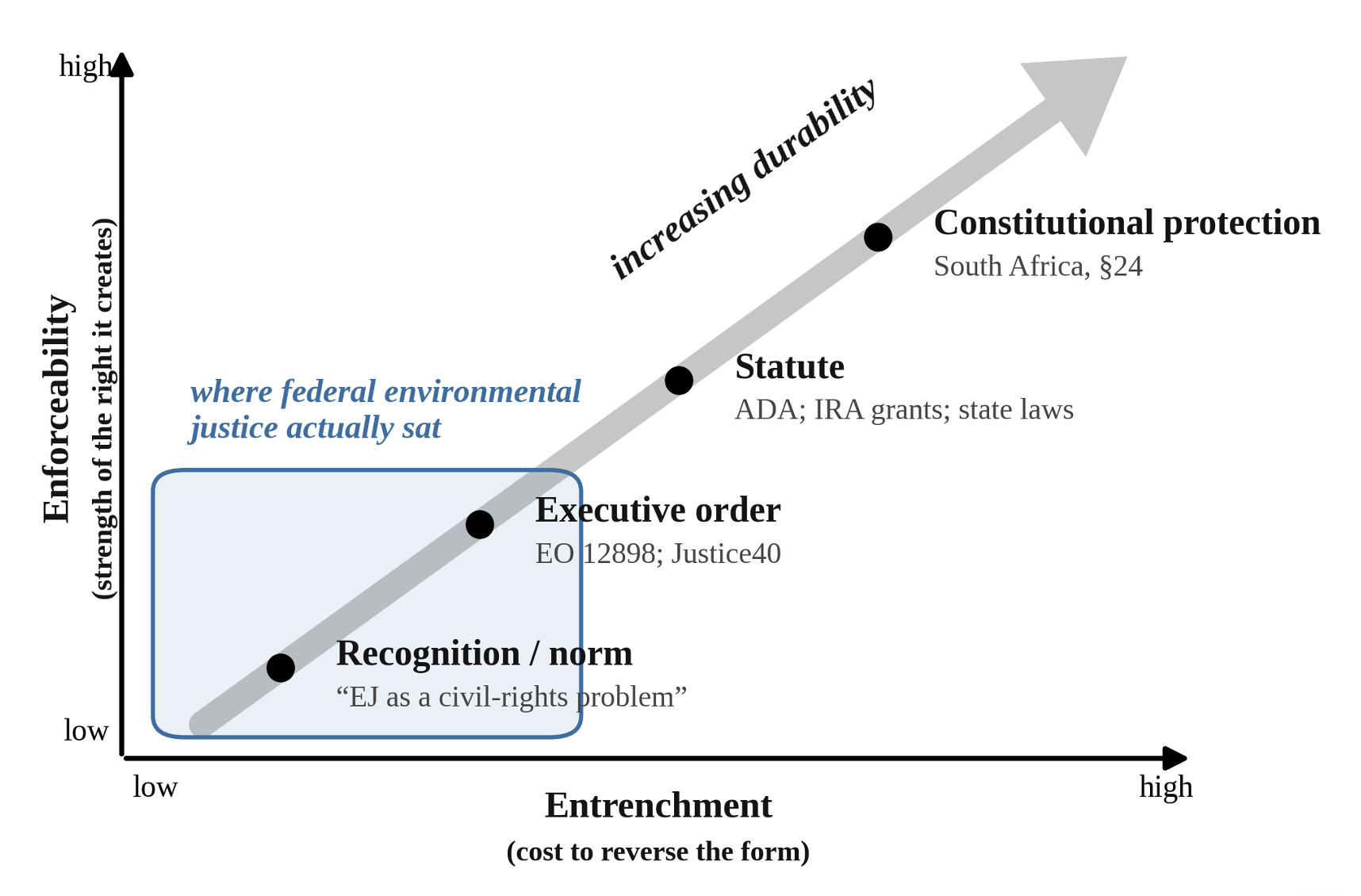
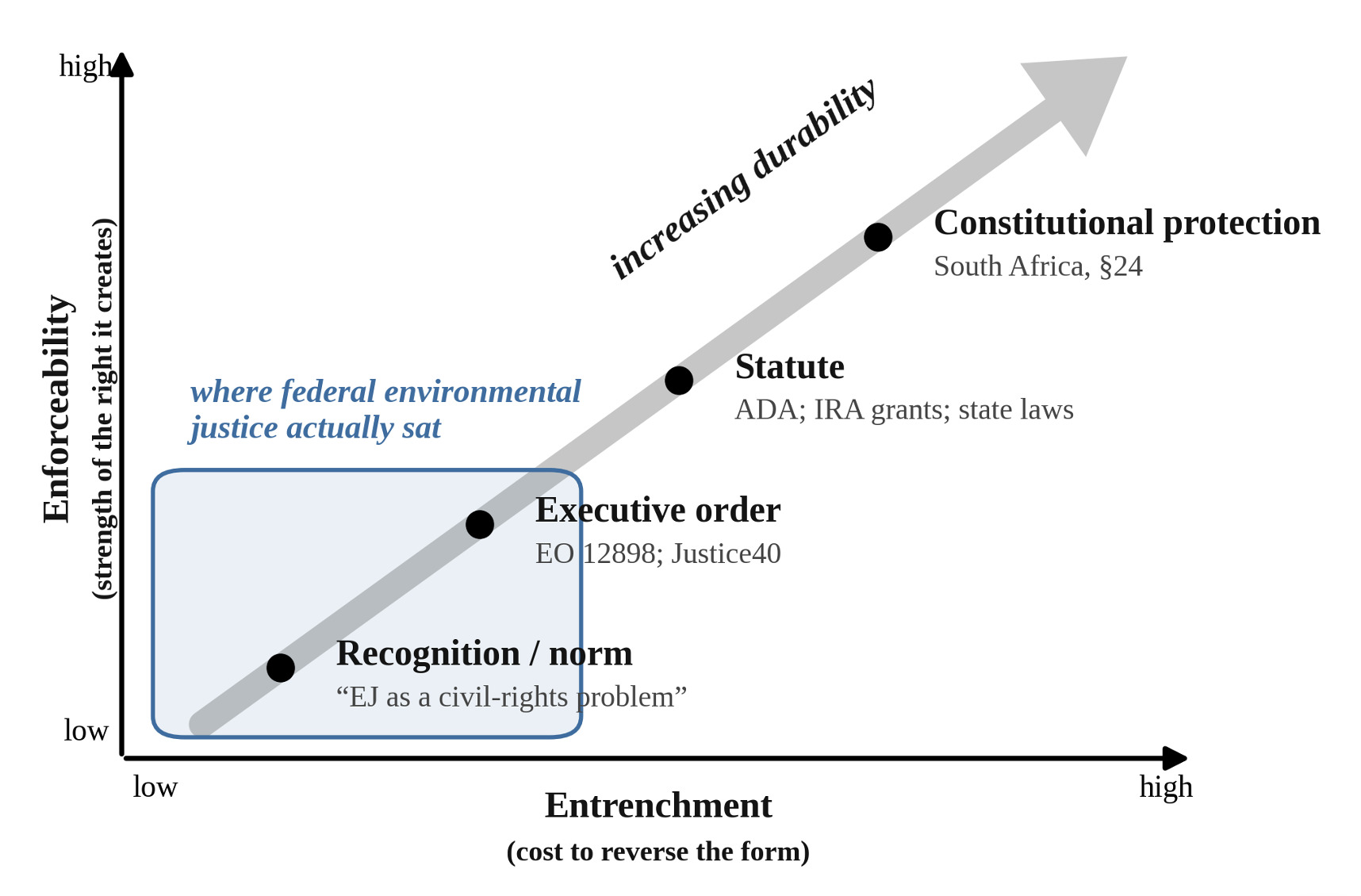
This is where “recognition without remedy” departs from Fraser. Her framework distinguishes symbolic recognition from material redistribution. This review adds a second axis: the legal form through which gains are held. It turns on two conditions: whether the form is enforceable and whether it is entrenched, making reversal costly enough that no single official can undo it. Legal forms range from constitutional protection to bare recognition, with durability declining at each step (Table 1, Fig. 1).
Durability is a matter of degree, not a binary. Legal form alone is not sufficient, since statutes can also be repealed, but stronger forms raise the cost of reversal and leave movements something to defend when political power changes. Remedy, as used here, means the enforceable and entrenched footing that determines whether gains survive a change in government.
By Fraser’s measure, environmental justice appears successful, yet her framework has no category for a movement that wins recognition and loses it almost overnight. Her distinction concerns the content of what movements win; the durability axis introduced here concerns the legal form through which those gains are preserved.
Each form on the ladder carries its own prediction about durability, and the sections that follow test those predictions. Federal environmental justice secured only the bottom rungs (Table 1).
Stated as observable implications, the framework reaches past this one regime. First, durability rises with both conditions: constitutional protection outlasts statute, and both outlast an executive order or bare recognition. Second, a movement whose opponents would bear concentrated costs is likelier to win only a weak form, since concentrated losers organize to block the durable kind. Third, once a weak form is settled on, path dependence raises the cost of later upgrading it. Each is testable against movements beyond environmental justice, and the cases below are consistent with each.
Comparative Analysis
Constitutional Form: Entrenched yet Unenforced in South Africa
Begin at the top of the ladder. South Africa wrote environmental protection into its 1996 Constitution. Section 24 guarantees everyone “an environment that is not harmful to their health or well-being,” the most entrenched form a recognition can take, beyond any administration’s power to revoke by signature (Constitution of the Republic of South Africa, 1996, § 24, n.d.). Yet for two decades it stayed a largely dormant right. Only in 2022, after Highveld communities had breathed some of the world’s worst air for years, did the Deadly Air judgment hold that the state’s failure to curb the pollution violated Section 24 (Trustees for the Time Being of Groundwork Trust v. Minister of Environmental Affairs (39724/2019) [2022] ZAGPPHC 208 (March 18, 2022), affirmed, Minister of Environmental Affairs v. Trustees for the Time Being of Groundwork Trust (549/2023) [2025] ZASCA 43 (April 11, 2025), n.d.). Even then, the leading polluter was granted new exemptions in 2025, days before an appellate court affirmed the judgment. The case fits the prediction: constitutional form sets the ceiling on durability, but enforcement decides whether a right reaches it. The guarantee was impossible to erase, yet on its own could not deliver clean air.
Statutory Form: The Gains That Survived 2025
One rung down sits statute, where (though it never won a comprehensive law) environmental justice held some ground. Under Justice40 and the Inflation Reduction Act, the Biden administration steered an unprecedented share of federal climate spending toward disadvantaged communities (Congressional Research Service, 2022), but its footing varied by form. Justice40’s targeting rested on an executive order and vanished with it in 2025. The Act’s block grants were written into statute, so when the administration moved to cancel the $3 billion block-grant program, grantees could sue, and courts have repeatedly held the termination unlawful (Inflation Reduction Act Tracker, 2026). A revoked order leaves nothing to contest. A statute turns revocation into a fight a movement can sometimes win.
The same logic explains where durable protection now lives. With the federal executive route closed, the enforceable layer has migrated to the states, whose environmental-justice laws came through 2025 untouched and carry the right to sue and the cumulative-impact permitting the federal regime never had.
Executive Form: An Order Undone in Forty-Eight Hours
The form on which federal environmental justice actually rested was the executive order, and the court doctrine already traced is what left it so little to stand on. With the constitutional route narrowed by Davis and the Title VI suits closed by Sandoval, the order signed in 1994 stood on ground the courts had already cleared. It was a procedural gesture standing in for the enforceable law they never reliably supplied.
An executive order binds the agencies of the administration that issues it and no longer. It created no right a community could assert and required no repeal, only rescission, which came in three orders in January 2025 (Trump, 2025a, 2025b, 2025c). Thirty-one years of recognition rested on a form a single signature could undo.
At the foot of the ladder, recognition stands without any enforceable form behind it, and the Houston record is the cleanest test, because the data cover the whole life of Executive Order 12898. It began in 1979 with a landfill set 1,700 feet from a Black high school with no air conditioning, and with a young sociologist, Robert Bullard, mapping the city’s dumps by hand. “Houston is flat,” he told his students. “Anytime you see a mountain, that’s a landfill.” His first study (Bullard, 1983) found eleven of thirteen city-owned waste sites in Black neighborhoods, in a city less than twenty-eight percent Black. Returning decades later, Bullard (2014) found the ownership changed but the pattern intact. The landfills had passed to private operators, yet the burden still tracked the same map of color it had three decades before.
Bullard won the documentation, but the order that named the harm could not touch it. Executive Order 12898 directed federal agencies and created no private right of action. Against a state-permitted, privately run landfill it was executive in form but, lacking any enforceable hold, recognition in effect. Sandoval had shut the suit residents might otherwise have brought. The pattern had many drivers, market sorting among them (Been, 1994), but the order’s non-binding form left whatever drove it legally unchallenged: the data proved the harm, the order could not halt it, documentation without remedy in a single city.
Discussion
Had the executive order been the only possible outcome, “recognition without remedy” would describe an iron constraint, not a contingent result. The disability-rights movement, working at the same time, shows the result turned on conditions that could have differed. From a 1986 federal report recommending a full statute, the movement spent four years building a coalition of civil-rights groups, affected industries, and bipartisan sponsors. The Americans with Disabilities Act passed the Senate 76 to 8 and the House 403 to 20 (Fleischer & Zames, 2011; National Council on the Handicapped, 1986). The same era that handed disability rights a durable law handed environmental justice an order.
Why could one coalition form and not the other? Wilson’s (1980) regulatory politics gives the plainest answer: costs spread thin meet weak resistance, while costs concentrated on a few identifiable players provoke organized opposition. The ADA’s costs spread thinly across employers and builders. An environmental civil-rights law would have concentrated them on the chemical, waste, and energy industries, who had every reason to fight (Hamilton, 1993).
Once recognition had been won by order in 1994, after an earlier statutory bill died in committee (Environmental Justice Act of 1992), that route became the path of least resistance. It repeated itself through the self-reinforcing process Pierson (2000) describes, and held even under Biden. The Environmental Justice for All Act cleared a House committee in 2022 but never reached a floor vote, and the Senate’s sixty-vote threshold would have blocked it regardless (Environmental Justice for All Act, 2022; House Committee on Natural Resources, 2022). The order was less a naive choice than a survival route taken early, when the legislative path was narrowing, but taking it made that path harder to revive.
The difference between the two movements points to legal form as the variable the field’s usual explanations leave out. None of this proves a statute was there for the taking. The windows were narrow, and the environmental-justice movement’s insistence on independence kept it from the coalition partners it would have needed (Bullard, 1994; Moore et al., 1993). But if durability turns on coalition and legislative structure rather than organizing, litigation, or evidence, the variables that shaped this regime’s fate sit outside all three traditions.
The 2025 reversal invites explanations other than legal form: partisan polarization, judicial conservatism, congressional gridlock, industry lobbying, federalism, or shifting public opinion. Several are not rivals to the argument but the machinery inside it. Gridlock and the filibuster explain why no statute passed. Lobbying by concentrated industries explains why a coalition never formed (Hamilton, 1993; Wilson, 1980). Judicial conservatism emptied the doctrinal space the order then filled. Each names a reason the regime took the weak form it did, which is the paper’s claim, not a rival to it. The genuinely rival accounts, polarization and public opinion, fail the comparison. The Americans with Disabilities Act faced the same polarized Congress and survived because it was a statute, and public support for environmental protection remained broad even as the regime fell. What separated the two outcomes was not partisanship or sentiment but form.
A stronger rival is that 2025 was simply a broad anti-DEI wave that would have swept away any environmental-justice program whatever its form. But the wave did not fall evenly. The same administration moved against both: the order and Justice40 were erased by signature, while the block grants, written into statute, could be defended in court. With the opponent held constant, form separated the outcomes. Federalism, often read as environmental justice’s retreat, deserves a more careful reading. State laws survived because no federal signature can reach them. What the movement holds there it holds as statute, a form the next hostile state government cannot erase by signature.
Limitations
Three limits bound these claims. First, form sets the odds of survival rather than guaranteeing it: some executive actions endure by accretion and norm, and some statutes are hollowed by non-enforcement, as South Africa shows from the other direction. Second, the argument rests on a small, outcome-selected comparison (cases chosen partly because their fates differed) that can show a mechanism at work but not how often it operates. A fuller test would trace many movements across many forms. Third, the reach beyond these cases is suggested, not settled. The same ordering appears elsewhere. The Voting Rights Act, won as statute, was narrowed in Shelby County v. Holder (Shelby County v. Holder, 2013) rather than erased by signature, form setting even the mode of loss. The climate regime’s loss-and-damage fund won recognition at the 2022–2023 summits but left payment voluntary (Carbon Brief, 2023). Such echoes invite the comparative work this framework is built to support, not proof that form governs everywhere.
Two further cautions bound the causal claim. That a statute was within reach rests on a counterfactual the record cannot fully settle. The disability comparison shows a durable law was possible in those years, not that environmental justice could have passed one against the industries arrayed against it. And durability here is read across a single transition. An order that fell in 2025 might have survived a friendlier successor, and a statute that held might still be repealed. The framework names the odds a form sets, not a movement’s fate.
The analysis leaves clear work ahead. The young state environmental-justice statutes that now carry the enforceable layer deserve close study as the working models the federal regime never had. If the federal route is ever revived, the open question is what a durable law should contain: a fix to the Civil Rights Act restoring the private right Sandoval removed, or a cumulative-impact rule weighing a community’s existing burden before another source is approved.
Beyond environmental justice, “recognition without remedy” reaches into Title IX guidance, contractor-diversity rules, and other policies an executive order props up. Testing it there would show whether the fragility exposed in 2025 is general to rights won by recognition rather than law.
Conclusion
The history of environmental justice, from Bean in 1979 to the collapse of 2025, is the story of a movement that won its argument and never secured its law. Its three traditions explain how the movement formed, how its lawsuits were shut down, and how the burden persisted and was measured. None explains why a movement so successful at changing minds could not build a legal form able to survive one change of administration.
Much of the answer lies in the ground all three hold still. The first piece is the choice of legal form. A recognition can be held in many forms, and federal environmental justice was held in close to the weakest, an order binding only the administration that signed it. The second is the politics that fixed that choice. A real statute would have concentrated its costs on the chemical, waste, and energy industries while spreading its benefits thin, the configuration a movement tends to lose. The broad coalition that carried the disability statute never formed here. The third is path dependence: once recognition was won by order in 1994, that route became the path of least resistance and made the law it stood in for harder to revive. What this review adds is not new evidence but a variable, the form recognition takes and the politics that fix it in place. It also adds a question the field can now ask: not whether a movement won recognition, which environmental justice plainly did, but what legal form held it?
That gap is what the title marks. Recognition without remedy is a recognition a movement has won and cannot enforce: a harm named in language everyone now accepts, held in a form a signature can erase. In Houston, where Bullard began, the Whispering Pines landfill is still open, in a council district ninety-three percent people of color. The pattern he first mapped in 1979 has been remeasured in every federal framework since (Bullard, 2014), a faithful record of a harm that does not stop. Seen this way, the 2025 collapse was less a sudden rupture than the consequence of the form recognition took in 1994, a revocable order rather than an enforceable law. It stands as a warning to any movement that wins acknowledgment without the form to make it last. Whether a sturdier form was reachable is a question the field has not asked. That the form chosen would shape what followed, this review has shown. The question returns whenever a movement does.