Introduction
Artificial intelligence is no longer a distant technology; it is integrated into the tools students use daily, the media they consume, and increasingly, the art they create. As AI systems become capable of generating images that rival human output, fundamental questions arise about what creativity means, who or what can be considered an artist, and how young people learn to evaluate artwork. To address these questions, it is useful to clarify the key terms involved. AI-generated art refers to images or works produced or enhanced by algorithms trained on large datasets (What Is AI Art?, 2025), while artificial intelligence is defined as technology designed to mimic human thought and problem-solving (Clarke, 2022). Furthermore, understanding how students interact with and evaluate this technology requires definitions of two additional concepts: creativity, broadly understood as the ability to produce work that is both original and meaningful (Faiella et al., 2025), and AI literacy, meaning the ability to understand how AI functions, what it can and cannot do, and how it shapes learning and culture (Hu, 2024). Together, these four ideas are the foundation of this inquiry.
The urgency of this study has grown as AI tools like DALL-E and Midjourney move from novelty to everyday use. Research suggests that AI can now match or surpass human performance on standard measures of creative thinking (Haase & Hanel, 2023), while cultural critics warn that widespread AI use may be homogenizing creative output and quietly eroding originality (Chayka, 2025). As art educators begin integrating generative AI into their curricula (Hu, 2024; Lee et al., 2024), understanding how students visually evaluate AI-generated work becomes urgent. The debate surrounding AI and creativity is also deeply cultural and philosophical; some view AI art as a legitimate new movement while others see it as a threat to human expression (Baxter, 2024; Illing, 2024), and research consistently shows that labeling and attribution shape aesthetic judgment independently of visual quality (Horton et al., 2023; van Hees et al., 2025).
Despite its relevance, most existing research on AI art perception has focused on adult participants, leaving a clear gap in understanding how high school students detect and evaluate AI-generated images. Art educators, students, policymakers, and AI developers all stand to benefit from evidence grounded in adolescent experience (Chayka, 2025). This study addresses that gap by asking: what factors influence high school students’ ability to distinguish between human-made and AI-generated art, and how do they perceive the creativity of each?
Literature Review
The integration of artificial intelligence tools into educational settings, particularly within art and creative curricula, presents both opportunities and challenges that directly impact students’ understanding of AI capabilities and their ability to evaluate and distinguish AI-generated from human-created work. Marrone, Taddeo, and Hill (2022) conducted an eight-week design program with 80 Australian secondary school students who built Mars rovers while engaging with an AI-based vision analytics tool. Through focus groups and interviews, researchers discovered that students held notably limited conceptualizations of AI, primarily viewing it as robots or futuristic computers rather than recognizing the everyday AI systems they regularly encountered. Students believed that AI would negatively impact social skills, failed to perceive it as a potential collaborative partner, yet showed increased comfort with greater familiarity and increased trust with greater transparency into how AI systems function. To address these perception gaps, Marrone, Taddeo, and Hill (2022) proposed the “4AI Model” and emphasized that effective AI literacy education should encompass teaching for AI, teaching with AI, and teaching about AI.
The study’s generalizability is limited by its homogeneous sample and by its lack of reporting on students’ prior AI exposure or art education backgrounds. More significantly, the AI system students encountered was domain-specific (vision analytics for engineering design) rather than generative art AI. The study does not assess whether improved AI literacy translates to enhanced ability to distinguish AI-generated from human-created work. Researchers measured changes in comfort and trust but did not test whether students who understood AI better could identify its outputs more accurately, a significant gap between conceptual understanding and recognition of its creative products.
When AI tools are introduced into classroom practice, student responses reveal both enthusiasm and frustration, emphasizing how AI literacy shapes students’ ability to evaluate and engage with AI-generated work. Lee et al. (2024) examined 46 fifth-grade students in South Korea during a 90-minute workshop using Stable Diffusion to create imaginary picture diaries. While some students felt the AI outputs matched their creative vision, others found that the generated images did not align with their intentions. This divergence in experience is relevant because students who struggled to align AI outputs with their intentions may develop distorted perceptions of what AI-generated work looks like, which could affect their ability to accurately evaluate and identify it. Lee et al. (2024) emphasized that without adequate education and support, students may develop a distorted understanding of both AI capabilities and the visual characteristics of AI-generated outputs.
Hu (2024) conducted a survey and interviews with six high school art teachers and 19 high school students in China, all of whom had recent experience using AI tools such as ChatGPT and DALL-E in art education. The findings revealed a notable disconnect: 52% of students found AI helpful for creative outputs, and 56% used it for initial ideation, viewing AI as a creativity facilitator that expanded their possibilities and helped them overcome initial barriers to starting projects. In contrast, teachers expressed significant concerns about overreliance and its potential negative impacts on student development. Teachers primarily used AI for providing feedback rather than as a creative tool, and worried about standardization of student work, plagiarism, and erosion of fundamental artistic skills. Teachers’ concerns about standardization are particularly relevant here. If AI exposure leads students to associate certain visual qualities with AI-generated work, their judgments about creativity and origin may be shaped as much by familiarity with AI aesthetics as by genuine visual analysis (Medeiros et al., 2025).
These three studies establish that educational experiences with AI significantly shape student perceptions, comfort levels, and patterns of engagement with AI tools in creative contexts. However, a critical gap emerges: while the research establishes that AI literacy education influences students’ comfort and trust in AI systems, none of these studies directly investigates whether improved AI literacy translates into an enhanced ability to distinguish AI-generated from human-created artwork, or what specific factors drive that recognition ability in adolescent populations.
Moving beyond the classroom, research on how broader audiences perceive and evaluate AI-generated art reveals that recognition is shaped as much by bias and attribution as by visual analysis. Understanding how people perceive AI-generated art is critical for investigating high school students’ ability to distinguish between AI and human works. Perception research shows that judgments of artistic value are not based solely on visual quality but are strongly shaped by labeling and attribution. Horton, White, and Iyengar (2023) found that participants rated identical artworks as significantly lower in creativity, skill, and monetary value when labeled AI-generated, and as more original and valuable when labeled human-made. This pattern revealed a strong labeling bias that inflated human artistic credibility and diminished AI’s perceived creativity. The study demonstrated strong validity through controlled experiments, though its reliance on adult participants limits applicability to adolescents, who may express different attitudes shaped by familiarity rather than suspicion.
van Hees et al. (2025) found that hiding authorship details led participants to often prefer AI-generated art, yet they could still identify AI-generated work at above-chance rates, suggesting bias stems more from cultural beliefs than from visual traits. Salas Espasa and Camacho (2025) reviewed 48 studies and introduced the concept of “semi-aura,” arguing that AI art gains partial authenticity when human intention is part of the process, and that aesthetic value depends on perceived human agency rather than origin alone. These studies show that perception of AI-generated art depends heavily on context. Bias mainly appears when audiences know about AI involvement, and authorship claims affect aesthetic judgment. This research explains how adults judge AI art but does not examine how adolescent learners form biases or whether those biases affect their ability to spot AI-generated work.
These questions of perception and bias are further complicated by the growing prevalence of human-AI co-creation, which blurs the boundaries of authorship and raises new questions about how creative agency is experienced and attributed. Medeiros et al. (2025) ran a controlled experiment to compare human and AI assistance during divergent thinking tasks. They found that low-quality AI input reduced participants’ creativity—a phenomenon they termed the “Golem effect.” Participants lowered their standards and produced less original work, while high-quality AI help did not outperform human input, suggesting that AI’s impact depends on user trust. The study’s brief tasks and homogeneous university sample limit applicability to high school contexts.
Building on how AI shapes human creative processes, Ivcevic and Grandinetti (2024) synthesized research across fields and identified two models of successful collaboration: the “Centaur” model, in which humans and AI divide tasks based on complementary strengths, and the “Cyborg” model, in which both act as integrated partners. Across studies, they found that AI enhanced overall creative productivity but reduced idea diversity, especially among similar-skill groups. O’Toole and Horvát (2024) extended this discussion by analyzing how AI tools can be designed to preserve human agency. They emphasized that support systems for creativity must include transparent mechanisms and intuitive interfaces that allow users to map AI parameters to human concepts. Without such alignment, users risk losing ownership of the creative process. Zhou and Lee (2024) provided large-scale quantitative evidence that AI adoption increased creative output by 25% and artwork value by 50% but also led to stylistic homogenization, confirming that co-creation boosts efficiency but may dilute originality.
These studies show a complex dynamic: AI can expand creative capacity as a supportive partner, but overuse or poor design can reduce creative agency. Existing research explains adult and professional patterns of collaboration but rarely examines younger users, who are still forming ideas about authorship. The main gap is not knowing how AI co-creation shapes high schoolers’ views of what AI-generated work looks like, or whether those views help them identify AI-generated work versus human art.
Underlying these questions of co-creativity and recognition is a deeper debate about how authenticity and creativity should be defined in an age of generative AI. Haase and Hanel (2023) provided experimental evidence that generative AI systems such as ChatGPT-4 now perform at human levels on standard measures of creativity. Participants and AI models completed identical alternative-use tasks, and blind raters found no significant difference in originality scores, with ChatGPT-4 outperforming most participants. These results suggest that AI can mimic key features of human creativity, challenging the assumption that originality depends on human consciousness. However, these short, context-free verbal tasks do not capture the emotional intent, long-term refinement, and audience reception central to artistic creativity, meaning their findings show cognitive parity but stop short of demonstrating artistic authenticity.
Seli et al. (2025) compared professional artists, novice artists, and AI models generating prompts converted into images using DALL-E 3. They found that professional artists’ prompts produced the most creative images, but AI outputs were rated as more creative than those of novices, suggesting that human expertise and AI-generated content lie on a continuum rather than at opposite ends. Situating these findings historically, Epstein et al. (2023) drew parallels with earlier artistic technologies such as photography and digital music, arguing that AI transforms rather than displaces creativity. Their review identifies a core tension between the democratization of art production and the erosion of traditional authorship, noting that because AI relies on human-created training data, its outputs are embedded in a recursive loop of human influence. Epstein et al. (2023) concluded that authenticity in the AI era should be defined not by the source of creation, but by the transparency of process and acknowledgment of collaboration.
Collectively, these studies illustrate that creativity is shifting from an individual act to a distributed system between humans and machines, yet current research remains centered on adult creators and professional contexts. The literature has not addressed how high school students apply these shifting definitions of creativity and authenticity when evaluating specific works. This gap matters because, if students judge creativity by perceived origin rather than visual analysis, their identification decisions may reflect cultural bias more than genuine detection skill, with direct implications for how AI literacy should be taught in art classrooms.
Methods
To identify factors that affect how high school students perceive AI-generated art and its creativity, I used a mixed-methods design. I created a survey with a visual recognition task in which participants viewed images that were either human-made or AI-generated, identified each image’s source, rated their confidence in that identification, rated the work’s creativity, and responded to open-ended questions about their reasoning and views on AI in art. This method was appropriate because it produced accuracy scores, confidence ratings, and participants’ qualitative explanations, directly measuring the factors in the research question. Faiella et al. (2025) used structured survey measures to examine creative self-beliefs in AI contexts, while Horton, White, and Iyengar (2023) used survey-based experiments to assess how people judge AI art relative to human art, supporting the validity of survey responses in studying attitudes toward AI-generated images.
This study’s participants were Montgomery County public high school students who had taken or were currently enrolled in a county high school arts course. My study received IRB approval before data collection began. I excluded homeschooled students, private school students, and students outside Montgomery County. Students completed the survey independently through a Google Form at their convenience. Participation was completely voluntary, surveys remained anonymous from start to finish, and data from participants who submitted incomplete surveys or included any identifying information in open-response fields were discarded.
The survey instrument was created using Google Forms and included three main components: demographic questions, visual identification tasks, and open-response items. Demographic questions verified high school and art class enrollment. The visual identification task presented 12 images—6 created by human artists and 6 generated by AI—displayed one at a time. For each image, participants indicated whether they believed it was human-made or AI-generated, rated their confidence in their decision on a five-point Likert scale (1=not confident at all, 5=extremely confident), and rated how much creativity the work demonstrated (e.g., originality, imaginative choices, novel approach) on a five-point Likert scale (1=no creativity, 5=extremely creative). Following the visual task, participants responded to two open-ended questions: “What factors helped you decide whether an image was AI-generated or human-made?” and “How do you think AI tools should or should not be used in visual work?” These qualitative items captured the reasoning behind participants’ identification decisions and their broader attitudes toward AI in creative contexts.
I emailed visual arts teachers at Montgomery County public high schools with a brief description of the study and a request to share the survey with students in their courses. The survey began with an informed consent statement for students and parents that explained the study’s purpose, voluntary participation, anonymous data collection, and the right to withdraw at any time. Those who agreed clicked “Continue” to proceed; if not, they were prompted to exit the survey.
A limitation of this method is that online surveys do not allow real-time clarification of confusing questions. To address this, I pilot-tested the survey with five students excluded from the final sample and revised unclear wording based on their feedback. To further mitigate image selection limitations, I selected images spanning various artistic styles (realistic, abstract, digital illustration) and ensured both categories contained artworks of comparable technical complexity, reducing the risk that students relied on style differences rather than AI-detection skill.
To analyze the quantitative data, I calculated each participant’s accuracy score as the percentage of images correctly identified, then computed the mean across all participants. I also calculated mean confidence ratings for correctly and incorrectly identified images to examine whether confidence aligned with accuracy and compared participants’ perceptions of the two categories. For the qualitative data, I used thematic coding to identify recurring patterns in participants’ explanations. I read through all open responses, created a list of codes, and systematically applied them across all responses to explore whether students’ reasoning varied with their accuracy in identifying AI-generated images.
Results
The survey was administered to 39 high school students; however, six participants were removed from the sample for failing to indicate current or previous enrollment in a Montgomery County visual arts course, leaving a final sample of 33 usable responses. Each participant evaluated 12 images, producing 396 total identification responses. The sample contained students from two different high schools.
Identification Accuracy
Across 396 valid responses, participants identified images correctly 59.8% of the time (237/396), a rate significantly above the 50% chance baseline (binomial test, p<0.001). This overall result conceals a notable inconsistency: students identified human-made images correctly 69.7% of the time (138/198), also significantly above chance (p<0.001), but achieved only 50.0% accuracy on AI-generated images (99/198), statistically indistinguishable from random guessing. The difference between human-made and AI-generated accuracy was itself highly significant (two-proportion z-test, z=3.96, p<0.001). Accuracy per image ranged from 97.0% for Image 12 (human-made) to 18.2% for Image 3 (AI-generated), indicating that recognition depended on specific visual features rather than a general skill.
Creativity Ratings
Averaged across all responses, participants assigned a mean creativity rating of 3.78 out of 5 for human-made images and 2.90 for AI-generated images. An independent samples t-test conducted on per-image mean creativity ratings confirmed this difference was statistically significant: t(10)=2.72, p=0.022. Dividing responses by both true origin and participant identification reveals that the label assigned, rather than the image’s actual content, drove these differences. Human-made images identified as human received a mean creativity rating of 4.16, while human-made images misidentified as AI dropped to 2.92, nearly identical to the 2.40 rating given to correctly identified AI images. AI-generated images misidentified as human received a mean of 3.40. Images believed to be AI-generated were rated similarly regardless of their true origin, confirming that perceived label was the primary driver of low creativity scores.
Confidence and Accuracy
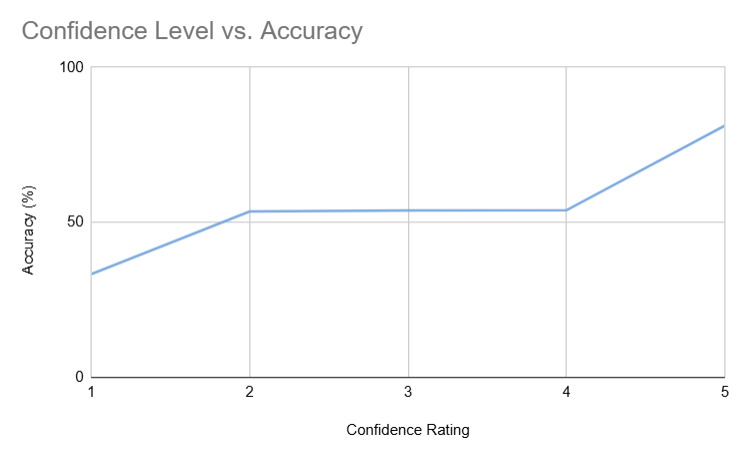
Participant responses were grouped into five confidence-rating buckets. Binomial tests against the 50% chance baseline revealed that confidence ratings of 1 through 4 all failed to predict above-chance accuracy: confidence 1 yielded 33.3% accuracy (4/12, p =0.39), confidence 2 yielded 53.5% (23/43, p=0.76), confidence 3 yielded 53.8% (56/104, p=0.49), and confidence 4 yielded 53.9% (76/141, p=0.40). Only confidence 5 produced accuracy significantly above chance, at 81.2% (78/96, p<0.001). The vast majority of responses—288 of 396, or 72.7%—fell in the moderate confidence range of 2-4, where accuracy never meaningfully exceeded chance.
.png)
Qualitative Themes
Open-text responses revealed a coherent set of strategies students used when making identification decisions. For images identified as human-made, participants most frequently cited visible brush strokes, deliberate or expressive use of color, emotional meaning, a sense of purposeful composition, and deliberate imperfection. For images identified as AI-generated, participants cited anatomical errors such as distorted fingers or unnatural faces, over-smooth or hyper-perfect rendering, and background. For instance, Participant #18 noted they looked for “uncertainties or unclear parts” as signs of AI, while Participant #30 described how “most human artists will naturally make consistent lines or patterns which don’t fall apart, unless the falling apart is intentional.”
Discussion
Interpretation of Findings
Taken together, the four findings reveal a clear pattern: high school students can distinguish human-made from AI-generated art above chance, but that ability is uneven, label-dependent, and anchored in visual cues that are becoming obsolete as generative AI improves. Students’ above-chance overall accuracy was driven almost entirely by their recognition of human-made work, while their performance on AI-generated images was statistically equivalent to guessing. Accuracy varied dramatically by image, from 97.0% to 18.2%, confirming that recognition depended on specific visual features rather than a transferable skill. The confidence data reinforces this: across the moderate confidence range of 2–4, where 72.7% of responses fell, accuracy never exceeded chance. Only at maximum confidence did accuracy rise substantially, likely reflecting images with obvious, easily nameable cues. Most students, most of the time, lacked a reliable internal signal to distinguish correct from incorrect judgments.
Connections to Prior Research
These findings converge with and extend the current literature. The labeling bias in creativity ratings—confirmed by a significant t-test (t(10)=2.72, p-0.022) directly replicates Horton, White, and Iyengar (2023), who demonstrated that identical artworks received significantly lower ratings for creativity and skill when labeled AI-generated. The current study extends that finding to an adolescent population, suggesting the bias is not limited to adults. It also aligns with Salas Espasa and Camacho’s (2025) concept of “semi-aura”: students appear to withhold full creative credit from any work they believe was produced without human intention, regardless of what the work actually looks like. The gap between confidence and accuracy across moderate ratings affirms Marrone, Taddeo, and Hill’s (2022) finding that secondary students hold limited conceptualizations of AI; without an accurate mental model of how AI generates images, confident judgments reflect disposition rather than genuine visual skill.
The visual cues students described—anatomical anomalies, over-smooth gradients, background inconsistencies—align with van Hees et al.'s (2025) genuinely detectable features of AI art. However, as Haase and Hanel (2023) demonstrated, generative AI has reached human-level performance on standard creativity measures, meaning these cues are increasingly absent from high-quality outputs. Image 3, which deceived 81.8% of participants, illustrates this directly. The cues students rely upon are not wrong; they are becoming obsolete.
Educational Implications
These findings carry direct implications for how AI literacy should be taught in art classrooms. General exposure to AI tools is insufficient to build detection skills, as evidenced by the gap between students’ confidence and their actual accuracy. Encouraging students to trust their instincts is similarly inadequate. Effective AI literacy instruction must provide concrete, nameable visual criteria so that confidence is anchored in something reliable. Furthermore, because students automatically assigned lower creative value to work they believed was AI-generated, their judgments of authenticity in art more broadly may reflect label-driven assumptions rather than genuine aesthetic analysis. Art educators should address this bias explicitly, helping students separate the question of origin from the question of quality.
Theoretical Significance
At a broader level, these findings sit at the intersection of two tensions identified in the literature. Epstein et al. (2023) argue that in the AI era, authenticity should be defined not by the source of creation but by the transparency of process; the students in this study applied the opposite standard, treating source as the primary determinant of creative value. Meanwhile, the visual cues students used to detect AI—however theoretically sound—represent a moving target. Teaching students to identify current-generation AI outputs provides only a temporary skill. A more durable approach would focus on understanding the generative process itself, so students can reason about what AI is and is not capable of producing, rather than memorizing a checklist of visual tells that will degrade as the technology improves.
Limitations
The generalizability of these results is limited by the sample size of 33 participants. The creativity and confidence analyses relied on per-image means rather than individual response-level data, which limits the precision of inferential tests. The reliability of creativity and confidence ratings may also be affected by the subjective nature of those scales, as participants may have interpreted the 1-5 range differently. These limitations aside, the consistency of patterns across 396 total responses, and the statistical significance of the key findings, suggest that the core conclusions are meaningful for answering the research question in this context.
Conclusion
This study investigated whether high school students can distinguish AI-generated from human-made visual art, and what perceptual patterns shape their judgments. The findings suggest a much more complex answer than a simple yes or no. Students demonstrated above-chance recognition ability overall, but this was driven almost entirely by their familiarity with human-made art. Their accuracy on AI-generated images was statistically equivalent to guessing. More significantly, the labeling bias finding revealed that the problem is not only one of detection: even when students were shown the same image, their creativity judgments shifted dramatically based on what they believed they were looking at. Inconsistent detection ability and label-driven devaluation represent distinct challenges that AI literacy education would need to address separately.
The educational implications extend across curriculum design, classroom practice, and assessment. Visual arts programs would benefit from integrating explicit instruction on how generative models work as a core component of visual literacy. Students who understand that AI outputs reflect statistical patterns rather than intentional creative decisions are better equipped to reason what AI can and cannot produce, which is a more durable foundation than teaching students to spot visual artifacts like anatomical distortions or over-smooth gradients, which are already disappearing from higher-quality outputs. Where detection skills are taught explicitly, instruction should focus on building a principled visual vocabulary rather than a checklist that will become obsolete as the technology improves.
Addressing creativity bias may be the most urgent implication for art educators. Because students automatically assigned lower creative value to work they believed was AI-generated regardless of its actual appearance, their aesthetic judgments risk being driven by assumption rather than analysis. Structured critique activities in which students evaluate work before and after learning its origin could make this bias visible and discussable. Assessment frameworks that emphasize process documentation (sketches, iterations, written reflections) would similarly allow educators to evaluate genuine creative thinking rather than output quality alone, and model the standard Epstein et al. (2023) argue should define authenticity in the AI era: transparency of process rather than purity of origin.
Future research might take a longitudinal approach, tracking students through an AI-integrated art curriculum to investigate whether explicit instruction in how generative models work changes both detection ability and creativity bias over time. A comparative design examining students with and without prior AI art exposure would also help isolate whether these patterns reflect general adolescent cognition or the specific gap in AI literacy that Marrone, Taddeo, and Hill (2022) identified. Ultimately, this study suggests that preparing students to navigate an AI-saturated creative field requires more than familiarity with different tools; it requires building a genuine conceptual understanding of what AI is and is not doing when it makes art.
Acknowledgements
I would like to thank Ms. Marshall for providing me with support and guidance throughout my research journey and Dr. Hunsicker-Blair for helping with IRB approval.
Conflicts of Interest
The author declares no conflicts of interest.