
Introduction
Over the last century, global developments have led to millions of tons of human waste being created every year and eco-systems being destroyed because of human activities (Gonçalves & Machado, 2023; Robinson & Igini, 2025). Around the 1960s many people began to express concern about environmental issues they were seeing due to pollution, chemical contamination, and deforestation, leading to the emerging concept of sustainability (Gonçalves & Machado, 2023). However, these concerns have grown more widespread in later decades as online platforms allow for more exposure to environmental issues (Merino et al., 2025). With rising environmental issues and more exposure to them, environmental anxiety has been found to be becoming more prominent, especially amongst teenagers (Mojumder, 2023). Environmental anxiety can influence many teenagers to change their consumption habits in more pro-environmental ways, which businesses try to keep up with (Elitok, 2022). However, eco-friendly products are more expensive to produce, so many companies utilize greenwashing, a marketing tactic that appeals to consumer demand but misleads them on the environmental attributes of a product or company (TerraChoice, 2007). Greenwashing can be hard for consumers to accurately identify as misleading (Gutsa, 2023). They then can be misguided to buy products that have no pro-environmental attributes despite consumer intentions (Fella & Bausa, 2024; Steinhausen, 2023). This led to the research question: how are levels of self-reported eco-anxiety in teenagers associated with their product selection tendencies and abilities to distinguish greenwashed product advertisements from eco-friendly product advertisements?
Literature Review
Eco-anxiety is defined as worry about the future of the environment, fear of environmental doom, and feelings that oneself is not doing enough to make a difference about environmental issues (Clayton et al., 2017). Eco-anxiety stems from one’s exposure to environmental issues. Both direct and indirect exposures to environmental issues can trigger eco-anxiety (Merino et al., 2025). Many teenagers experience indirect exposure to environmental issues via the information they see about these issues online (Mojumder, 2023). Roser-Renouf et. al. found 50% of their teenage participants believed they will be harmed by environmental issues (2020). Hickman et. al. supports this, as 60% of their 10,000 teenage participants felt very or extremely worried about climate change (2021). Higher levels of environmental knowledge can also contribute to higher levels of eco-anxiety; however, there is discrepancy here. Cui et. al’s study found that higher levels of environmental knowledge correlated with higher levels of eco-anxiety, however, Zacher & Rudoplh, found the opposite (2024; 2023). However, this can highlight that the correlation between environmental knowledge and eco-anxiety is not linear for each person.
Teenager’s environmental behaviors can be attributed to their concern for their environment, their personal values, and their moral obligations to want to help the environment (Balundė et al., 2020). Furthermore, eco-anxiety associated with rumination about personal environmental contributions was found to be directly linked with pro-environmental behaviors (Baroni et al., 2025), demonstrating that eco-anxiety can correlate with pro-environmental behaviors. In the context of green purchasing intention(GPI), which according to Chen et. al, is the psychological tendency of consumers to choose eco-friendly products or services over a traditional form of the product or service when they are making purchasing decisions, multiple studies have supported that eco-anxiety influences higher GPIs (2024, Mathers-Jones & Todd, 2023; Sharma et al., 2023; Wang et al., 2021). However, one study found that for a portion of their participants, eco-anxiety and affective symptoms led to lower GPI (Stanley et al., 2021). Though this counteracts the research above, these findings suggest some teenagers cope with environmental stress and guilt through avoidance of environmental issues instead of action (Sharma et al., 2023).
As consumer GPIs are increasing, there is thus growing consumer demand for eco-friendly products (TerraChoice, 2007). This can be seen as a marketing advantage to companies as they can use deceptive environmental claims to appeal to interested consumers instead of switching into eco-friendly manufacturing of products (Vos, 2014). Eco-friendly products are more expensive to manufacture than their conventional counterparts because eco-friendly products require materials that are higher quality, specialized labor, and more advanced manufacturing systems that conventional product production does not (Gutsa, 2023). Additionally, in order to acquire verified eco-labels for products, companies have to pay for inspections, auditing, and documentation by verified organizations, which increases costs (Gutsa, 2023).Greenwashing continues to occur as the limited regulations on these claims lack clarity and are outdated so companies can continue to find loopholes to utilize greenwashing tactics (Kang, 2025 in FTC, 2012).
Greenwashing is an issue because it misguides consumers to believe they’re making environmentally conscious purchases, when in actuality they could be having no positive impact on the environment (Steinhausen, 2023). Without proper verification, it is hard to know if a company is truly creating a product that will have an actual pro-environmental impact. Thus, greenwashing promotes products with false solutions, and false beliefs of progress to consumers. This can continue to delay action against pressing environmental issues that cause consumers eco-anxiety (UN, 2025).
Research shows visible signals in product marketing can positively influence perceptions of a product and a company’s credibility to consumers (Choubey et al., 2025). In environmental marketing, consumers can best identify eco-friendly products when the products’ visible signals match stereotypical environmental mental images (Ende et al., 2023). Products containing colors like white, green, beige, and brown are found to be commonly associated with being an environmentally related product (Ende et al., 2023). Choubey et. al. found consumers also favored products that contained images of plants and trees as eco-friendly (2025). Additionally, products that feature eco-labels can lead to increased perceptions of eco-friendliness and higher green purchasing intentions (Taillie et al., 2024).
Greenwashing utilizes these visual signals, as well as fake eco-labels and claims that are easy to understand, but are vague and misleading. TerraChoice created definitions for the characteristics of greenwashing claims. They say a product is greenwashed if:
- The claim suggests that the product is eco friendly based on only one singular environmental attribute
- The claim made cannot be easily verified through accessible information or a reliable certification
- The claim is made to portray the product as the lesser of “two evils”
- The claim made is very broad or poorly defined, and its true meaning can be easily misunderstood
- The claim makes an environmental claim that may be truthful, but it is irrelevant to the current day and age
- The claim is legitimately false
Greenwashing marketing has found to be hard for consumers to accurately identify. Research done by both Fella and Bausa and Ende et. al. both found that when their participants were asked to distinguish eco-friendly products from greenwashed ones, they were confused and could not accurately distinguish one from the other, displaying how greenwashing can be misleading and make a product seem eco-friendly to consumers (2024, 2023).
There is a gap in research on studies that both measure eco-anxiety in participants and realistically address their abilities to distinguish greenwashed products from eco-friendly products. Multiple studies have done research both measuring eco-anxiety and then asking participants about their GPIs (Baroni et al., 2025; Mathers-Jones & Todd, 2023). However, these studies never prompted participants with actual products, and this is an issue as a person could say they want to make green purchases, but not actually reflect this when they are prompted with actual products with different characteristics they must evaluate. Additionally, many studies have researched how participants could identify greenwashed claims, but this was never related to eco-anxiety (Ende et al., 2023; Fella & Bausa, 2024). One study was found by Neurieter et. all that did compare eco-anxiety to analysis of environmental advertisements, but they did not effectively measure eco-anxiety of participants and solely used airline advertisements, which limits the findings of this study. This demonstrates a gap in research as no studies have effectively measured eco-anxiety levels in teenagers and assessed their selections and analysis of eco-friendly products versus greenwashed products to see if there is a pattern in selections.
Method
This study was designed to find how teenagers’ levels of eco-anxiety are associated with their product selections when prompted with products with traditional, eco-friendly, and greenwashed advertising. Teenagers aged 13-18 were selected as eco-anxiety is becoming more prominent amongst teenagers, and this age group can independently make purchasing decisions (Hickman et al., 2021; Mojumder, 2023). To answer the research question, a two part survey was created that combined a section that asked for selection from multiple product stimuli and a section with an eco-anxiety test so the researcher could compare these two variables.
Product Stimuli
Based on the research gap, to effectively assess how participants would analyze and select products with greenwashed claims versus eco-friendly ones, participants needed to be prompted with actual product advertisements. The researcher decided to create the product advertisements themselves to avoid consumer bias towards pre-existing products and brands. Four product types that would be familiar to participants were selected: a t-shirt, protein bar, soap bar, and resealable bag. Based on a study by Fella and Bausa, the researcher decided to create 3 advertisement versions of every product type to prompt participants with: a control, greenwashed, and eco-friendly (2024). This would cause participants to have to analyze between the different advertisements, and the addition of the control version could help show the researcher if some participants did not care for products with pro-environmental advertising. To create the visual cues, the researcher used green and brown colors and plant designs as prior research by Ende et. al. suggests those visual cues are associated with mentally perceived eco-friendliness (2023). The control version contained no environmental claims or labels, or associated visual cues. The eco-friendly product versions contained factual eco-friendly claims and eco-labels that had verification and were thoroughly researched before use, as well as eco-friendly visual cues. The greenwashed versions contained greenwashed claims that fit the criteria of research by TerraChoice, as well as labels that were not accurately verified (2007). Eco-friendly visual cues were also used for the greenwashed versions to make products appear more eco-friendly.
To measure eco-anxiety levels in participants, the Hogg’s Eco-Anxiety Scale was used as it was used in many studies the researcher previously reviewed. It allowed eco-anxiety levels to be quantified in participants, making it easily comparable to other data. The original scale had 13 questions, but the researcher decided to remove three very similar questions, as the researcher received multiple suggestions in an initial survey review period to remove redundant questions to lower survey time. This created a modified 10 question eco-anxiety scale based on the Hogg’s Eco-Anxiety Scale. Participants were asked to answer how each question pertaining to eco-anxiety applied to them over the last two weeks on a 0-3 Likert scale. 0= no days at all, 1= a couple days, 2= nearly half the days, 3= nearly everyday. To calculate a numerical eco-anxiety score for each participant, their responses from each 10 questions were averaged to get a score between 0-3, as done by Mather-Jones and Todd’s study (2023).
A Google Form was used to conduct this survey. A consent form was provided at the beginning of the study, and participants were first asked if they were thirteen to eighteen years old. Anyone not in that age range could not complete the survey. Those thirteen to seventeen had to receive parental consent before continuing. First, the 3 versions of each product type were presented to participants; they were asked to select which product they would be most inclined to buy and then answer an open ended question as to why. Participants were told each product had the same price, size, and function to eliminate bias. In the next section, participants were asked two questions about their green purchasing intentions. However, data from these questions did not end up being used by the research as it conflicted with prior findings addressed in the research gap. The next section contained the adapted Hogg’s Eco-Anxiety Test and participants answered ten questions on a zero to three Likert scale. The last section contained a debriefing form, and participants had the ability to consent if their information could be used in the study or not.
Participants for this study were required to be between thirteen and eighteen years old. Teenagers were selected as previously stated research proposes they could be a valuable sample population. Participants were recruited through flyers, online platforms and social media, and by asking friends and family.
This study was approved by the Institutional Review Board at Hampton High School. All questions, except for demographic information, were optional and participants were not required to answer any questions. Parental consent was required for children under the age of seventeen via electronic signature. No personal information was collected of participants, and all data was stored in a shared Google Drive folder that only the researcher and researcher’s advisor could access.
Findings and Analysis
103 total responses were collected. 5 responses were removed because participants selected they were over eighteen. 2 responses were removed because participants did not give consent for their data to be used. 21 responses were removed because participants did not provide enough data to analyze. A total of 75 responses were left(n=75).
The adapted version of the Hogg Eco-Anxiety Scale calculates an eco-anxiety score from 0-3. The Hogg Eco-Anxiety Scale states that high scores are correlated with higher levels of eco-anxiety, and low scores are related to lower levels of eco-anxiety(cite). To group participants together with similar levels of eco-anxiety to analyze product selection, the researcher decided scores from 0-0.9 would be grouped as low eco-anxiety, scores from 1-1.9 grouped as medium eco-anxiety, and scores from 2-3 grouped as high eco-anxiety.
There were 37 participants in the low eco-anxiety group, 30 participants in the medium eco-anxiety group, and 7 participants in the high eco-anxiety group. The largest majority of participants were calculated to have low eco-anxiety, and a very small number of participants were found to have high levels of eco-anxiety. The average eco-anxiety score was found to be 0.995. This represents that overall, the participant pool had lower level eco-anxiety scores which counteracts Hickman et. al’s study suggesting teens have overall high eco-anxiety (2021).
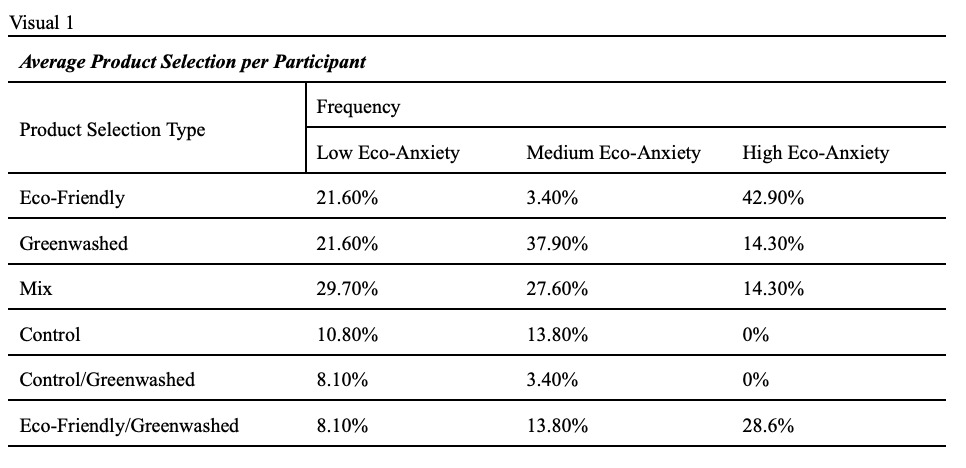
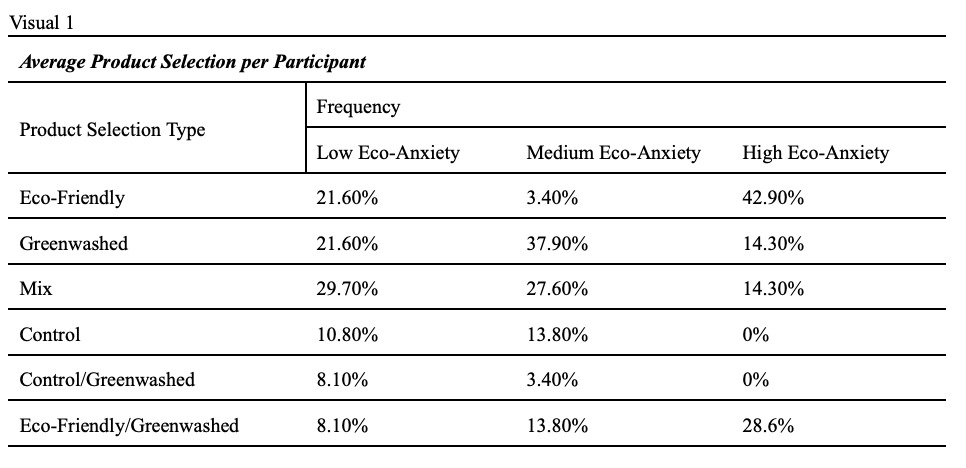
To find what product versions participants were most commonly selecting, they were each given an overall average product version selection type. If participants choose 3 or more of one kind of product version, it was said they picked the majority of that product version. If they picked half one version and half another version it is said they picked half version X/half version Y. If participants selected every product version, it is said they had a mixed selection. Frequencies of product selection frequencies can be seen in Figure 1.
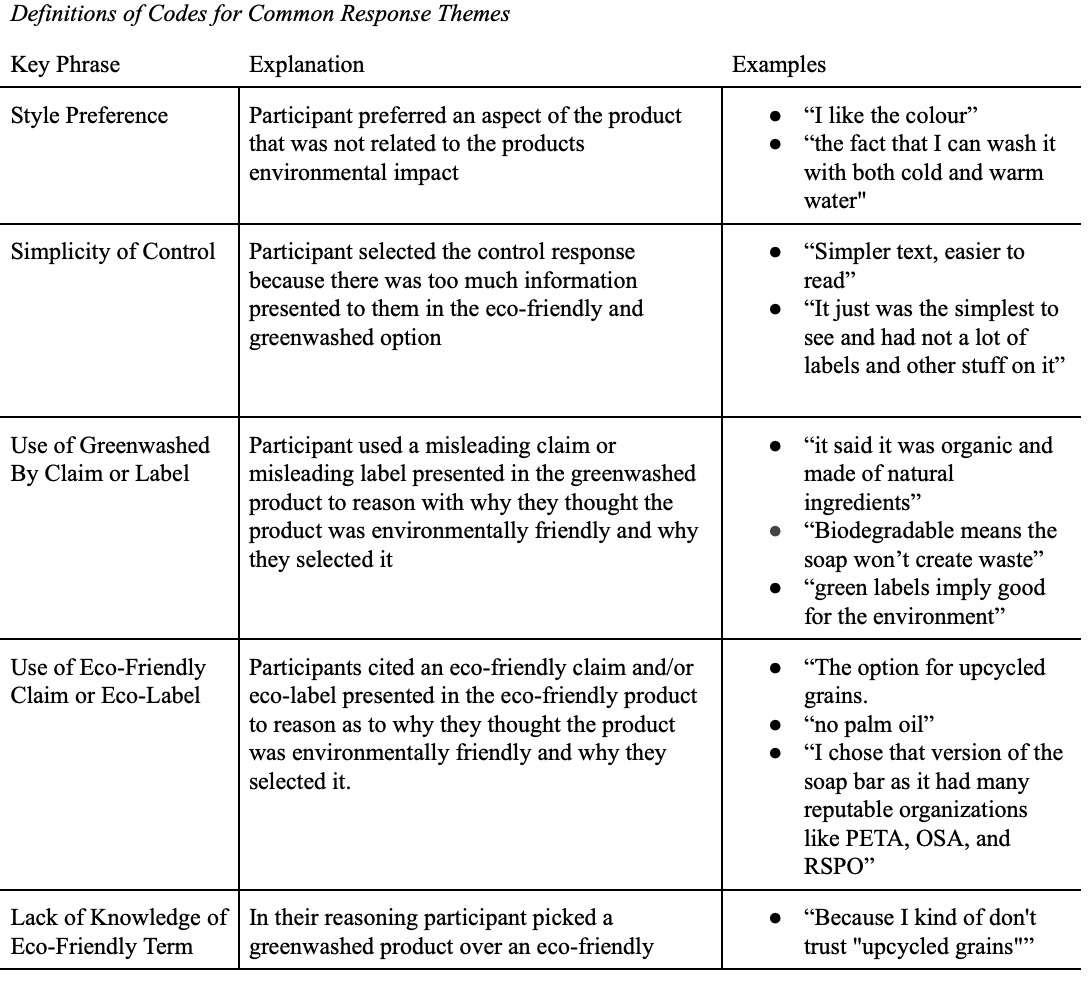
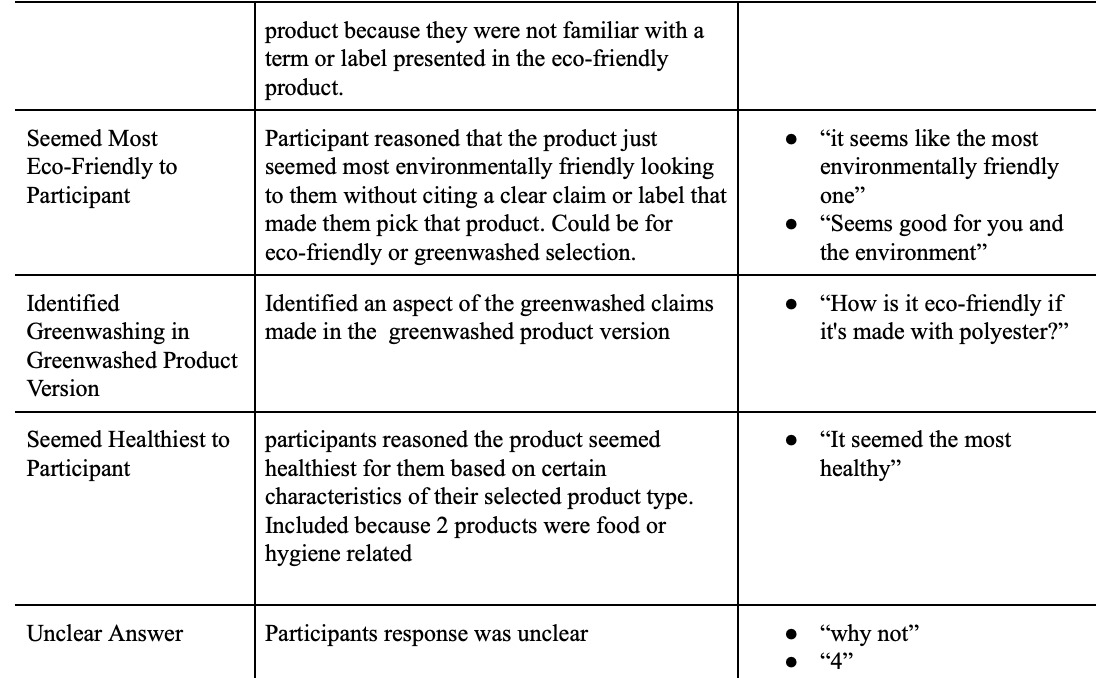
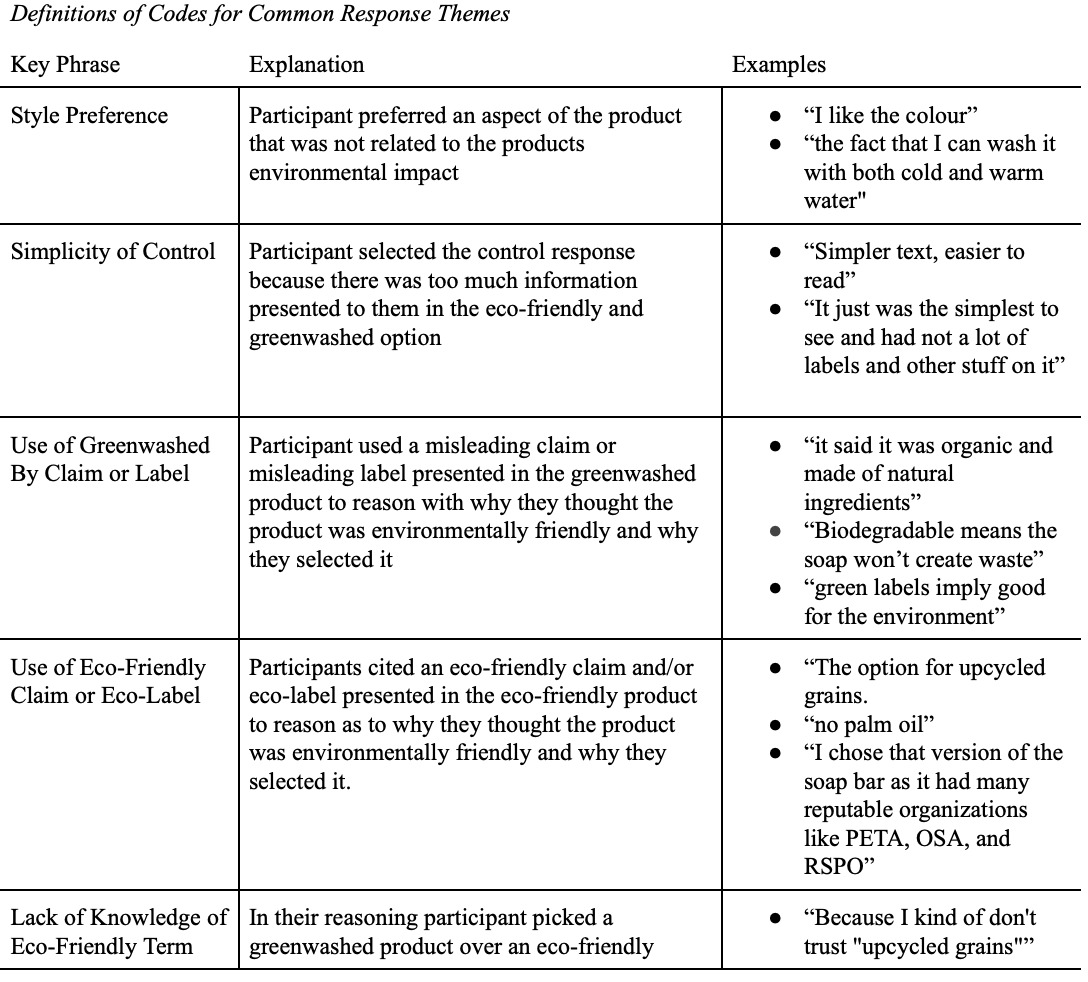
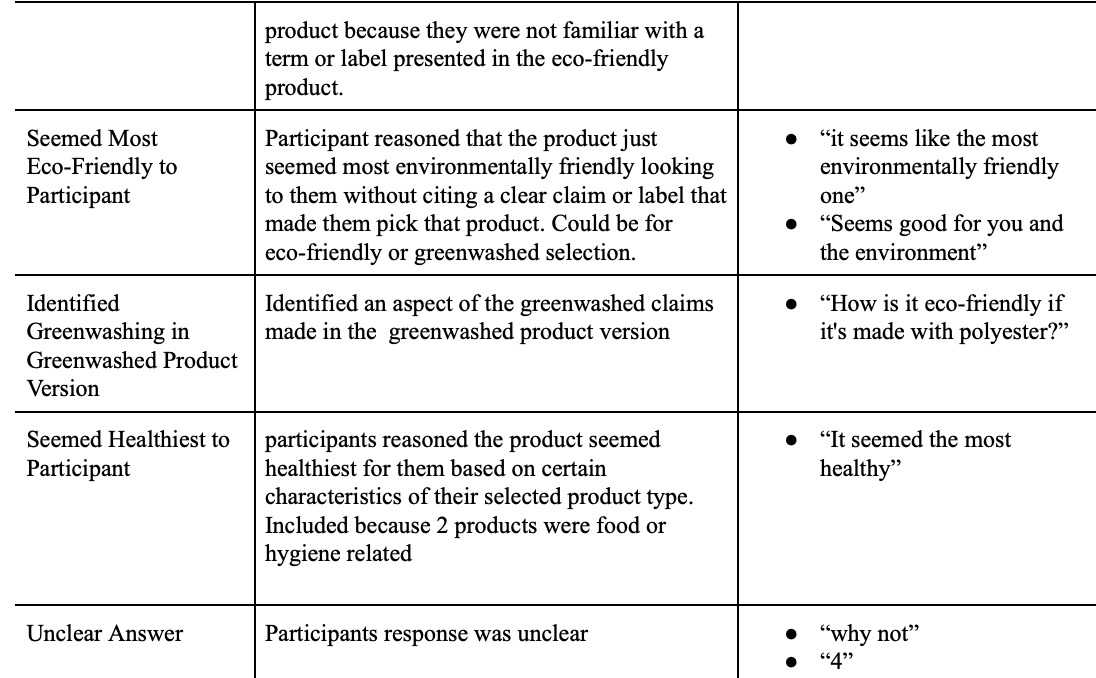
Based on an initial reading of all participant responses, the researcher recorded 11 categories of common response themes that were seen. These response theme categories were then used to code participants’ open ended responses for selections when the researcher read through the responses again. The definitions for each code can be seen below.
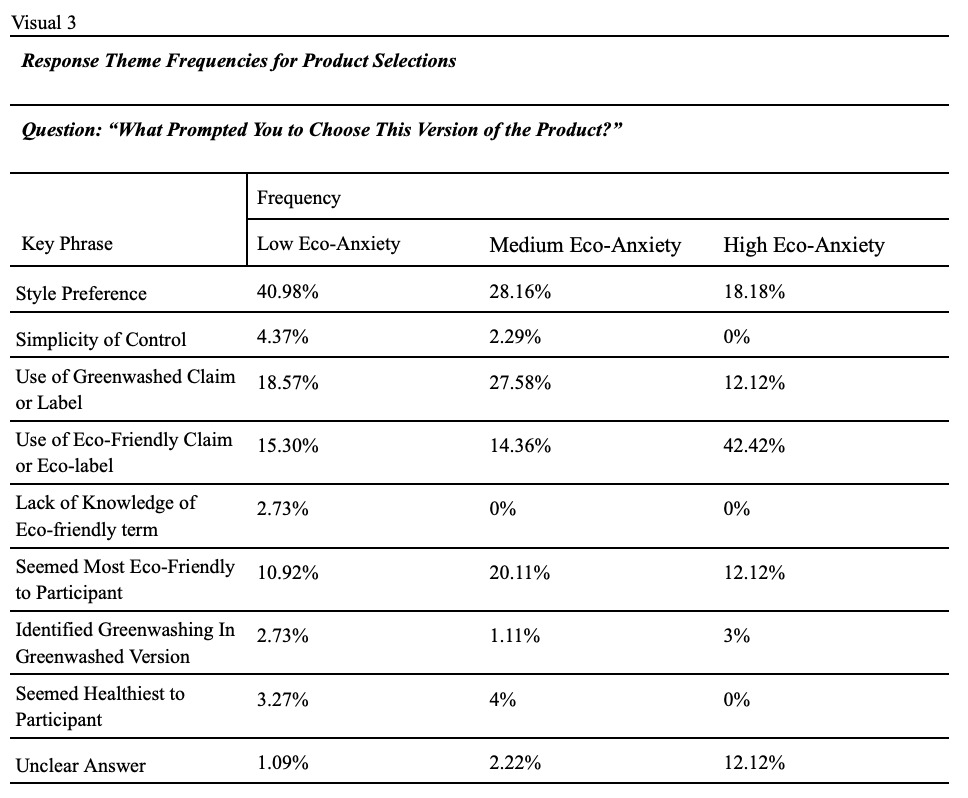
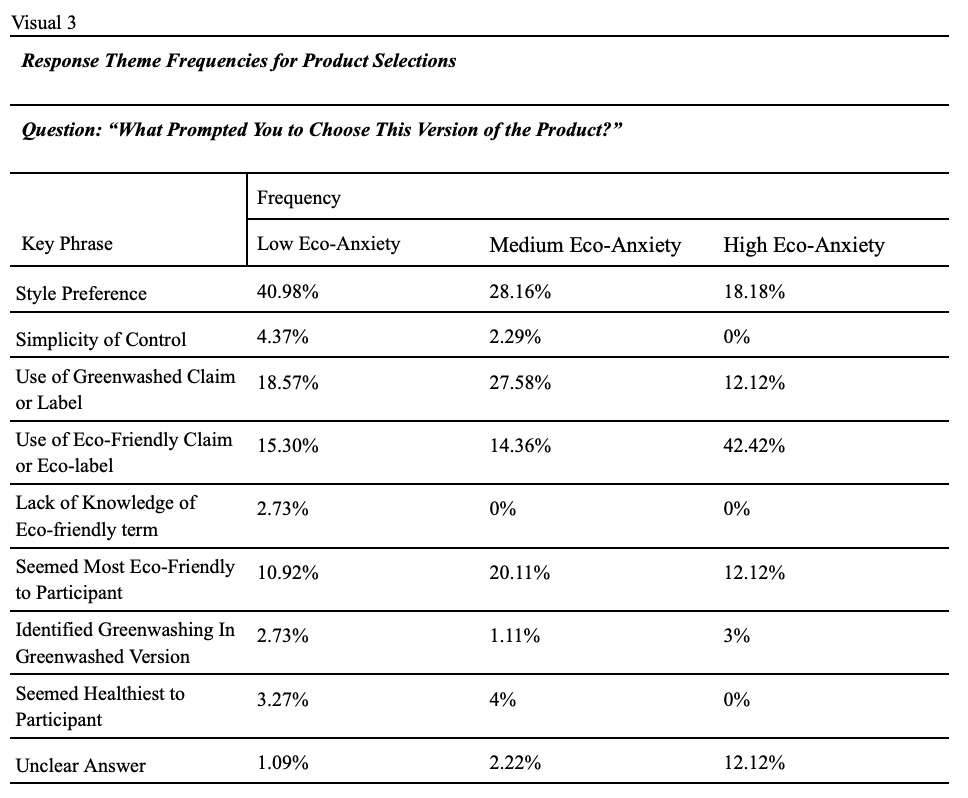
The researcher then found the frequencies of each response theme for each eco-anxiety group, which can be seen in Figure 3.
Discussion
Three distinct product selection patterns appeared within the group of participants with low eco-anxiety scores. The largest majority of participants selected a mix of products, and this can be associated with the most frequent response theme being “Style Preference”, according to Figures 1 and 3. This selection pattern can be associated with participants likely selecting every different product version because of personal preferences rather than a consistent key theme of one product version. Furthermore, there were also notable and equal numbers of participants who selected either majority greenwashed or majority eco-friendly products, according to Figure 1. This can be associated with the close frequencies of response themes of “Use of Greenwashed Claim or Label” and "Use of “Eco-Friendly Claim or Eco-Label”, seen in Figure 3. This pattern represents that there were both notable amounts of participants who could identify products with eco-friendly claims to select their product versions, but there were also notable amounts of participants who could not distinguish the greenwashed claims from the eco-friendly claims, likely causing them to select greenwashed product advertisements over the eco-friendly ones, based on their open ended responses. Considering there were three distinct selection types and a range in abilities to accurately identify eco-friendly claims, this presented no clear evidence that low eco-anxiety had association with a common product version selection or abilities to analyze environmental claims.
In the medium eco-anxiety group, two prominent selection patterns appeared. Of participants who demonstrated an interest in green purchasing intentions by selecting majority products with pro-environmental advertising, the most prominent selection type was majority greenwashed seen in Figure 3. This can be associated with prominent frequencies of “Use of Greenwashed Claim or Label” and “Seemed Most Eco-Friendly to Participant” seen in Figure 3. This showed participants in this group had GPIs and had a notable pattern of identifying greenwashed claims or labels to back their selections, or believed greenwashed product versions looked the most eco-friendly. The next most participants selected a mix of products in reference to Figure 1. This can be associated with the notable response frequency of “Style Preference” shown in Figure 3. These participants highlighted a pattern described with the low eco-anxiety group of selecting products based on personal preferences in the product version rather than a key aspect of one product version. The selection patterns in this group connect with research by both Stanley et. al and Fella and Bausa. The prominent selection pattern of picking products based on personal preferences corresponds with research by Stanley et. al that a heightened level of eco-anxiety in some teens may lead them to not want to make green purchases (2021). On the other hand, the other prominent selection type of participants picking majority greenwashed products connects with Fella and Bausa’s findings that greenwashed advertising can be confusing to consumers and can be hard for them to accurately identify (2024).
In the high eco-anxiety group, due to the small group population, it is not accurate to say individually one product version was selected the majority overall, but most participants had high selections of eco-friendly products as as multiple participants had either majority eco-friendly selections or half eco-friendly half greenwashed selection in reference to Figure 1. Referencing Figure 3, the most frequent response theme was “Use of eco-friendly claim or eco-label”, showing many participants could identify eco-labels or claims that would allow them to select the eco-friendly product versions. Together, this showed a pattern between high levels of eco-anxiety and abilities to accurately identify eco-friendly claims and labels from the to select majority eco-friendly products. These patterns can be associated with Cui et. al’s study that higher levels of environmental knowledge correspond with higher levels of eco-anxiety (2024). This indicates that the participants with high levels of eco-anxiety can have more knowledge on eco-friendly claims and labels which can help them to more accurately identify eco-friendly products.
Limitations
There were several limitations with the researcher’s participant pool. Between the three eco-anxiety, there were not equal numbers or participants within each group, so the groups could not be accurately compared. This limited the ability of the researcher to specifically see how product selections and response themes compared between each group because of eco-anxiety. Additionally the overall survey pool was relatively small, so this limits the generalizability of these results. Recreating this study over a larger population could provide more applicable results.
There were additional limitations with the researcher’s method. Coding posed a limitation to this study as the researcher did not have multiple coders and was only able to code the data once. To decrease bias, the researcher created descriptions for each code to detail components the response had to include to be labeled with that code. However, without a second coder or chance to go through the data, the researcher’s coding could be biased and not completely accurately represent participant responses. Secondly, since the researcher’s eco-anxiety scale modified the original Hogg’s Eco-Anxiety Scale, the researcher can not be certain their modified scale produced the exact same eco-anxiety measurements as the validated scale did. Furthermore, the survey design could also pose a limitation to participants’ true purchasing intentions. The researcher tried to use a neutral design for the survey, limit use of words relating to the environment, and use deception to limit participants’ knowledge of the study, however there was still some wording and design that had environmental themes. This could have prompted participants to feel the need to select the product version with environmental advertising, which comprises the extent of participants selecting product versions based on their own reasoning.
Conclusion
This study was designed to find how teenagers’ levels of environmental anxiety were associated with their product selections when prompted with products with traditional, eco-friendly, and greenwashed advertising. Low levels of eco-anxiety showed no pattern with selection types or abilities to analyze environmental claims. Medium levels of eco-anxiety had two prominent selection types: mix and greenwashed. Of the participants demonstrating GPIs, they showed they could not distinguish eco-friendly claims from greenwashed ones, corresponding with the prominent selection of greenwashed versions. The high eco-anxiety group had frequent selections of eco-friendly product versions. They exhibited abilities to be able to recognize actual eco-friendly claims and labels, suggesting they have substantial knowledge of these claims to be able to identify them.
Though it is unlikely these results are generalizable to a larger population, the results have a few implications. First, the relatively low levels of eco-anxiety among participants suggests teenagers currently may not be as worried about environmental issues as prior research suggests, and this could be continued to be explored to see if eco-anxiety levels are shifting amongst teens from prior research. Secondly, the medium eco-anxiety group helped highlight why greenwashing is an issue. Participants in this group displayed moderate levels of eco-anxiety and many participants showed they wanted to make green purchases by selecting products with pro-environmental advertising, but they lacked the abilities to distinguish the greenwashed advertisements from the eco-friendly ones. Based on their open-ended responses, many participants believed they were selecting eco-friendly products, but in reality they were selecting products that in real life scenarios, would have no pro-environmental attributes. Though the population size of these groups limits the generalizability of their results, many teens in this survey demonstrated they want to consume ethically, but lack the environmental literacy to do so. If this survey was replicated on a larger scale and results were consistent, this could generalize the issue greenwashing poses to the teenage population. Though businesses who utilize greenwashing possess far greater knowledge and resources to contribute environmentally friendly production to growing green consumerism, they resort to greenwashing, shifting unequal distribution of responsibility for environmental harm onto consumers. Many teen consumers lack high enough environmental literacy to accurately identify eco-friendly claims when making purchases, and if they do not have the opportunities to gain environmental literacy, teens trying to take environmental action through consumerism can easily be led to unknowingly purchasing products that perpetuate the environmental issues they are worried about. When these issues are perpetuated, teens continue to be exposed to them contributing to eco-anxiety that can deteriorate their mental health and increase severity of depression and anxiety, which can have significant impacts on their wellbeing (Stanley et al., 2021). With limited regulations on greenwashing, greenwashing is allowed to continue to be an issue that negatively affects teenage consumers.
Overall, this study was able to begin to bridge the gap in research as it was able to illustrate patterns between eco-anxiety levels in teens and their selections when prompted with actual product advertisements; however, implementing this research study over a larger teenage population could have less limiting results, making them more applicable to accurately address the current gap.