
Introduction
Over 96% of collegiate athletes report awareness that sunscreen prevents skin cancer, yet more than half do not use it consistently (Wysong et al., 2012). This gap between knowledge and behavior is not adequately explained by ignorance alone. Sunscreen is among the most universally recommended preventive health products in the United States, yet the marketing language through which sunscreen brands communicate this recommendation has received comparatively little scrutiny for whom it actually includes.
This paper applies Framing Theory (Entman, 1993) to marketing claims across five major sunscreen brands, arguing that the dominant communicative frame is universalist, science-backed, and performance-oriented, and that this frame may systematically omit cosmetic acceptability information relevant to consumers with darker skin tones, within the brands and populations studied. This communicative pattern constitutes what this study terms communicative negligence: a structural practice in which brands assert universal suitability without disclosing formulation properties that may vary by skin tone. When marketing promises fail the skin they claim to serve, protective behavior may be abandoned. It is important at the outset to distinguish the two primary populations examined: survey respondents who self-identified as having darker skin tones, and Black student-athletes recruited for interviews. Skin tone refers to self-reported pigmentation and varies considerably within and across racial and ethnic groups; Black racial identity is a distinct social category that does not map directly onto any specific skin tone. These populations are analyzed separately and the terms are not used interchangeably.
Although individuals with darker skin tones have a lower incidence of UV-associated skin cancers than those with lighter skin tones, melanin provides only partial protection against ultraviolet radiation; it does not eliminate the risks of sunburn, photodamage, or pigmentary changes. The relevant question this paper examines is not whether sunscreen carries equal necessity across all skin tones, but whether cosmetic and communicative barriers are preventing some consumers with darker skin tones from using a product that may benefit them. Existing research documents a substantial sunscreen use gap between Black and White Americans (Calderón et al., 2019; Olagun-Samuel et al., 2025) without fully explaining its communicative roots. This paper addresses that gap through systematic analysis of five sunscreen brands, corroborated by consumer review data, athlete interviews, and existing literature, while acknowledging the exploratory limits of a single-school, convenience-sampled study.
Literature Review
The Function of Marketing Language
In consumer advertising, the words a brand selects to characterize a product construct that product’s identity, define its imagined user, and demarcate who belongs within the brand’s intended community (McCracken, 1986; Stern, 1994). Research on descriptive marketing claims suggests that language functions as a cognitive shortcut: consumers use phrases such as “clinically proven,” “dermatologist-recommended,” and “broad-spectrum protection” as proxies for authority and efficacy rather than independently evaluating the evidence behind them (Petty & Cacioppo, 1986). This behavior reflects a structural reality: a fundamental information asymmetry exists between manufacturers and consumers in the health and beauty industry (Akerlof, 1970). Marketing language thus becomes the primary channel through which formulation information is transmitted, yet it is designed to signal scientific credibility while implying universal suitability regardless of skin type or physiology. The problem, as this study argues, is not that brands misrepresent their products outright but that the frame is structured to make certain questions difficult to raise: a consumer told a product works “for all skin types” has been given limited communicative space to raise a skin-tone-specific cosmetic concern.
In the sunscreen context, this architecture is particularly consequential because cosmetic incompatibilities can discourage use. Cosmetic concerns such as white cast, poor absorption, and greasy texture are fundamentally formulation concerns. These formulation concerns become communication concerns, however, when brands make universalist claims without acknowledging them. A consumer who encounters white cast after purchasing a product marketed as suitable for all skin tones has limited communicative framework within which to attribute that failure to a specific formulation property rather than to the product category as a whole. According to Kreuter and Wray (2003), effective public health communication must be personally relevant to motivate protective action; universalist claims that do not address skin-tone-specific cosmetic barriers may fail this standard for some consumers.
Representational Diversity Versus Functional Inclusion
Researchers distinguish between “representational diversity”, the presence of racially diverse people in brand imagery, and “functional inclusion”, the adaptation of products and communications to address the specific needs of those consumers (Brumbaugh & Grier, 2006). In the sunscreen industry, many brands feature models across a range of skin tones while maintaining virtually identical formulation claims for all of them. Individuals with darker skin tones may become part of the visual rhetoric while the formulation-level concerns most relevant to their cosmetic experience remain unaddressed. Developing equitable formulations and disclosing skin-tone-specific performance data are costly undertakings, so brands may face an incentive to signal inclusiveness without investing in it. The result is what critical communication scholars describe as inclusion by erasure: universalist claims such as “for all skin types” may foreclose rather than invite questions about skin-tone-specific cosmetic performance.
Consumer Trust and the Sunscreen Use Gap
Consumer trust in advertising comprises cognitive trust, evaluation of clinical evidence and ingredient credibility, and affective trust, the consumer’s sense that the brand understands their needs (Chaudhuri & Holbrook, 2001; Johnson & Grayson, 2005). Both are necessary for health-protective behavior. When a consumer purchases a product marketed as suitable for all skin types and experiences cosmetic incompatibility, the marketing promise may be experienced as failing at the point of use. According to Hess, Ganesan, and Klein (2003), such trust violations may generalize to category-level distrust, especially when consumers perceive the failure as structural rather than random. Consumer reviews for Neutrogena Sport Face SPF 70 are consistent with this pattern among some darker-toned reviewers, who cite visible white cast and aesthetic incompatibility, noting that marketing did not disclose these limitations (Rigel et al., 2022).
The sunscreen use gap between Black and White Americans is well documented. Olagun-Samuel et al. (2025) found that adult Black Americans are approximately eight times less likely to report consistent sunscreen use than adult White Americans across two decades of NHANES data, though this disparity reflects multiple factors including access, cultural norms, and communication. Calderón et al. (2019) confirmed this disparity after controlling for demographic and lifestyle covariates. Critically, Fliorent et al. (2023) found that Black and Asian/Pacific Islander consumers received equivalent dermatological education to White consumers yet reported significantly lower sunscreen use rates, suggesting the gap may partly reflect a failure in marketing communication rather than clinical education alone. The available literature thus establishes the scope of the sunscreen use gap and identifies marketing as a contributing factor, while acknowledging that broader structural and healthcare-related factors are also relevant. This study examines the brand claim structure that may contribute to the gap without claiming to explain it fully.
Theoretical Framework
This study relies on two theoretical models operating at different stages of the same process. Framing Theory accounts for message construction; the Health Belief Model explains how that message may produce disengagement rather than engagement.
According to Framing Theory (Entman, 1993), a communicator selects certain aspects of a situation and highlights them to promote within the audience a particular problem definition, causal interpretation, moral evaluation, and treatment recommendation. In sunscreen advertising, the salient frame elements are performance, scientific authority, and universality: “broad-spectrum,” “clinically proven,” and “for all skin types.” What the frame may omit is cosmetic acceptability information relevant to consumers with diverse skin tones, specifically that mineral formulations can produce visible white cast, absorb differently, or present texture incompatibilities. This omission is not the result of explicit discriminatory intent; the evidence in this study indicates structural communicative patterns rather than demonstrated bad faith. In the current analysis, this constitutes communicative negligence: a structural pattern in which brands assert universal suitability without disclosing the cosmetic acceptability limitations most relevant to consumers with darker skin tones. The construct is descriptive rather than legal.
The Health Belief Model (Janz & Becker, 1984; Rosenstock, 1966) proposes that health-protective behavior depends on six constructs: perceived susceptibility, perceived severity, perceived benefits, perceived barriers, cues to action, and self-efficacy. The universalist frame may leave perceived cosmetic barriers unacknowledged and cues to action impersonally framed. After repeated cosmetic product failure, self-efficacy may collapse at the category level. The trust violation framework (Hess et al., 2003) explains why this disengagement may outlast any single brand. Together, Framing Theory identifies how the omission is built into the message, and the Health Belief Model explains how that omission may suppress protective behavior.
Methodology
Brand Claim Analysis
This study analyzed marketing claims from five sunscreen brands selected to represent a range of positioning strategies: three mass-market brands with a primary focus on science and effectiveness (Neutrogena, Coppertone, Blue Lizard), one mass-market brand focused on performance and endurance (Banana Boat), and one brand created specifically for consumers with melanin-rich skin (Black Girl Sunscreen). This selection enables a comparison between brands employing universalist framing and a brand explicitly addressing an underserved demographic. Marketing claims were gathered from product description pages of each brand’s most popular sunscreen for daily athletic use, accessed in August 2025.
A claim was defined as any phrase, slogan, or sentence asserting something about the product’s inclusivity, trust, scientific authority, effectiveness, or credibility. Each product description page was read in full and all phrases meeting this definition were flagged; between five and ten claims per brand were identified, yielding 39 total claims. Each claim was coded into one or more of five inductively constructed categories, trust, performance, inclusivity, scientific authority, and representation, subsequently refined against Entman’s (1993) four frame functions. Multi-coding was applied where claims served multiple categories. This study also distinguished elaborated inclusivity claims from unelaborated ones. Because coding was conducted by a single researcher, each category was defined in writing before coding began, coding decisions were documented with explicit rationale, and each brand’s claims were cross-referenced against independent consumer reviews, journalistic coverage, and legal records. The absence of inter-rater reliability remains a limitation.
Survey Research
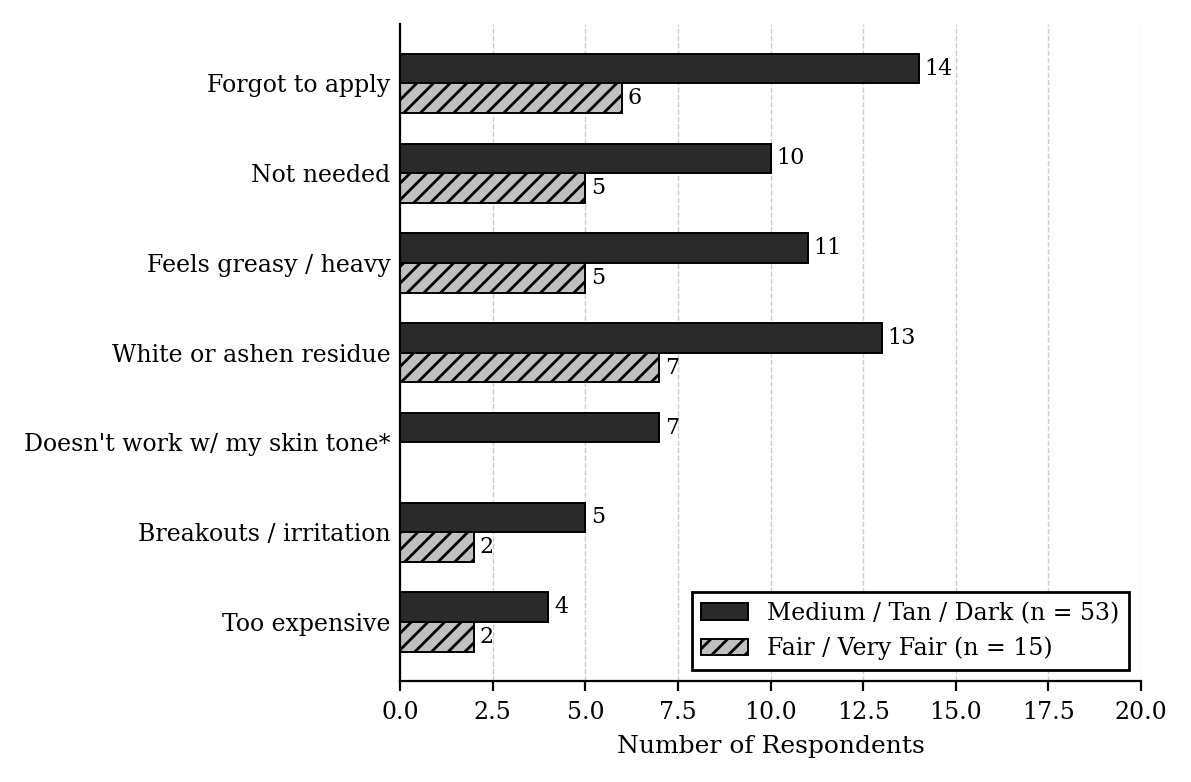
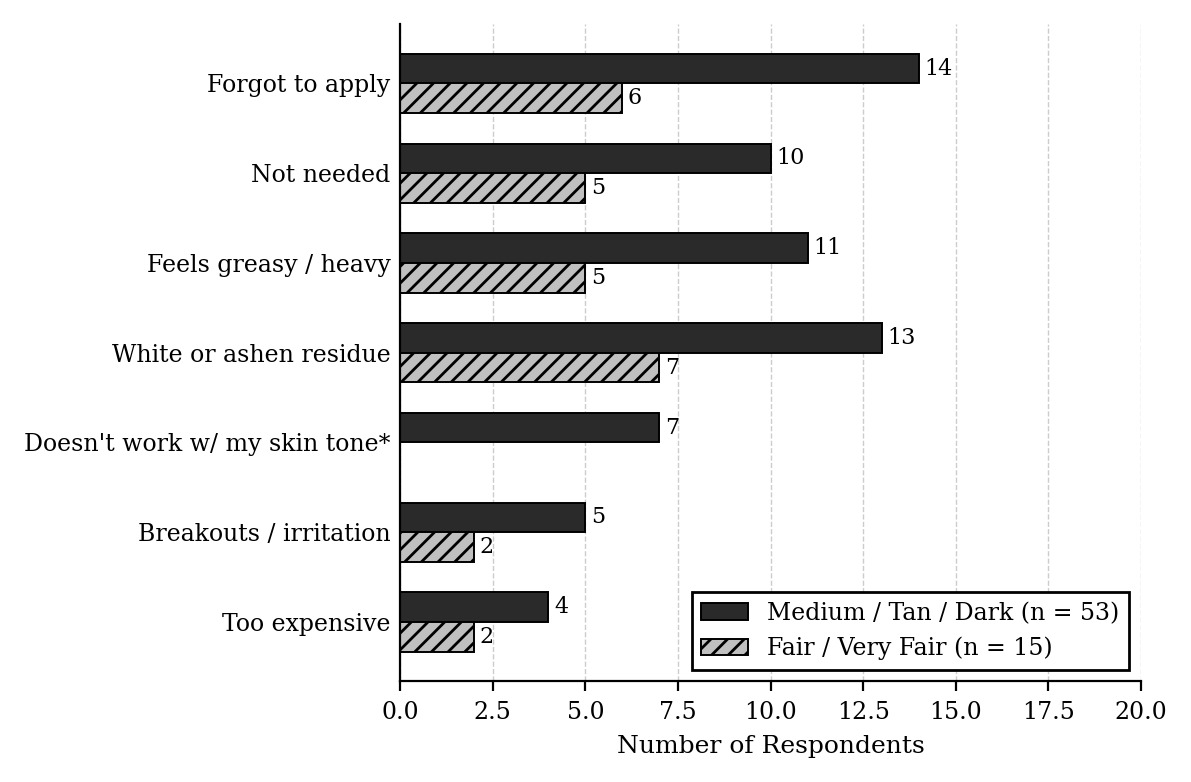
An online survey was distributed to the approximately 900-member student body at Chadwick School in Palos Verdes, California, via email in November 2025. Of 900 students reached, 72 responded (8% response rate). The survey included six response options for skin tone (Very Fair, Fair, Medium, Tan, Dark, and Prefer not to say); the sixth option was included to respect participant privacy and is noted here to correct a discrepancy between the description of a five-point scale in the methodology and the six options appearing in the findings. The Dark skin tone subgroup includes only four respondents (n=4), which severely limits any conclusions about this subgroup specifically. Respondents also indicated sunscreen use frequency on a five-point scale (Never to Daily). Those reporting infrequent or no use selected applicable barriers from a pre-defined list. Two items were identified as formulation indicators: complaints about visible white or ashen residue and about poor skin-tone compatibility. These were cross-tabulated by skin tone using a binary classification of Medium/Tan/Dark (n=53) versus Fair/Very Fair (n=15); this grouping was chosen because these subgroups represent the most meaningful analytical contrast in this sample, and because neither the Dark nor the Very Fair subgroup alone was large enough for meaningful analysis. The “Prefer not to say” group (n=4) was excluded from the binary comparison. A final question assessed willingness to try a hypothetical reformulated sunscreen. This study was approved by the Chadwick School Internal Review Board; all participants provided verbal informed consent.
For the purposes of this study, skin tone refers to participants’ self-reported skin pigmentation rather than their racial or ethnic identity. Participants selected from descriptive categories ranging from Very Fair to Dark. These categories were used to examine differences in reported sunscreen experiences and should not be interpreted as fixed biological or racial classifications. The study recognizes that skin tone varies considerably within and across racial and ethnic populations. Accordingly, the terms “darker-skinned consumers” and “Black athletes” refer to distinct characteristics and populations and are not used interchangeably throughout this paper. The classification system is descriptive rather than a validated clinical measure of pigmentation or ultraviolet sensitivity.
Athlete Interview
Ten Black student-athletes were recruited from the researcher’s athletic network and Shade Equity Initiative contacts at Chadwick School. This sample reflects the racial identity of participants, not a specific skin tone classification; it is possible that participants varied in their individual skin tone within the Black racial category. All participated in outdoor high-UV sports. To mitigate potential confirmation bias, all interviews followed an identical pre-scripted protocol without leading prompts. Probing questions were restricted to clarifying ambiguous phrasing only. The researcher disclosed their dual role as Shade Equity Initiative founder and affirmed that negative, positive, and neutral experiences were equally valid. Four questions were posed verbally in person, with responses recorded in writing, addressing sunscreen use frequency, product failure experience, comprehension of universalist marketing language, and awareness of melanoma disparities by skin tone. Responses were analyzed using inductive thematic coding: first-cycle line-by-line coding followed by second-cycle categorization into four themes. Athletes are identified by number; all provided verbal informed consent.
Limitations
The survey sample (n=72; 8% response rate from a single private school) limits statistical generalizability. The Dark skin tone subgroup (n=4) is too small for reliable subgroup conclusions; all findings from this group are treated as illustrative rather than representative. Both samples are self-selected. All participants came from a private school athletic community in Southern California, limiting transferability across socioeconomic, geographic, and institutional contexts. The athlete interview sample (n=10) was recruited through the researcher’s personal network, creating risk of selection and confirmation bias. Brand claims were coded by a single researcher without inter-rater reliability checks. Skin tone self-classification using a descriptive scale has not been validated against clinical pigmentation measures and may be inconsistently interpreted across participants. This study does not establish causal links between marketing language and health outcomes; all findings are descriptive and exploratory. The reversed sunscreen use pattern, where darker-toned respondents reported more consistent use than lighter-toned ones, is addressed more fully in the Discussion.
Findings
The Dominant Frame: Universalist, Scientific, Performance-Based
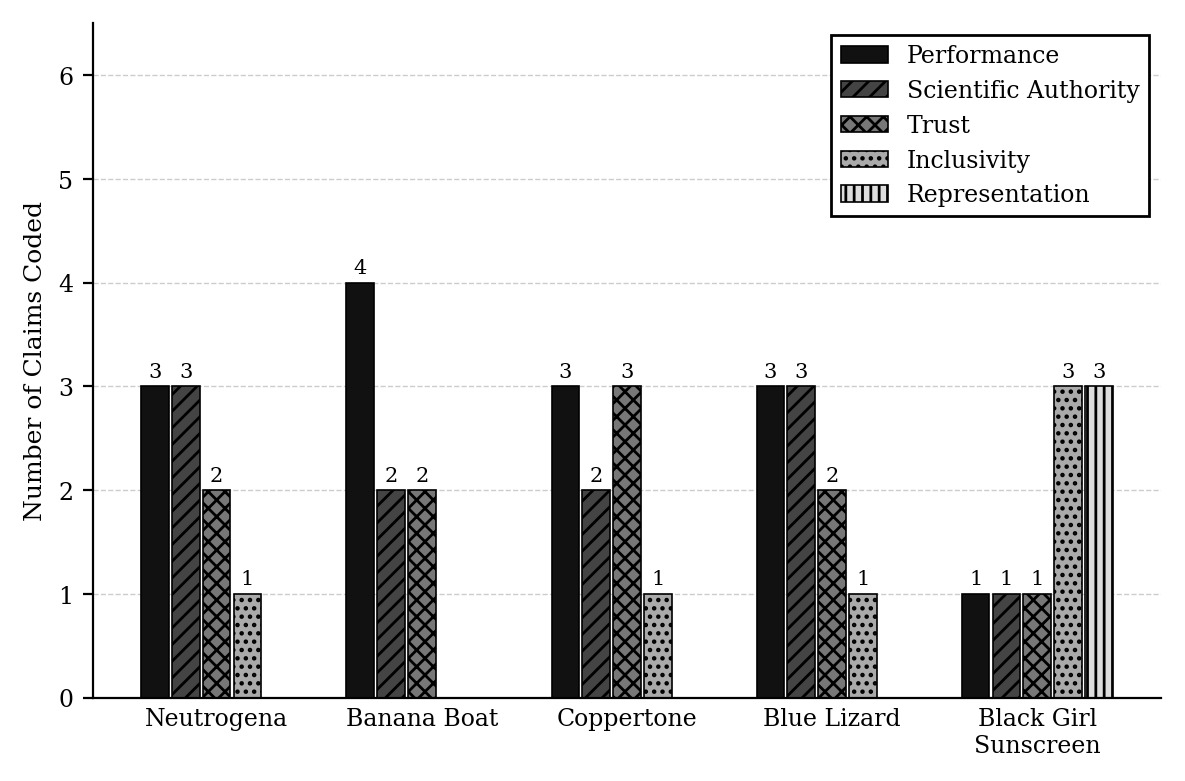
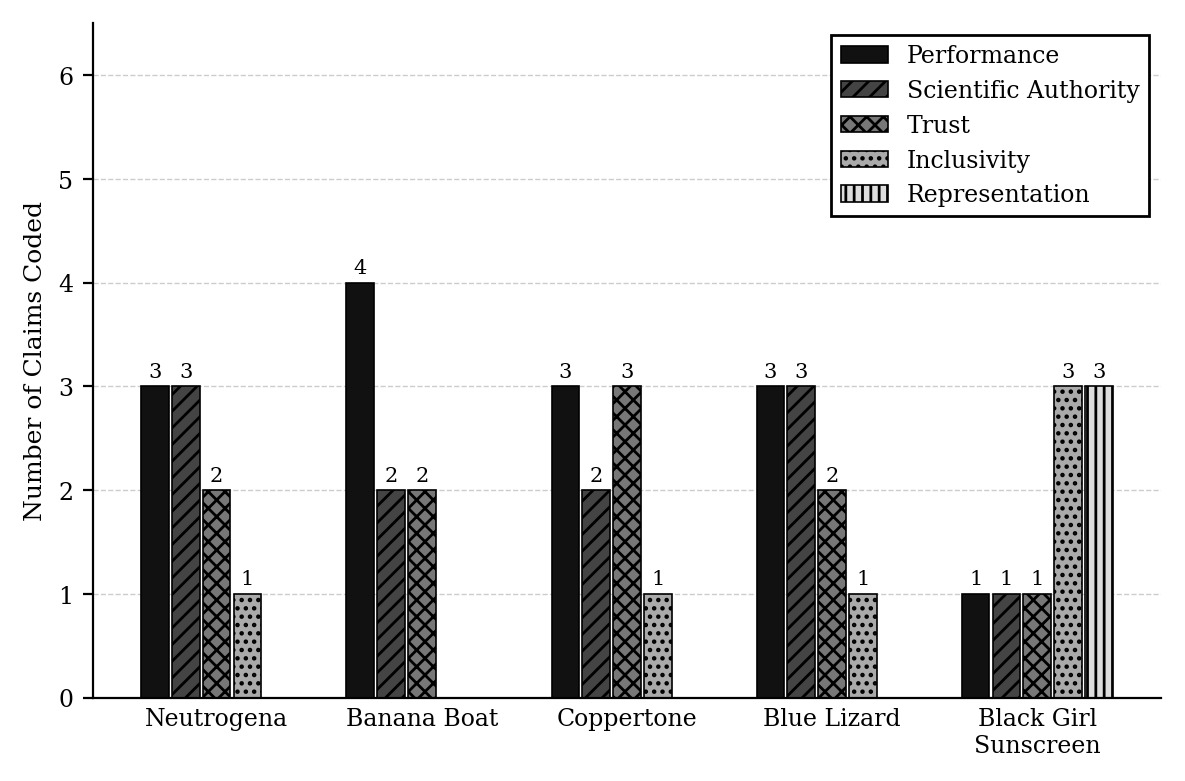
Of 39 coded claims across the five brands examined, performance, scientific authority, and trust dominate the four mass-market brands. Neutrogena combines proprietary science (“Helioplex Technology,” “Dry-Touch Technology absorbs fast”) with performance claims (“no greasy or chalky residue”). Banana Boat emphasizes endurance (“Tested to stay on in 7 real-life conditions,” “Superior endurance versus sweat and water”) alongside scientific authority (“Clinically Proven UVA/UVB Protection”). Coppertone combines performance (“most trusted brand of sunscreen voted by dermatologists”) with scientific claims (“dermatologist, ophthalmologist, and pediatrician tested”). Blue Lizard similarly combines performance (“thousands of tiny mirrors reflecting UV rays”) with trust (“trusted by dermatologists for over 20 years”). Inclusivity and representation claims across these four brands are brief and unelaborated: Neutrogena offers “for all skin types and tones,” Coppertone “every tone,” Blue Lizard “no white cast.” None explains the cosmetic mechanism behind its inclusivity claim or addresses skin-tone-specific product concerns explicitly. Applying Entman’s (1993) framework, these claims construct a consistent problem definition (UV exposure is a universal threat) and treatment recommendation (the product resolves it for everyone), while omitting the causal interpretation that cosmetic acceptability may vary by skin tone within the studied brands. Black Girl Sunscreen is the sole exception among the five brands examined: “SPF Made for Melanin Rich Skin” and “made with melanated skin in mind” position inclusivity and representation as organizing principles rather than supplementary language. (See Figure 1.)
Brand-by-Brand Evidence
The Coppertone “Every Tone” claim applies only to one product line and does not extend to its flagship Sport or Pure and Simple lines. Coppertone paid $2.25 million in a 2021 false-advertising settlement related to one product line (Class Actions, 2021); this settlement should not be generalized to all Coppertone products or to the sector as a whole. Consumer reviews of Coppertone mineral products consistently document white cast on darker skin tones, representing a contradicting case for that specific product line’s claim. Blue Lizard’s “no white cast” claim is technically defensible (its Sheer line uses a zinc oxide dispersion that reduces white cast), but the brand does not explicitly connect this feature to consumers with darker skin tones, a mixed case. Neutrogena’s “all skin types and tones” claim is contradicted by consumer reviews documenting white cast complaints among darker-toned users, and is consistent with Fliorent et al.'s (2023) finding that equivalent clinical education does not produce equivalent sunscreen use across racial groups, suggesting a marketing rather than knowledge contribution to the gap. In contrast, Black Girl Sunscreen’s claim that it is “made by women of color for people of color, because we get sunburned too” is supported by convergent evidence across consumer platforms (Moody, 2023) and is consistent with Evans, Olaleye, and Cacciatore’s (2025) finding that Black consumers respond significantly more to hyperpigmentation-focused messaging. When representation claims are paired with formulation investment, consumer evidence for the brands studied suggests trust and cosmetic performance may align.
Survey Findings
Consistent Sunscreen Use by Skin Tone Group
Note. Consistent use defined as daily or most-days application. This sample reverses the national trend (Calderón et al., 2019; Olagun-Samuel et al., 2025). This finding is discussed in relation to the study’s central argument in the Discussion section.
Self-Reported Barriers to Sunscreen Use by Skin Tone Group
Note. Multiple barrier selections permitted. *“Doesn’t work well with my skin tone” was selected exclusively by Medium/Tan/Dark respondents (n=7, 100% of selectors). This pattern is not statistically significant (Fisher exact p≈0.334) and is an exploratory observation. Skin tone groupings reflect self-reported pigmentation, not racial identity.
Athlete Interview Findings
Interviews with ten Black student-athletes revealed four common themes. These findings reflect the experiences of this specific recruited group and should not be generalized to all Black athletes or all consumers with darker skin tones. First, formulation failure was the most common reported barrier: Athlete 1 reported struggling “to find sunscreen that works well on my skin tone,” Athlete 4 described products leaving skin “gray or chalky,” and Athlete 9 found that performance-oriented marketing consistently overpromises. Second, athletes described representational exclusion as a distinct barrier: Athlete 3 noted that marketing rarely “features athletes who don’t reflect the diversity of sports,” and Athlete 8 observed that advertising is situated in beach contexts rather than training environments where Black athletes are predominantly active. Third, athletes identified persistent misinformation: Athlete 2 cited the myth that “Black people don’t need sunscreen,” and Athlete 6 traced this to her upbringing: “Grew up hearing that darker skin provides enough protection from the sun.” While melanin does provide some natural UV protection, this protection is incomplete and does not eliminate the benefits of sunscreen use. Fourth, athletes proposed solutions aligned with functional inclusion: Athlete 7 called for Black athletes and consumers to be involved in product development, and Athlete 10 identified “better representation, more inclusive product testing, and stronger education” as continuing unmet needs.
Discussion
Communicative Negligence: What the Frame Conceals
The findings from the five brands examined are consistent with the concept of communicative negligence. Among the brands studied, inclusivity claims such as “Every Tone,” “for all skin types and tones,” and “no white cast” do not elaborate on the formulation properties most relevant to cosmetic acceptability across skin tones. Cosmetic concerns such as white cast, poor absorption, and texture incompatibility are product-level issues, but they become communication issues when brands make universalist claims without acknowledging them. This distinction is central to communicative negligence as a descriptive construct: it is not that the products are biologically less effective on darker skin, nor that brands act with discriminatory intent, but that the marketing language may foreclose consumer inquiry about cosmetic acceptability. The evidence in this study identifies structural communicative patterns across the studied brands, not demonstrated bad faith.
This pattern is notable for three reasons within the studied sample. First, the Coppertone false-advertising settlement for one product line suggests that a discrepancy between claim and cosmetic experience was recognized and litigated for that specific product; this evidence cannot be extended to all Coppertone products or other brands. Second, Blue Lizard’s “no white cast” claim is technically defensible but does not address the consumer with darker skin tone for whom this distinction is most relevant. Third, Black Girl Sunscreen indicates that pairing representation claims with formulation investment may produce more favorable consumer evidence. Communicative negligence is therefore not inherent to the category but a pattern observable in four of five brands examined in this study.
Engaging the Contradictory Finding
One finding that complicates the central argument deserves direct engagement: darker-toned respondents in this sample reported greater consistent sunscreen use than lighter-toned respondents (43.4% vs. 13.3%), which is the reverse of national trends. This finding cannot be dismissed as merely an exception. Several interpretations are possible. Most plausibly, the Shade Equity Initiative at Chadwick School may have elevated sunscreen awareness among darker-toned students specifically, given its focus on sun safety and equity. This would mean the sample is not representative of darker-skinned consumers generally, and that the study captures a population that has already been reached by targeted communication, precisely the kind of intervention the paper advocates. Alternatively, the finding may reflect the self-selection of more health-conscious darker-toned students into survey participation. Either interpretation is consistent with the paper’s argument: if targeted, culturally relevant communication produces higher sunscreen use among darker-toned students, this is evidence for the value of the communicative approach this paper recommends, not against it. What the finding does demonstrate is that the paper’s central claim cannot be that darker-skinned consumers categorically avoid sunscreen; rather, the claim is that universalist marketing creates communicative barriers that, absent targeted intervention, may contribute to lower use rates in broader populations.
The Trust-Behavior Chain: A Public Health Question
The survey and interview data are consistent with the trust violation mechanism described by Hess, Ganesan, and Klein (2003): when a universalist product claim is followed by cosmetically unacceptable experience, consumers may conclude that sunscreen does not work for their skin rather than that the marketing did not address their specific needs. All seven respondents who identified skin-tone incompatibility as a barrier came from the Medium/Tan/Dark group; this non-significant exploratory finding (Fisher exact p≈0.334) is consistent with Fliorent et al.'s (2023) finding that the sunscreen use gap may reflect a communicative and cosmetic barrier. Olagun-Samuel et al. (2025) document the population-level pattern: a persistent sunscreen use gap between Black and White Americans across two decades of NHANES data. This study does not establish that marketing language is the primary or sole cause of this gap, nor does it link marketing to melanoma outcomes; broader structural factors including access to care, clinical recognition, and cultural norms are also relevant. The communicative patterns identified here represent one possible contributing factor that warrants further investigation.
Implications for Health Communication Practice
Closing the sunscreen use gap may require language interventions alongside reformulation. Brands could consider elaborating inclusivity claims by naming the cosmetic barriers their formulations address, white cast, absorption rate, blending across skin tones, and by explicitly identifying consumers with diverse skin tones as intended audiences. The convergent consumer evidence for Black Girl Sunscreen among the brands studied suggests this communicative approach is achievable. For public health communicators and dermatological organizations, barrier-specific, skin-tone-tailored messaging may be more effective than general awareness campaigns for some populations. Future research should directly test whether elaborated skin-tone-specific marketing claims produce measurable increases in cosmetic acceptability and sustained sunscreen use, and whether the patterns identified here appear in other brand categories or other national markets.
Global Justice and Health Equity
The findings of this study also raise important questions concerning global justice and health equity. Although the research focuses on sunscreen marketing and student-athletes in the United States, the concept of communicative negligence has broader implications for understanding how consumer health products and preventive health messages may reproduce structural inequalities. Global justice requires attention not only to the availability of health-related products but also to whether these products and their accompanying communications adequately address the diverse needs of the populations they are intended to serve. When corporations employ universal claims without sufficiently considering variations in skin tone, cultural experiences, and consumer needs, they risk reinforcing patterns of exclusion. This raises broader questions about representation, corporate accountability, and equitable participation in product development. The study therefore contributes to discussions of global justice by identifying how ostensibly inclusive marketing practices may obscure unequal consumer experiences within the brands and populations studied. Further comparative research across countries and populations would be necessary to determine whether these patterns extend beyond the United States.
Conclusion
This study applied Framing Theory (Entman, 1993) to marketing claims of five sunscreen brands, finding that the dominant frame, universalist, science-backed, and performance-driven, may omit cosmetic acceptability information relevant to consumers with darker skin tones within the brands and populations studied. Four of five mass-market brands examined employed unelaborated inclusivity claims that do not disclose formulation properties relevant to skin-tone compatibility; only Black Girl Sunscreen paired representation claims with formulation investment, and its consumer evidence is correspondingly more favorable. Survey data provide a preliminary, non-significant observation that skin-tone compatibility may be a more salient cosmetic barrier for some darker-toned respondents, and athlete interviews corroborate patterns of cosmetic product failure, representational exclusion, and persistent misinformation as compounding barriers. It is important to note throughout that skin tone and racial identity are distinct categories; the two primary populations examined, darker-toned survey respondents and Black student-athletes, reflect different characteristics and cannot be treated as interchangeable.
The concept of communicative negligence describes a structural communicative pattern, not a legal finding and not a claim of discriminatory intent, in which brands assert universal suitability without disclosing cosmetic acceptability information relevant to consumers with diverse skin tones. This study’s contribution is exploratory: it identifies a gap between what brands claim and what some consumers identify as the cosmetic information they need. Whether closing that gap would meaningfully increase sunscreen use among consumers with darker skin tones, and whether such an increase would affect health outcomes, are questions requiring prospectively designed experimental research with representative, adequately powered samples. Brands and public health communicators seeking to reach consumers with diverse skin tones more effectively should consider elaborating inclusivity claims with specific formulation disclosures. The concept of communicative negligence may also contribute to global justice scholarship by raising questions about corporate accountability and equitable health communication across populations with diverse skin tones worldwide.
Conflicts of Interest Statement
The author declares no conflicts of interest.