Introduction
Chinese Americans often feel caught between two worlds—the American mainstream and their native Chinese heritage. Which community do they belong to? How do they navigate two competing cultures? While Chinese Americans have seen socioeconomic success, a Chinese immigrant’s place in the US is constantly being threatened by a long history of systematic exclusion and its xenophobic legacies, which motivates a framework to properly capture this complex and contradictory experience. Thus, this paper explores assimilation models that best explain Chinese Americans’ experience of belonging and both their internalized and external encounters with xenophobia.
Literature Review
The theoretical framework of assimilation has evolved over time and is still debated. Drouhot (2024) presents the definition of assimilation as a two-way process of mutual convergence of culture between immigrant and native populations. According to this framework, assimilation eventually erases the importance of ethnic origin and other cultural differences for immigrant families, increases socioeconomic parity and social interactions between populations and makes the dominant culture more accepting of immigrant-specific practices. Almasoud (2024) counters that assimilation is more harmful and one-sided, as it changes an immigrant’s morality and ethics by making them internalize harmful power structures, such as western gender roles and racism towards other groups. Statham and Foner (2024) identify the assumption made in Almasoud (2024) and the common understanding of assimilation in general: integration into dominant culture and racism is a zero-sum game. In other words, more assimilation leads to less racism, and vice-versa. Instead, Statham and Foner (2024) highlight other frameworks of assimilation and present counter-evidence to suggest that experiencing racism and becoming assimilated are distinct social processes, able to co-exist in a community. Assimilation across generations has been modeled differently, as well. Linear assimilation describes a stable, generational transition into the demographic, economic and cultural mainstream, whereas segmented assimilation implies that assimilation can be rejected or class status can decrease if later generations are socioeconomically disadvantaged, meaning that the immigrant experience is “bumpy” and not guaranteed to converge to the mainstream (Greenman & Xie, 2008). With many competing theoretical foundations of assimilation, the question remains: which model accurately reflects Chinese American experiences?
To answer this question, the history of Chinese immigration must be briefly examined. Chen and Xie (2024) argue that the Chinese Exclusion Act of 1882 prevented economic integration of Chinese immigrants, and that institutional discrimination has an effect on assimilation. The obstacles posed by discrimination caused Asians to adopt Americanized names, increase their English proficiency and encourage assimilation in the next generation (Chen & Xie, 2024). These assimilation pressures can be traced back to the Chinese Exclusion Act (Tran, 2024). The framing of Chinese Americans as racially inferior and unable to assimilate into white culture is an infamous example of xenophobia, defined as the fear of anything strange, odd or unknown (Adnan et al., 2023). Similarly, Yeung (2023) argues that during this exclusion period, Chinatown was the traditional choice to reside in for Chinese Americans, viewed by white non-immigrants as “slums” full of unassimilated foreigners. However, with the Immigration Law of 1965, Ma (2023) argues that Chinese Americans’ socioeconomic status improved and white culture became more tolerant. Tran (2024) claims that over time, the Chinese American stereotype has flipped, as education and upwards mobility transformed Asians from undesirable to a high-achieving racial minority. Yeung (2023) agrees that the proportion of Chinese Americans in Chinatown is declining, as more are integrating into suburban areas. This rapid upwards mobility has created the “model minority” stereotype (Lee & Kye, 2016), which frames Asian Americans as highly successful and obscures the racism and discrimination that Asian Americans still experience. Hackl (2022) argues that these tropes designating what constitutes a “good immigrant” reinforce “divide and rule politics”, where the dominant class holds control over both internal and external outsiders via conditional inclusion.
Lee & Kye (2016) argue that the literature should move away from the racialization-assimilation binary. Tran (2024) agrees that when racism and assimilation are seen as zero-sum, Asians are perceived to be “honorary whites” based on their socioeconomic success. Within the community, Kim (2014) furthers that “acting white” is a source of pride, leading many Asian Americans to inferiorize their own community in order to present as assimilated and receive acceptance. Statham and Foner (2024) observe further that only 60% of Asian Americans see themselves as people of color, meaning that assimilation into white culture has a substantial effect on how Asian Americans define themselves. Therefore, the assimilation framework that Statham and Foner (2024) propose likely applies best to Chinese Americans, as they have experienced social and economic upwards mobility as well as racism within and outside the Chinese community. While the literature disagrees on whether or not experiences of xenophobia decrease with assimilation, the cited references agree that the legacy of historic xenophobia pressures Chinese Americans to adopt white, upper class culture and pass as the “model minority”. While existing literature has traced assimilation throughout the history of Chinese people in America, the field has not yet answered how a legacy of exclusion impacts assimilation across immigration generations.
In order to determine the best assimilation framework, one must examine how assimilation into white culture changes the way Chinese Americans balance mainstream and Asian American culture. Group consciousness, or linked fate, is the awareness that events that happen to one member of a community affect one’s own life. Michael (2024), analyzing the campaign messaging of Asian American political candidates, argues that linked fate is strongest in the first generation, then weakens as assimilation into American society occurs through later generations. Trinh and Vu (2025) complicate Michael (2024)’s claim, finding that internal acculturation led to more linked fate, as a strong Vietnamese identity led to less tolerance for COVID-19 hate targeted at Chinese communities. On the other hand, higher external acculturation, like speaking the Vietnamese language, correlated with more tolerance, leading the authors to propose that external markers of identity leads to less linked fate between communities (Trinh & Vu, 2025). Group consciousness is also affected by external pressures to assimilate. Asian American youth still are uncomfortable being labeled as “Fresh Off the Boat” (FOB), or recently immigrated (Kim, 2014). Additionally, Kim (2014) cites qualitative evidence that second and third generation Asian Americans cannot connect with recently immigrated Asians, likely because Asian Americans feel unsafe about their own Asian identities. Evidence from The Asian American Foundation (2023) agrees, as the survey reports that 1 in 2 Asian Americans feel unsafe about their identity. This alienation from the first generation indicates that although racism may not decrease with assimilation, the Asian identity may be undermined by assimilative pressures in the second- and higher-generations, agreeing with Michael (2024)’s claim that group consciousness weakens in later immigrant generations. On the other hand, Hsieh (2021) finds evidence from a survey of 30 Chinese Americans that the rejection of Chinese culture may not be an inevitability, as the second-generation immigrants in the sample put in active effort to maintain and connect with Chinese traditions, family and culture. The choice between rejecting and embracing Chinese or Asian cultural identity seems to differ across immigrant generations, informing our use of immigrant generation as a key variable in our study. Thus, variables that measure xenophobic experiences, linked fate, and alienation from native culture will be central to studying the relationship between assimilation and connection to the wider Asian American community.
Wang (2024) outlines the various strategies that Chinese Americans may use in response to conflict over belonging in Chinese and American culture. The author cites Berry (1997), who proposed acculturation theory, stating that acculturation can manifest in four forms: integration, assimilation, separation and marginalization. Wang (2024) continues that Chinese Americans could maintain cultural identity while integrating into American culture (integration), reject Chinese culture in favor of mainstream American culture (assimilation), avoid adopting American culture (separation) or fail to maintain a connection to Chinese culture and adopt American culture (marginalization). Integration is closely related to cultural hybridization, a strategy to navigate bicultural identities that involves the combination of the dominant and marginalized cultures (Bhandari, 2022). Hsieh (2021) finds evidence that supports the hybridization path, arguing that the Chinese American identity can be a source of courage and perseverance, embracing the two cultures while favoring none. On the other hand, Min (2002) argues that Asians will struggle to be accepted and create identity in America, regardless of generational status, unable to let go of a perpetual foreigner status. The author identifies a phenomenon called “authenticity dilemna”: the state of not being a real American nor a real Asian. Hsieh (2021) agrees, finding that in a sample of 30 Chinese Americans, second-generation immigrants may feel an ambiguous sense of belonging between American and Chinese communities.
The existing gap in knowledge is closely examining and comparing the differences in acculturation strategy between immigrant generations, informing the direction of our study. This study presents an analysis of how Chinese Americans either assimilate, hybridize, marginalize or separate, how the strategy differs among immigrant generations and explores the potential factors that may lead to differences in belonging and way of acculturation.
Two key topics emerge as most important in this field of study. First: the debate over how xenophobia and assimilation are related. There is an emerging consensus that racism and assimilation are not zero sum, as Chinese Americans experience perpetual foreigner stereotypes and have internalized “FOB-ism”. Second is the debate over how Chinese Americans engage in the Asian American community. The literature surrounding the history of Chinese American exclusion argues that its legacy has created pressures to assimilate into white culture, often entailing the rejection of Chinese community, family and culture that affects individual’s perceived linked fate with other Asian American communities. However, prior research has shown that assimilation is not the only option, as finding a sense of self and belonging in being both Chinese and American equally can be a source of empowerment and resolve conflict over cultural identity. There is a general consensus, however, that immigrant generation may play a role in the choice to embrace Chinese and American culture or assimilate into the mainstream. There remains a lack of analysis for 3rd and higher immigrant generations, which this paper aims to fill. In order to paint a fuller and more nuanced picture of the Chinese American experience with identity and belonging, this study will analyze experiences of xenophobia, cultural hybridity, and sense of belonging in American society between immigrant generations.
Methodology
The dataset used is the Pew Research Survey of Asian Americans, which covered topics such as racial and ethnic identity, policy priorities, belonging in America, and immigrant experiences (Pew Research Center, 2023). Responses were collected from July 5, 2022 to Jan. 27, 2023. The survey sampled US adults who self-identify as Asian, including mixed race. The whole dataset oversamples Chinese populations, so once Chinese Americans are isolated, 848 individuals remain. Respondents were drawn from a random national sample of residential mailing addresses, which included 50 states and the District of Columbia, so the dataset ensures representation of diverse US regions. Both traditional and simplified Chinese options were provided, making the survey available to a diverse group of Chinese Americans and reducing response bias. Because of this accessibility, varying levels of assimilation into American society should be well-represented and random in the dataset.
Assimilation is defined as the convergence of culture between immigrant and native populations, where racism and feelings of belonging are not mutually exclusive (Drouhot, 2024; Statham & Foner, 2024). Assimilation is typically measured with country of birth, language proficiency, and time spent within America (Greenman & Xie, 2008), leaving personal dimensions of assimilation as unexplored, namely self-identification with the dominant group. Thus, we measure perceived belonging with an American identity. Responses to, “Overall, do you think of yourself as a typical American or very different from the typical American?” were analyzed. Response options are “typical American”, “very different from typical Americans”, or no response. Belonging, which cannot be objectively quantified, is instead calculated in a relative manner: those who view themselves as typical Americans feel more belonging than those who stated the opposite. 41% of Chinese American respondents self-identified as a typical American, while 55% stated that they perceive themselves as very different from typical Americans, and 4% did not respond.
Since cultural hybridity is difficult to capture, we use linked fate, a sense that anything that affects one member of a group impacts everyone in the group, to quantify the result of internal and external acculturation. Thus, Asian American linked fate in the Chinese American community was analyzed with responses to: “To what extent do you feel that what happens to Asians in the U.S. overall affects what happens in your own life?” A higher relative feeling of empathy and connection to other Asian Americans should be approximated to a higher level of linked fate. Response options include “a lot”, “some”, “not much”, and “not at all.” 18% of respondents said “a lot”, 52% said “some”, 23% said “not much”, 6% said “not at all”, and 1% did not respond.
Xenophobia is defined as “the fear of anything viewed as being odd, fear of the strange, or unknown such as an intense dislike of practices, and people having an outsider status.” They express mistrust, avoid interacting with and blame perceived outsiders for local issues, treat them differently such as by being hostile to them, and treat them as dangerous without having any proof (Adnan et al., 2023). Xenophobia, specifically manifesting as bias against non-English and foreign speakers and cultures, was measured with agreement with the statement: “You have been criticized for speaking a language other than English in public // Please think about how strangers in the U.S. have treated you in your day-to-day encounters. Have each of the following things ever happened to you in the U.S.?” 23% of respondents said yes, they have experienced this kind of criticism, 75% said no, and 2% did not answer.
Immigration generation is defined as the point in time when a family immigrated to a country. The survey has three response options: first, second and third or higher. The Pew Research Survey finds the generation by combining data on the parents’ and respondents’ birthplace. For example, if the respondent and the parents were born in the US, they would be a 3rd or higher generation immigrant. Three people have an unknown immigrant generation and five people did not respond. An unknown immigrant generation cannot be used to analyze the individual’s background, so we excluded these data points. 68% of the sample are first-generation Chinese immigrants, 26% are second-generation Chinese Americans, and 7% are third or higher generation immigrants after cleaning the data. No outliers were found because generation is categorical.
Results
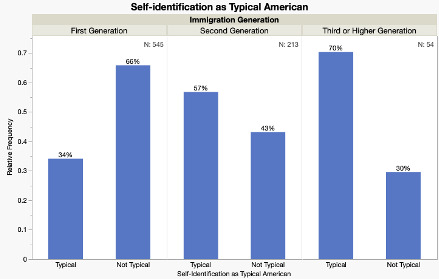
The higher the immigrant generation an individual belongs to, the more likely they are to feel like they conform to American society. In order to measure assimilation into American society, the results of the question, “Do you think of yourself as a typical American or very different from a typical American?” were analyzed. 28 respondents who did not answer were excluded, which is around 3.4% of the sample. Of second-generation immigrants, 57% said they think they are typical Americans. Among 3rd and higher generation immigrants, 70% believed they are typical Americans (Figure 1).
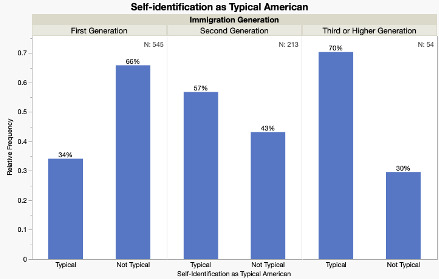
Inversely, 66% of first-generation immigrants think that they are very different from typical Americans. Immigration generation and assimilation into American society was found to be closely associated (X2 = 50.64, df = 2, p = 1.1 * 10-11). The moderate association (Cramér’s V = 2.50) between feelings of conformity and immigrant generation suggests that the higher the immigrant generation, the stronger feelings of belonging the individual may feel in American society.
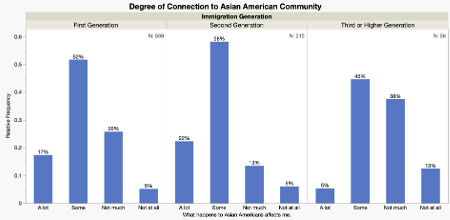
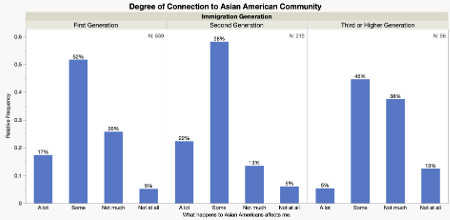
The majority of second-generation immigrants were found to have the strongest connection to the Asian American community compared to the other generations. To measure linked fate, responses to the question, “To what extent do you feel that what happens to Asians in the U.S. overall affects what happens in your own life?” were analyzed. Ten respondents who did not answer were excluded, which is 1.2% of the sample. First-generation immigrants have a smaller proportion of strong connections, while the third- and higher-generation has a split proportion between a strong and weak connection. These results suggest that second-generation immigrants have the highest sense of empathy with the Asian American community, with the greatest proportion of responses: “a lot” (22%) and “some” (58%). Linked fate with other Asian Americans was found to be weakly associated (Cramér’s V = 1.23) with immigration generation (X2 = 25.1, df = 6, p = 4.8 * 10-5), but does not grow directly with immigration generation.
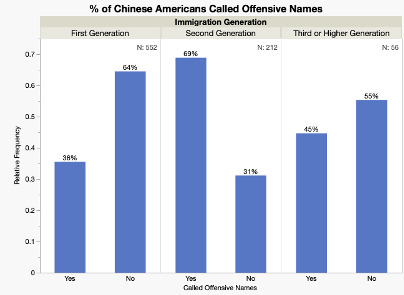
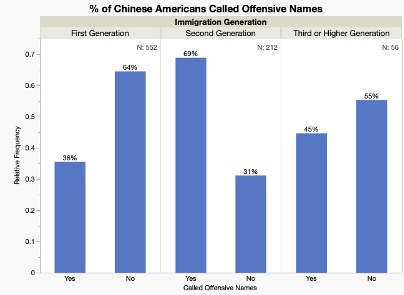
Analyzing experiences of language-based xenophobia reveals that first- and second-generation immigrants have very similar proportions of being criticized for not speaking English in public, while the vast majority of third- and higher- generation immigrants have not experienced such criticism. 17 respondents who did not answer were excluded, which is 2.1% of the sample. 25% and 26% of both first- and second-generation immigrants, respectively, have experienced criticism for not speaking English, indicating that language-based discrimination may remain constant despite increased belonging in American society, until the 3rd generation. Immigration generation was found to be weakly associated (Cramér’s V = 0.138) with being criticized for not speaking English in public (X2 = 15.74, df = 2, p = 3.803 * 10-4). However, the amount of criticisms received by each individual is unknown, meaning that it is possible for first-generation immigrants to simply have experienced more criticism than second-generation immigrants, or the inverse may be true as well. The trend indicates that the first- and second-generation experience similar targeting of language, while the third- and higher-generation experienced very little of the same bias.
Discussion
Existing assimilation models may be oversimplifying the trajectory of belonging, community, and experiences of xenophobia across Chinese American generations. Rather than the immigrant generations forming a continuous path towards assimilation, we propose that each generation should be seen as a distinct state, where dimensions of belonging and identity will not build on the previous generation linearly. The findings of this study suggest that higher immigrant generations feel a stronger sense of belonging as an American. Simultaneously, however, the second generation appear to experience the strongest linked fate with the Asian American community, suggesting that an American identity and the cross-cultural empathy necessary for racial solidarity and resistance are not forced to compete. Our study challenges the argument proposed by Michael (2024) that assimilation into American culture, specifically the adoption of an American identity, does not necessitate weakened linked fate. Instead, we encourage assimilation models to account for a “third space” outside the Chinese/Western binary, where American identity has been re-negotiated by the second generation as harmonious with cultural alliance.
Another dimension of assimilation, however, is how Chinese Americans are viewed externally. Dominant culture has rewarded and punished the ways in which Chinese American identity is presented. We find a weak association between language-based xenophobia and immigrant generation, suggesting that a higher sense of personal belonging as American does not translate linearly to acceptance by the mainstream. The third and higher-generation report less language-based xenophobia while experiencing higher belonging than the previous generations, which does not necessarily mean that xenophobia disappears. For the third and higher-generation, we hypothesize that feeling “FOB” stigma (Kim, 2014) coerces decreased visibility, possibly through code-switching, loss of native language, or internalized social pressures to conform to the American mainstream, which may decrease racialized exclusion. Citizenship, therefore, can be framed as more than a legal process, as markers of ethnicity, such as language, lead to “othering” and rejection as American, regardless of personal identity. This interpretation strengthens Hackl (2022)’s argument that social recognition is conditional upon suppressing outward differences, becoming a mechanism to police which identities are permitted and which are marginalized in America. Our work calls into question the completeness of citizenship, and how social movements must supplement legal rights to achieve equal acceptance of culture.
There are various opportunities for further improvement of our study. The third and higher-generation group constitutes approximately 7% of our sample, warranting caution when comparing its experiences against the first and second generations. In particular, the observed differences in belonging and language-based xenophobia should not be taken as definitive evidence of a distinct assimilation trajectory without further investigation in larger samples. Future research with greater representation of third and higher-generation Chinese Americans could test the robustness of these patterns and clarify whether they reflect generational differences in belonging and experiences of xenophobia. The measure of connection to the Asian American community in this study is an imperfect proxy for linked fate, as a responder could empathize with the Asian Americans but pragmatically believe that what happens to that community doesn’t affect their individual lives substantially. For our assimilation variable, self-labeling as not a “typical American” does not have to correspond to a lack of belonging and could rather indicate self-awareness of not being part of the dominant class while still holding an American identity. When measuring experiences with language-based xenophobia, it is impossible to discern whether a group really did experience less xenophobia, or simply underreported xenophobia because of language barriers or higher tolerance towards such comments. Thus, response bias could have contributed to the substantial increase in language-based targeting. The gaps between measured variables and the construction of the Pew Research Center’s questions could have led to false negatives, but likely not substantial discrepancies between our results and interpretations.
To capture a more complete picture of Chinese American identity, the variables under consideration should be expanded. To trace other dimensions of assimilation through generations, future work should examine social networks, cultural practices, socioeconomic incorporation, intermarriage, and political ideology as variables. To strengthen conditional assimilation as a theoretical framework, xenophobia that attacks the national loyalty or public health safety of Chinese Americans, regardless of immigrant generation, should be explored. Additionally, quantifying internalized xenophobia and how perceived foreignness impacts cross-generational relationships will help illuminate how conditional assimilation affects Chinese American identity.
Chinese Americans vary significantly across the US in terms of assimilation, feelings of belonging, local Asian community and experiences of language-based xenophobia. Our results cannot discern between these regional differences and are therefore missing an influential dimension of Chinese American life. Future work should study how belonging and anti-Chinese sentiment vary among rural versus urban cities, blue and red states, along with the regional differences in Chinese assimilation. We also do not control for mixed race identity in Chinese Americans, which can affect how they present themselves to the world and therefore, the racist comments they may experience. Future work should analyze how assimilation models may exclude and mischaracterize mixed race Chinese Americans.
Conclusion
This study has provided insights into the mechanisms of immigration, identity, belonging and xenophobia, contributing to the understanding of the complex and ever-evolving Chinese American experience. Our work reveals a “second generation paradox”, where the second generation appears to experience more belonging in America without sacrificing cross-ethnic solidarity or acceptance from the mainstream, aligning with third space theory. Our work challenges assimilation models which assume that dimensions of assimilation develop linearly upon the previous generation. Instead, we push these models to view each immigrant generation as its own distinct state, where citizenship, community, and identity is constantly being redefined by its members. Future work should improve upon our limitations by utilizing survey questions that measure different experiences of xenophobia, cultural identity, and assimilation. Additionally, geographic, political and racial factors should be explored to avoid missing differences within the Chinese American community. Cultural identity and what it means to be Chinese American is an incredibly complex product of many factors: colonialism, xenophobia, community and family. Developing nuanced assimilation models that capture the complexity of assimilation for Chinese Americans will be crucial for advocacy work, understanding identity and creating a more inclusive America.