
Introduction
Grid extension becomes harder to justify as settlement density falls, since the cost per connection cannot be recouped as the customer base falls. Mountainous terrain compounds this structural disadvantage: slope, distance and poor access raise construction and maintenance costs precisely where household purchasing power is often lowest (Peters et al., 2019). The result is an energy justice problem. Communities that may gain substantial health, time-saving and economic benefits from reliable electricity can be the least commercially attractive customers for conventional infrastructure investment. This study therefore asks not only which off-grid technology best delivers adequate electricity affordably and sustainably, but who may remain excluded, why that exclusion may persist, and whether emerging technologies could alter the relationship between remoteness, poverty, and energy access.
Even when grid coverage reaches rural communities, its impact can be limited if the supply is too low. Rwanda’s Electricity Access Roll-out Programme raised household electrification from 6% to 54% by 2023, yet a study of 41 rural communities a decade after connection found that roughly half the households remained unconnected and connected households consumed only 8.1 kWh per month (Masselus et al., 2025). Lighting and phone charging accounted for nearly all consumption, with no consistent evidence that these applications alone raise household income (Bos et al., 2018).
By contrast, electrification systems sized to support small business appliances like irrigation pumps, welding sets and sewing machines have been correlated with economic development (ESMAP, 2023). Such systems also support the two largest domestic energy draws in low-income countries: cooking and refrigeration. In rural emerging markets, cooking energy is still largely met by burning biomass (IEA, 2023). Gathering and burning this fuel falls disproportionately on women and girls, and household air pollution contributes to around 3.7 million premature deaths annually worldwide; in Africa, women and children account for 60% of those deaths. Universal access to clean cooking would also return about 1.5 hours a day to the average household by reducing time spent collecting fuel and tending fires (IEA, 2023). Refrigeration sits at the boundary between domestic and productive business use because it reduces food wastage and enables the storage of medicines for both households and traders.
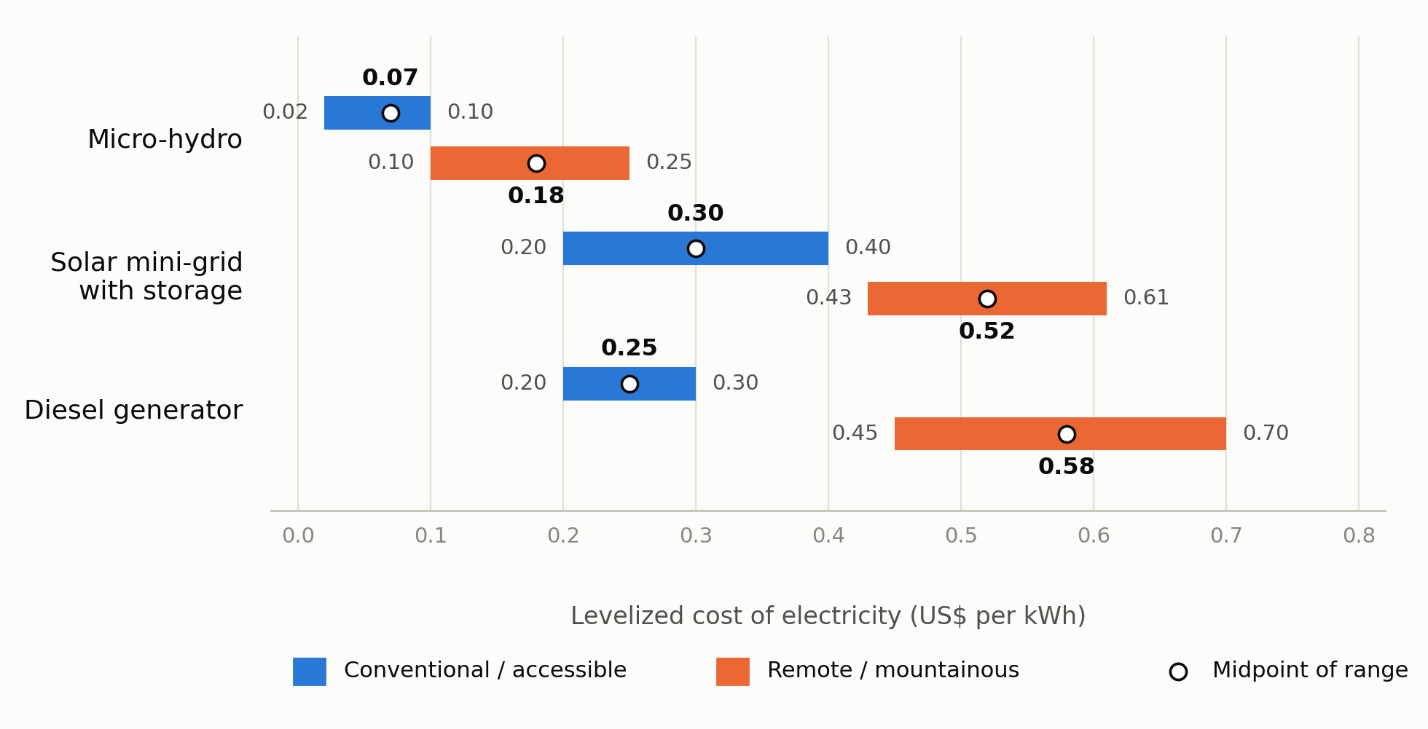
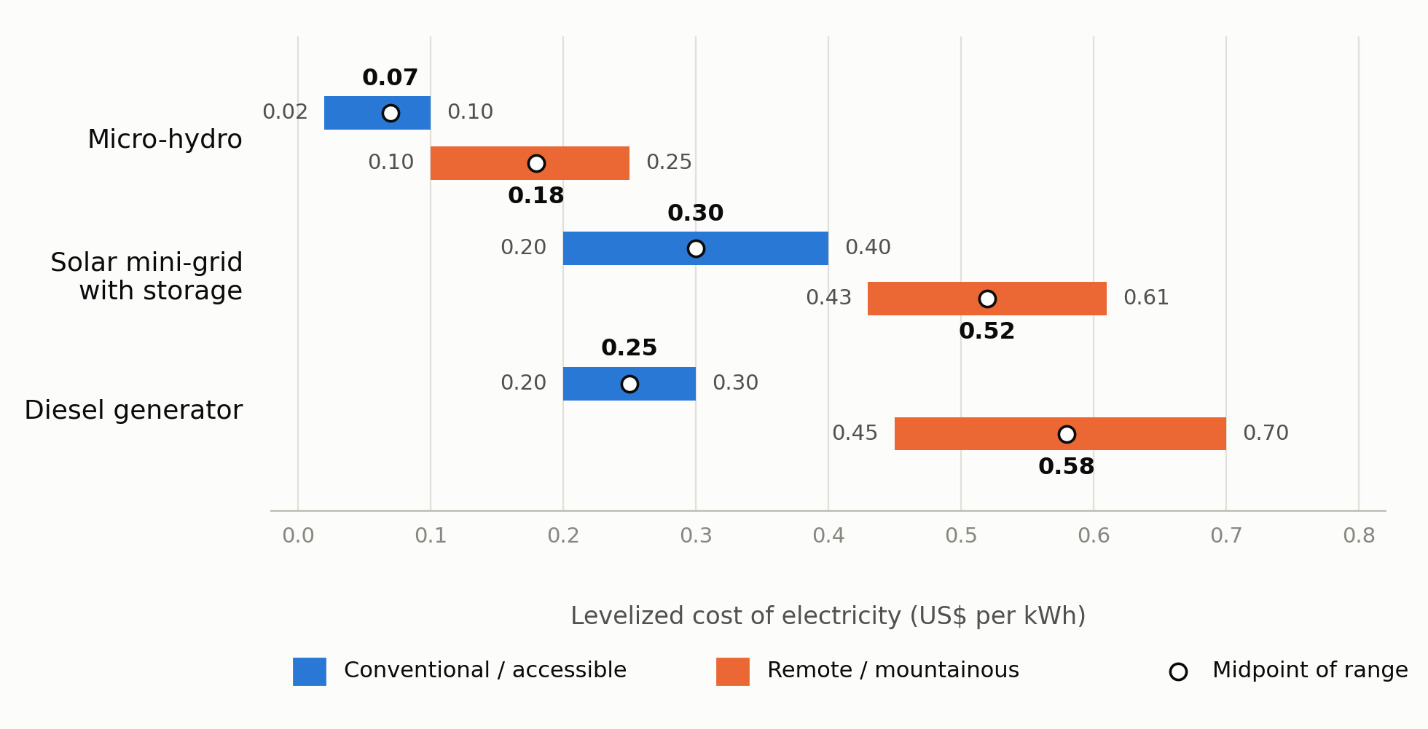
Off-grid electrical generation has expanded rapidly in emerging economies, but many systems remain unable to support higher-load applications such as cooking and refrigeration. Fig. 1 compares published LCOE ranges for three off-grid technologies in conventional, accessible sites against remote, mountainous ones. Micro-hydro has an LCOE in conventional sites of US$0.02–0.11/kWh in developing countries (Klein & Fox, 2022), compared with US$0.10–0.25/kWh in remote, mountainous areas (Das et al., 2025). Solar mini-grids with storage range from US$0.20–0.40/kWh in conventional settings (ESMAP, 2019; IRENA, 2016) to US$0.43–0.61/kWh in remote rural areas (Bertheau, 2020; UNESCAP, 2021). Diesel generation is approximately US$0.20–0.30/kWh in conventional sites (IFC, 2019), rising to US$0.45–0.70/kWh in remote communities (Atsbeha & Gebremariam, 2026). These ranges illustrate variation with site accessibility, logistics and system context rather than a controlled accessibility effect.
Since the three established technologies become less attractive as road access deteriorates, this paper compares them with dwelling-scale organic photovoltaics (OPV) printed roll-to-roll onto flexible plastic sheets. Printed OPV weighs 300 g/m2, roughly fifty times less than a framed silicon panel per unit area, offering a potentially important transport advantage in remote, hilly terrain.
Published reviews do not compare these technologies against a common full-domestic-load requirement in remote, high-relief, low-income settings while including printed OPV. This study therefore applies a common framework, uses local conditions in Hela Province, Papua New Guinea as a benchmark, and tests whether any option can satisfy the combined technical, economic and sustainability requirements.
Literature Review
Four strands of literature inform this study. First, research on decentralised, off-grid rural electrification emphasises alternative delivery architectures where conventional grids are poorly matched to dispersed demand. Bhattacharyya (2012) highlights roles of decentralised systems and financing.
Second, the productive-use literature distinguishes electricity access from energy services that improve household welfare and livelihoods. Cabraal et al. (2005) established a conception of productive energy use encompassing income, health, education and gender outcomes.
Third, energy-justice scholarship provides a framework for assessing who benefits from energy systems and who participates in their design. Jenkins et al. (2016) identify distributional, procedural and recognition dimensions, while Lacey-Barnacle et al. (2020) demonstrate their relevance to marginalised communities and decentralised energy systems in developing economies.
Finally, OPV research establishes the technological rationale for printed solar. Dastoor and Belcher (2019) trace its development towards flexible, printable manufacture; Kaltenbrunner et al. (2012) demonstrate ultralight flexible cells; and Centre for Organic Electronics research has demonstrated roll-to-roll fabrication (Andersen et al., 2016).
Taken together, these literatures reveal a gap at their intersection. Rural-electrification research has focused on infrastructure and economics, energy-justice scholarship on distribution, recognition and participation, and OPV research on device performance and manufacture. Few studies integrate these perspectives to assess whether lightweight, dwelling-scale renewable technology can address the constraints of remote, high-relief communities. This study addresses this gap by evaluating printed OPV alongside established off-grid technologies against a full-domestic-load benchmark.
Methods
A printed OPV-based dwelling electrification system was constructed and assessed against the three competing technologies using a six-criterion framework. This section outlines the framework, the consultation with Hela Province authorities to parameterise real-world conditions, and the methodology used to prototype and test the system at the Centre for Organic Electronics, University of Newcastle, and the cost modelling approach.
Assessment framework
Drawing on documented challenges in rural electrification programmes, including payment default, weak technical capacity, overestimated demand and high transaction costs (Peters et al., 2019), six criteria were developed to assess the technologies. Energy sufficiency asks whether the technology delivers the daily per-dwelling target set in the Hela consultation. Site independence explores whether it can be deployed anywhere, regardless of specific natural conditions. Dispatchability asks whether energy is available when needed, since cooking and lighting demand peaks in the evening. Transportability requires that equipment and fuel can reach settlements regardless of remoteness and terrain. Sustainability considers whether the source is renewable and how feasibly materials can be recycled or remediated at end of life. Finally, affordability asks whether monthly system cost falls within the household affordability threshold, incorporating capital equipment, logistics and construction, along with lifetime costs of local maintenance, end-of-life recovery, and financing. For micro-hydro, solar mini-grids, and diesel generators, these operating costs are embedded in the published figures in Fig. 1. For printed OPV they were derived from prototype testing and the Hela consultation. Deployment in emerging economies also requires community engagement, technician training, and payment-collection infrastructure. For established modalities, these are embedded in published levelized costs; for printed OPV, they are modelled by household pay-as-you-go financing which is a prevalent approach across sub-Saharan Africa.
Site parameterisation
Consultation with local authorities in Hela Province provided the parameters used to model an illustrative remote-highland case. Hela provides a demanding illustrative benchmark for remote-highland conditions because its mountainous terrain, poor road access, wet tropical-highland climate and semi-subsistence settlements make conventional electrification particularly challenging.
Tari, the capital of Hela Province, sits at 5.85°S, 142.95°E at an elevation of 1,650 m. Global Solar Atlas gives a site-specific daily insolation for Tari of 4.82 kWh/m2 (Global Solar Atlas, 2026). Local authorities in Hela described typical cooking practice as preparing two meals per day, each requiring 2 L of water to boil and then simmer for about half an hour. Dwellings were reported to present approximately 20 m2 of usable roof area, which sets the physical limit on rooftop solar deployment. 5% of household income benchmark is used to assess electricity affordability (World Bank, 2023). Applied to the upper end of the rural Papua New Guinea living-income reference range, PGK 1773 (US$512) (Anker & Anker, 2020), the affordability threshold for off-grid electrification was US$25.60. The Hela authorities corroborated this figure as affordable for most rural households in the region.
The Hela consultation also indicated that two technicians could deliver maintenance to 1,000 dwellings from a small equipment store. An acceptable technician salary was reported at US$14,000 annually, including a 30% loading for benefits and remote posting. The cost for a 25 m2 storehouse was reported at US$17,500 and was amortised over its expected fifteen-year life. The consultation deemed US$30,000 an adequate annual provision for spare parts (e.g., inverters, controllers, cells and cabling) as well as fuel and motorcycles to transport technicians to their clientele.
Freight was modelled using container capacity, packaging, payload limits and two-way transport between Australia, Port Moresby and Tari. Including end-of-life recovery, lifetime transport costs were US$67.35 for current OPV and US$54.34 for next-generation OPV.
Total energy demand for a dwelling combines a measured figure for cooking with benchmark figures for refrigeration, phone charging and other domestic electrical draws in emerging markets. Cooking was measured because its requirement depends on heat transfer between element and vessel, losses during heating, and the power needed to sustain a simmer, none of which appear on a manufacturer specification. Boiling trials raised 2 L of water from 20 °C to 100 °C, An 1,800 W power setting was selected because it reached a boil in 9 minutes which the Hela consultation deemed fast enough for local cooking practices. The energy required to bring 2 L of water to a boil was measured as 270 Wh, which was 68.9% efficiency against the 186 Wh theoretical figure due to losses in the inverter and cookstove. Simmering was measured to draw an additional 386 Wh over thirty minutes. Therefore, one cooking event required 656 Wh, giving a daily requirement of 1.31 kWh over two cooking events.
The remaining household loads of lighting, phone charging, a fan, a television, a refrigerator, and a laptop were taken from the International Energy Agency access methodology, which assumed energy-efficient devices, and totalled 1.25 kWh per day (IEA, 2020). Therefore, total dwelling demand was estimated as 2.56 kWh per day by summing the measured cooking energy demand and the IEA benchmark for other domestic loads.
Prototype and apparatus
A complete dwelling-scale OPV electrification system comprising printed OPV sheets, MPPT charge control, a lithium iron phosphate battery, inverter and induction cookstove was assembled and instrumented. All measurements were taken indoors under controlled artificial illumination rather than natural sunlight at the Centre for Organic Electronics.
The battery was rated at 4,220 Wh, of which 3,376 Wh was treated as usable at an 80% depth of discharge; the remaining 20% is held in reserve because repeated deep discharge shortens cell life. Discharge efficiency was measured at 88.6%. Combined with the controller’s 98% charging efficiency and the 80% depth of discharge, the system efficiency chain is 69.5%, describing the fraction of energy reaching the charge controller that is ultimately delivered to the load.
Four parameters, in addition to insolation, determine an OPV system’s daily areal energy density. First, power conversion efficiency (PCE) is the share of incident sunlight the active material turns into electricity. Second, geometric fill factor (GFF) is the fraction of sheet area occupied by light-converting cells rather than by the inactive gaps left between printed strips. Currently available OPV sheets from the Centre for Organic Electronics at the University of Newcastle achieved 2% PCE and 50% GFF. Third is the system efficiency chain, which accounts for losses and depth-of-discharge provisions, and was measured at 69.5%. A fourth adjustment is applied because PCE is measured under Standard Test Conditions of 1,000 W/m2 at 25 °C, which field conditions rarely reproduce. Outdoor monitoring has shown that printed OPV can outperform crystalline silicon under low and diffuse irradiance, with approximately 20% higher daily specific energy yield under overcast conditions at the tested inclinations (Feroze et al., 2025). This arises from OPV’s near-zero temperature coefficient of −0.008 %/°C, roughly forty times smaller than crystalline silicon’s, and because OPV’s efficiency rises rather than falls as irradiance drops. A field performance uplift (FPU) of 20% is therefore applied as a modelling assumption to OPV’s areal power density throughout this analysis.
The daily areal energy density and the required area of OPV sheets to meet the daily dwelling demand are given by the following equations:
Daily areal energy density (kWh/m2): E = I × PCE × GFF × η × (1 + FPU),
where I is daily insolation, PCE is power conversion efficiency, GFF is the geometric fill factor, and η is the system efficiency chain, and FPU is OPV’s field performance uplift.
Required array area: A = D ÷ E, where D is daily dwelling energy demand.
Next-generation OPV is modelled at 4.5% PCE and 90% GFF, giving approximately four times the current areal energy density, with service life increasing from four to ten years. These are prospective assumptions, not demonstrated system-level performance. They are supported by defined engineering pathways: certified large-area OPV modules have reached 14.5% PCE (Basu et al., 2024), while roll-coated OPV modules have demonstrated GFF of up to 98.5% using ultrafast laser patterning (Lucera et al., 2016). The remaining challenge is transferring these results to durable, roll-to-roll manufactured modules. Encapsulation and multilayer barrier laminates provide a pathway to longer service life. This is not a full lifecycle assessment; material sourcing, manufacturing impacts, battery replacement and recycling infrastructure remain limitations. The analysis therefore treats these targets as achievable scenarios rather than established commercial specifications.
OPV cost modelling
The cost of the complete OPV dwelling electrification and cooking system was calculated over a 10-year period, with components priced at bulk wholesale rates. Ten years was selected as the system’s reference lifetime to align with the expected lifetime of next-generation OPV sheets. Current OPV sheets were priced at US$20/m2 and next-generation sheets at US$24/m2, to include the additional cost of the encapsulation required for a ten-year service life, based on large-scale production expectations at the Centre for Organic Electronics.
The prototype used laboratory instrumentation, so the bill of materials was converted to functionally equivalent products available for off-grid deployment. The 4.2 kWh Victron battery was matched to a 5.12 kWh Mica Power LiFePO4 unit, the MPPT controller to a generic 30 A controller, and the cookstove plus inverter to a 1,500 W DC induction cooker. Wiring, mounting and balance-of-system were costed separately. A 25% volume discount produced modelled costs of US$450 for the battery, US$70 for the controller, US$120 for the cookstove, US$120 for wiring and mounting, and US$25 for assembly and kitting. A DC cooker with an integrated high-frequency drive removes the separate inverter.
The service-life ratings of the components defined replacement requirements: four years for current OPV sheets and ten years for next-generation; eight years for the battery; five years for the induction hob, assuming daily thermal cycling; eight years for the controller; and fifteen years for wiring and mounting. The 10-year cost of system ownership was calculated by amortizing the cost of each component over its service life and multiplying by ten, before summing up over all the components. Installation labour is costed at half a technician day (US$29.04), using the fully loaded salary from the maintenance calculation divided by 240 working days per year. This covers roof mounting, wiring and commissioning of a pre-kitted system.
A manufacturer profit margin of 15% is applied to the up-front hardware bill before financing. Financing then applies a 40% premium as a modelling assumption informed by the financing costs and affordability constraints documented for PayGo solar in emerging markets (ESMAP, GOGLA, and Dalberg Advisors, 2024). Maintenance and freight were costed according to the methodologies outlined above. Financing is charged only on up-front expenses, comprising hardware, installation labour, the outbound freight leg, and the manufacturer margin. Since maintenance is billed as incurred and the return freight leg falls due in year ten, neither is financed.
Results
This section first presents the printed OPV cost derivation, then assesses each technology against the six criteria to determine whether any would be suitable for supplying a full domestic energy load to dwellings in remote, high-relief locations in low-income countries.
Fig. 2 sets out the ten-year cost of printed OPV systems and finds that two-way transportation cost is only 1.6% of the up-front hardware bill for current OPV and 3.8% for next-generation OPV, highlighting how OPV’s lightweight nature and compact roll-to-roll form factor provide significant transportation advantages in remote, hilly locations. In terms of energy sufficiency, a dwelling electrification unit based on current OPV technology provides 0.80 kWh per day from 20 m2 of roof area. While the measured output was adequate to power cooking under the controlled artificial illumination test conditions, current OPV cannot deliver the 2.56 kWh per day needed to meet the defined full-domestic-load benchmark, which would require 63.8 m2 of roof space. Even if this much larger roof area were available, it would be too expensive at US$62.40/month (US$0.81/kWh).
By contrast, next-generation OPV can deliver the full daily energy demand with 15.8 m2 of roof area, and 3.25 kWh per day from the full 20 m2 roof space of the Hela benchmark. Supplying the full daily energy demand would cost US$24.53 per month (US$0.32/kWh), below the affordability threshold of US$25.60 per month. The difference between current and next-generation OPV sheets is attributable to differences in energy generation density, product lifetime, and freight costs.
For consistency, the midpoint of each published remote LCOE range in Fig. 1 was used for the monthly-cost calculations of the three established technologies. The monthly cost of each technology to deliver the 2.56 kWh daily energy target was therefore found to be: micro-hydro (US$12.67); solar mini-grids (US$39.94); diesel generators (US$44.16); current OPV (US$62.40); next-generation OPV (US$24.53). Only micro-hydro and next-generation OPV were below the US$25.60 affordability ceiling.
Fig. 3 scores the five technologies against the six criteria using a common 0–3 scale. A score of 0 means a criterion is not met, 1 indicates a substantial shortfall, 2 means it is met with qualifications, and 3 that it is fully met. Energy sufficiency was assessed as the ratio of usable daily electricity delivered to the 2.56 kWh/day dwelling benchmark: 3 for ≥100%, 2 for 75–99%, 1 for 50–74%, and 0 for <50%. Affordability was assessed as monthly system cost as a percentage of the US$512 monthly household income: 3 for ≤5%, 2 for >5–7.5%, 1 for >7.5–10%, and 0 for >10%. Dispatchability was assessed by the ratio of available system output to the measured 1,800 W cooking load: 3 for ≥100%, 2 for 75–99%, 1 for 50–74%, and 0 for <50%. Site independence was assessed by the degree of dependence on site-specific natural resources, with 3 indicating no material constraint, 2 a conditional constraint, 1 a substantial constraint, and 0 an essential resource requirement. Transportability was assessed primarily by the remote cost penalty, defined as the percentage increase in LCOE between conventional/accessible and remote/mountainous sites, using Fig. 1 for comparative data: 3 for ≤50%, 2 for >50–100%, 1 for >100–200%, and 0 for >200%. For OPV, transportability was assessed from modelled freight costs, system mass and roll-form shipping. Sustainability was assessed from renewable generation, material and replacement burdens, and end-of-life constraints; it is not a full lifecycle assessment. The criteria are equally weighted because the study asks whether a technology can satisfy all six constraints rather than estimate a composite welfare value. The totals are therefore a structured comparative assessment, not a statistically precise ranking.
Diesel generators score 11 because they provide sufficient dispatchable energy at almost any site, but transporting equipment and making recurring fuel deliveries increase environmental burdens and push monthly costs far above the affordability benchmark.
Current OPV scores 9 because its present areal energy density provides only 31% of the 2.56 kWh/day dwelling benchmark within the 20 m2 roof area. Although it is deployable at most unshaded sites and is dispatchable with a battery, the larger sheet area increases transport and end-of-life burdens; meeting full demand would cost US$62.40/month.
Solar mini-grids score 13 because they provide sufficient, dispatchable energy at most non-shaded sites, but their US$39.94/month cost exceeds the affordability threshold. Heavy panels, batteries and distribution infrastructure also make deployment and end-of-life recovery more difficult in hilly terrain.
Micro-hydro scores 14 because it is affordable and dispatchable, with a favourable sustainability profile under the assessment framework, atUS$12.67/month. Its main weakness is site independence: adequate year-round water flow and gradient are not available everywhere, while construction machinery and civil works are difficult to transport. Its long service life reduces the frequency of decommissioning and replacement.
Next-generation OPV scores 17 in the modelled scenario because, under the prospective performance and cost assumptions, it meets all six criteria except site independence, which remains conditional on adequate sunlight. Its principal advantage is transportability: OPV sheets are about 50 times lighter per unit area than silicon PV and can be shipped as rolls. The 17/18 score should be read as the outcome of the stated scenario, not as a demonstrated commercial performance.
Discussion
Although next-generation OPV could meet the full energy demand of emerging-market dwellings, even in mountainous regions,
First, the next generation of encapsulated printed OPV technology must be developed and proven to deliver a fourfold increase in areal power density, at a cost of US$24/m2 when produced in industrial-scale roll-to-roll printers, with a product lifetime of 10 years. As the energy generation capacity of printed solar increases, it could support full domestic energy demand in regions with lower solar irradiation and power light industrial applications, driving additional economic activity. Researchers at the Centre for Organic Electronics estimate that encapsulation will add approximately 20% to the areal production cost, taking it from US$20/m2 to US$24/m2. This cost premium is expected to fall as production scales up and could be offset by the increase in product lifetime from 4 years to 10 years, reducing long-term system costs for materials, recycling, and maintenance. Further work should also prioritise durability testing under sustained humidity, field measurement of maintenance coverage, and pricing of shading losses under realistic obstruction.
Second, mass deployment must address the key questions of energy justice. Distributional justice concerns who receives affordable, reliable energy and who bears the burdens of energy poverty. Recognitional justice requires treating remote and low-income communities as legitimate beneficiaries rather than peripheral markets. Procedural justice requires communities to participate in financing, ownership, implementation and maintenance. These dimensions matter especially for women and girls, who often bear primary responsibility for biomass collection and cooking, leaving them disproportionately exposed to the time burdens, household air pollution, and lost educational and economic opportunities associated with energy poverty. A commercial model that sells OPV systems directly to households risks concentrating access among wealthier families and leaving the poorest households behind. By contrast, community-governed schemes which draw in concessional finance, engage women in transparent decision-making, and drive local capacity-building are more likely to distribute benefits equitably (Gill-Wiehl et al., 2022).
Fiji’s rural electrification programme provides an illustrative PPP model, combining donor grants, concessional loans and household payments with private implementation (UNDP, 2026). Local committees support community education and payments, while local technicians are trained to enable capacity-building. The example reinforces the broader point that affordability is not simply about a product price: financing terms, payment mechanisms, and local institutional capacity determine who can actually obtain and retain access. Community participation also gives users, particularly women, a role in decisions about siting, maintenance, and collections, which strengthens procedural justice and local ownership.
Conclusion
Remote mountainous communities in emerging economies face a structural energy-access disadvantage: grid extension is costly, while low incomes limit the revenue available to recover those costs. This electrification challenge was treated as a dual technology and energy justice problem, assessing micro-hydro, solar mini-grids, diesel generators and printed OPV against six access criteria: energy sufficiency, affordability, dispatchability, site independence, transportability and sustainability.
Against the Hela benchmark, micro-hydro and next-generation OPV were the only options below the US$25.60 monthly affordability threshold. Micro-hydro is highly effective where suitable water resources exist. Under the prospective assumptions used here, next-generation OPV could meet the 2.56 kWh/day dwelling demand at US$24.53 per month while requiring only 15.8 m2 of roof area and offering substantially greater transportability. These are modelled results, not demonstrated commercial performance. They depend on OPV achieving higher efficiency and fill factor, a ten-year lifetime, and scalable production at US$24/m2. The Hela Province case is also a demanding illustrative benchmark, not evidence that these results generalize across all remote mountainous regions.
This study concludes that, while printed OPV may reduce a structural barrier to energy access, technology alone does not assure energy justice. Equitable deployment requires community financing and deployment schemes that reach poorer households, recognize and specifically target remote communities as legitimate beneficiaries, and foster community participation in ownership and implementation. Engaging women and girls in community governance is particularly important because their unpaid fuel collection and cooking responsibilities can concentrate inequalities in health and productive time.
If the technical targets for printed OPV are validated in the field and the technology is deployed through community-governed financing and deployment programs, it could support clean cooking, refrigeration, and other economically productive appliances like irrigation pumps, thereby helping to reduce inequities associated with energy poverty.
Acknowledgements
Prototyping, instrumentation, and measurements of the printed OPV electrification system were carried out under the mentorship of Professor Paul Dastoor and Dr Dan Elkington at the University of Newcastle, New South Wales, Australia. To parametrize local conditions for analysis, a consultation was conducted with Simon Areke, Chief of Staff to Governor Philip Aja Undialu of the Hela Province of Papua New Guinea Staff,. Responsibility for the modelling and all conclusions rests with the author.