
Introduction
In recent years, both the beauty industry and the public have witnessed an unexpected shift: the rise of “Sephora Kids”. In this study, this term describes a specific subset of preteens and young adolescents, aged between 9 and 14, who purchase high-end makeup and skincare products usually meant for adults (Vogue Business, 2025). On social media platforms like TikTok and Instagram, these kids mimic influencers by using products like various forms of makeup and anti-aging products like retinol. There are many reports and research papers that identified this cosmetic engagement trend and discussed its health, psychological, and ethical effects (EWG, 2024).
Developmental psychology identifies early adolescence as a period where identity and self-esteem are still developing. At this stage, social media heavily influences perceptions of self-worth through the intensification of social comparison. Marketing professionals have taken advantage of this sensitivity by promoting cosmetics as symbols of empowerment and self-care. These campaigns appear positive, but they often blur the line between self-expression and commercial manipulation.
The health consequences of this trend are more concerning. Dermatologists have noted that many of the ingredients popular among influencers such as retinol, niacinamide, and exfoliating acids are unsuitable for young, sensitive skin. Ethics around introducing beauty standards at such an early age is questionable not only due to the health concerns but forming lifelong habits and consumer dependency.
Literature Review
Research interest in how adolescents use cosmetics and skincare has increased as social media continues to influence how young people view themselves and make purchasing decisions. For example, Medley et al. documented widespread use of children’s makeup and body-care products in the U.S., indicating that beauty routines are now embedded in early adolescence (Medley et al., 2023). At the same time, pediatric dermatology research points to additional concerns. Goff and Stein review the risks and ethical issues of cosmeceutical use among children, highlighting the fact that many products aimed at youth have not been tested for pediatric skin or marketed with appropriate safeguards (Goff & Stein, 2025a, 2025b). The trend toward “tween skincare” routines is further described as being shaped by marketing and social media, which frame cosmetics as a form of self-care among young users (Wetstone & Grant-Kels, 2025).
Research on social media and youth consumer behavior demonstrates how influencer culture, peer networks, and algorithm driven content promote early cosmetic use. Parikh and Lipner explore the ethical dimension of influencer led skincare trends among adolescents, noting that youth often lack full decisional capacity when experimenting with adult style routines (Parikh & Lipner, 2024). A brief report by McCoy et al. provides concrete case studies of children increasingly influenced by social media “skinfluencers,” leading to risky beauty practices. Reported cases include allergic reactions and skin irritation from viral products, underscoring the need for clinician awareness and youth education about social media beauty trends (McCoy et al., 2024). Studies of adolescent consumer behavior show that cosmetic purchasing in young teens is strongly correlated with peer influence, self-esteem issues, and media exposure rather than personal need (Rehman et al., 2023; Udayanga et al., 2024).
Health, environmental, and ethical implications of early cosmetic engagement are also focused in recent studies. Hales et al. and associated Northwestern University work highlights that skincare routines popularized on platforms such as TikTok may involve multiple active ingredients, minimal sunscreen use which leads to cancer and skin disease, and elevated risk of irritation or allergic reaction (Hales et al., 2025; Samuelson, 2025). Recent dermatology education research highlights the influence of social media platforms in shaping youth behavior and the spread of skincare practices. One study points out that most of the dermatology related content on social media is generated by non-medical influencers rather than board-certified clinicians, raising concerns about misinformation and blurred professional boundaries (Rey & Tan, 2025). This underscores how visual platforms can propagate beauty trends that lack evidence based guidance, especially among impressionable children.
On the chemical exposure side, a large study by George Mason University investigators found that children’s use of lotions, hair oils, sunscreens and other personal care products was associated with higher urinary levels of phthalates and phthalate replacement chemicals-endocrine disrupting compounds- linked to developmental, reproductive and metabolic risks. The study further revealed variation in exposure by race/ethnicity and sex assigned at birth, implying that personal care product use may contribute to health inequities among children (Bloom et al., 2024). The letter “Glow or No-Go” emphasizes the ethical imperative for transparent marketing, media literacy education, and clinician awareness when beauty routines intersect with adolescent development and health (Parikh & Lipner, 2024).
This study has two main goals. First, to review current research on adolescent and pre-teen cosmetic engagement and its health, behavioral and ethical implications. Secondly, use survey data to empirically assess whether the levels of youth cosmetic use reported in news and social media reflect what people observe in their own communities.
The first goal was addressed through a review of sixteen studies which show that youth cosmetic engagement sits at the intersection of health, social media culture, personal identity, commercial marketing and ethical concerns. Many media accounts describe the “Sephora Kids” trend in sensational terms, often implying near universal participation.
Building on that foundation, the rest of this study focuses on the second goal-testing whether this portrayal aligns with the reality. Using surveys distributed on LinkedIn and Instagram and applying a simple Bayesian framework, we estimate the prevalence of makeup use among kids and teens.
Methods
This study explores how widespread makeup use is among preteens and young adolescents, using surveys to better understand what people are seeing in their everyday lives. Two surveys-google forms with data captured in a datasheet- were distributed on LinkedIn and Instagram to capture generational and platform specific differences in perception. Respondents answered two questions: (Q1) How many children aged 9-14 do you personally know? and (Q2) How many of those children use makeup or shop at shops like Sephora?. Some responders were not serious or made data entry mistakes, so the collected data had many outliers. We used two rules to clean up the data. Responses where count of Q2 exceeded Q1 or where count of Q1 exceeded 100 were excluded. After cleaning, 87 valid responses remained with 52 from LinkedIn and 35 from Instagram.
LinkedIn survey was administered through the community member networks, generally aged 20 and older, represented an adult perspective. Instagram respondents were primarily under 20 and predominantly high school students so reflect a peer level awareness. These samples provided a cross-sectional view of generational awareness regarding the Sephora Kids phenomenon. The total number of children identified from the 87 responses was 1,371.
The survey gathered responses from two platforms: LinkedIn and Instagram. On LinkedIn, 52 people responded. They reported a total of 408 children aged 9–14, and 155 of those children use makeup. On Instagram, 35 people responded. They reported 963 children aged 9–14, with 530 using makeup. Overall, across both platforms, the survey collected 87 responses. Overall, across both platforms, the survey collected 87 responses. Together, respondents reported 1,371 children aged 9–14, and 685 of them use makeup
To estimate and update beliefs regarding the proportion of children who use makeup, this study employed a basic Bayesian inference framework as described in the book Bayes Rules! (Johnson et al., 2022). Bayesian analysis provides a way to estimate an unknown quantity, in our case the true proportion of children who use makeup, by combining prior knowledge with new evidence. Establishing a prior belief is the first step. In our case we started with a neighborhood and found out that three out of seven kids we know in that age group can be classified as Sephora Kids. So that information forms the basis for establishing our prior distribution. When new data are collected, as people respond to surveys, this prior is updated using Bayes’ rule to produce a posterior distribution, which represents the range of values for the true prevalence that are most consistent with the observed data.
In addition to updating our prior belief with new data, the Bayesian approach allows us to move beyond a single point proportion by quantifying uncertainty and producing a credible interval that shows how wide the plausible range of prevalence might be. Through Bayesian framework we can demonstrate how every data observation reduces the uncertainty (variance) and provides a more reliable estimate of youth makeup use. We will see this in subsequent sections.
The analysis employed Python libraries—pandas and NumPy for data handling, matplotlib for visualization, and scipy.stats for statistical analysis. A Beta distribution, implemented through SciPy’s beta function, was used to model beliefs about the proportion of children using makeup. The Bayesian update was performed sequentially, first using data from LinkedIn respondents and then from Instagram respondents, allowing the prior belief to be refined step by step as new evidence was added. The resulting prior and posterior distributions were plotted to visualize how the estimated prevalence shifted with each update. All data and python code are available in a public GitHub repository to enable full replication of the results (Kurian, 2025).
The methods described above provide a framework for estimating the underlying prevalence of makeup use among preteens as reported by different respondent groups. The following section presents the results of this Bayesian analysis, highlighting how the inclusion of data from each platform progressively refines the estimated proportion of youth makeup users and the associated uncertainty range.
Results
Bayesian analysis begins with a ‘prior’-an initial belief about a parameter’s value-then incorporates new evidence to produce an updated ‘posterior’ belief. We begin with a prior belief about the proportion of children aged 9-14 who use makeup. Based on observing 3 out of 7 nearby kids using makeup, we formed a Beta(4, 5) distribution. A Beta distribution is a probability distribution defined over the interval 0 to 1, making it well suited to modelling proportions (like “the proportion of kids who use makeup”). In the notation Beta(α, β), α and β are shape parameters. One can think of α as prior “successes” and β as prior “failures” in a binomial-type scenario. As α+β grows, the distribution becomes more concentrated and less uncertain. We started with a mean of about 0.44 so we believed that roughly 44% of kids in that age range use makeup. It also allowed plenty of room for uncertainty. Beta distribution lets us represent belief as a full distribution of possible values instead of a single number. The alpha and beta parameters (4 and 5) define the shape of this initial belief. With establishing a prior, we look at the posterior estimation in two different ways (1) Sequential updating by platform (2) Sequential update with each new response. Results are summarized in their respective sections below.
Sequential Updating by Platform
This table summarizes the results of our Bayesian analysis as we sequentially updated our belief about the proportion of children aged 9-14 who use makeup, using data from an initial prior, then a LinkedIn survey, and finally an Instagram survey. We grouped the responses by platform to show the incremental difference in posteriors. Results are summarized below.
Posterior Mean and Variance Summary by Platform
Stage 0 – Initial Prior
Stage 1 – After LinkedIn
Mean: 0.472
Alpha (α): 844
Beta (β): 944
Variance: 0.00013
95% Credible Interval: [0.45, 0.49]
Stage 2 – After Instagram
Mean: 0.499
Alpha (α): 1374
Beta (β): 1377
Variance: 0.00009
95% Credible Interval: [0.48, 0.52]
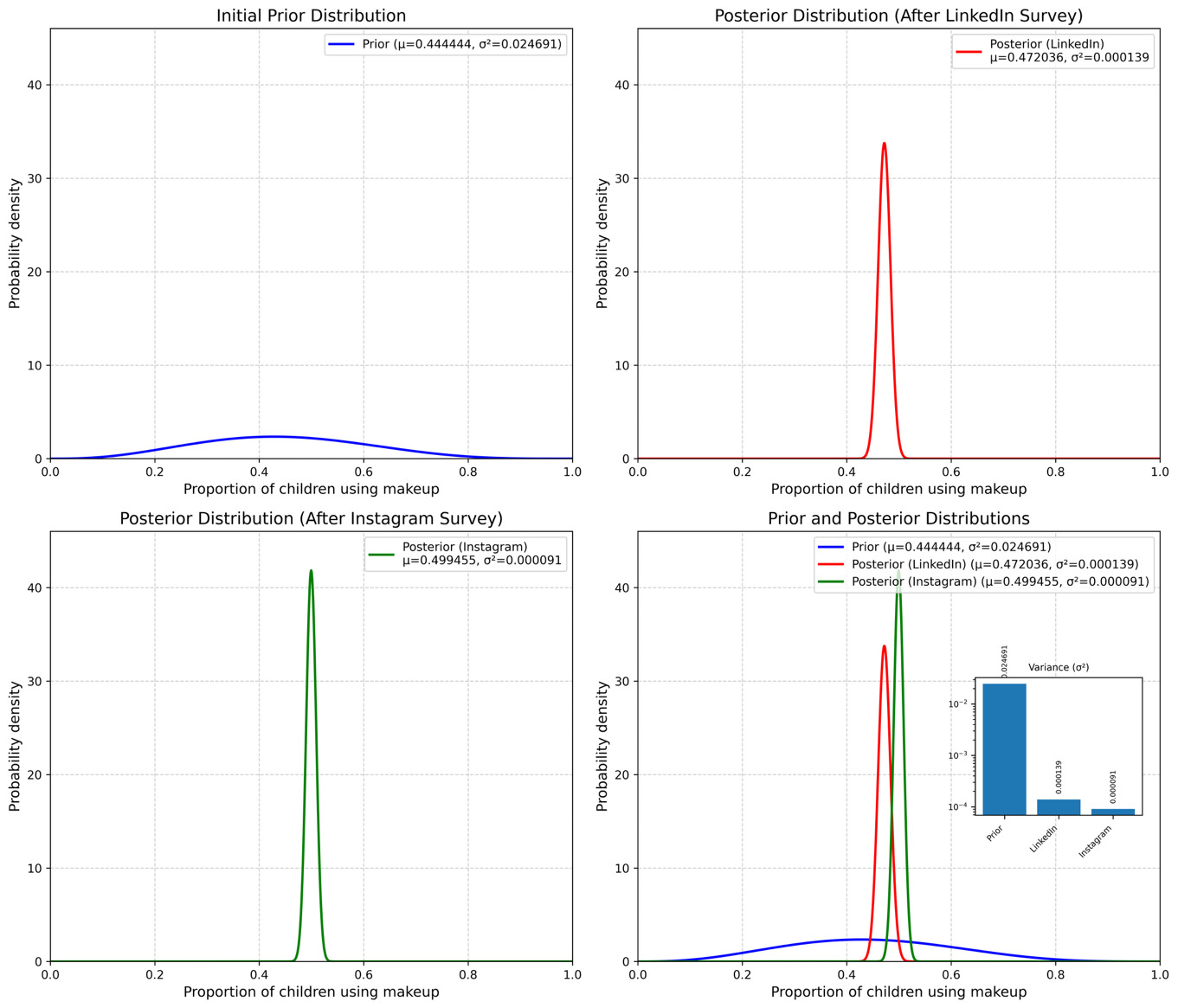
After LinkedIn Data: The mean of the posterior distribution after the LinkedIn data update is 0.47. This shows an increase in the estimated proportion compared to the initial prior of 0.44. Notice the significant increase in the alpha and beta parameters (844 and 944). These larger values reflect the substantial amount of data from the LinkedIn survey and result in a much narrower distribution, indicating a significant reduction in uncertainty. This reduction in uncertainty is clearly reflected in the much smaller variance of 0.000139 as compared to prior variance of 0.024691.
After Instagram Data: The mean of the posterior distribution after incorporating the Instagram data is 0.4995. This indicates another shift in the estimated proportion, moving it closer to 50%. The alpha and beta parameters (1374 and 1377) have increased even further, reflecting the cumulative data from both the LinkedIn and Instagram surveys. The variance has decreased even more to 0.000091, a significant reduction in uncertainty and a more precise estimate of the proportion. Figure 1 shows these shifts clearly. The blue curve is the prior. Green curve is the best estimate after the LinkedIn survey and red curve reflects the updated best estimate after LinkedIn and Instagram survey data update. The center of the curves gives the point estimates, and its width shows how much uncertainty remains around this point estimate. Clearly, narrowest green line shows the lowest variance or uncertainty around the posterior mean.
Alongside the posterior means, the 95% credible intervals provide an intuitive way to understand the remaining uncertainty around each estimate. The prior interval is wide [0.16,0.75], reflecting limited initial information and substantial uncertainty. In simple terms, this means that before collecting any survey data, we could only say that the true proportion of children using makeup was somewhere between 16% and 75%. After incorporating LinkedIn data, the credible interval narrows sharply to [0.45,0.49], showing that the larger dataset substantially reduces the uncertainty. Adding Instagram responses narrows the interval further to [0.48,0.52], centering the estimate near 50%. This final interval means we are about 95% sure that the true proportion of children who use makeup lies between 48% and 52%. These intervals make clear that, even when accounting for uncertainty, the prevalence is unlikely to be extremely low or extremely high; instead, the data consistently point toward makeup use being common among children aged 9-14.

Sequential Update with Each New Response
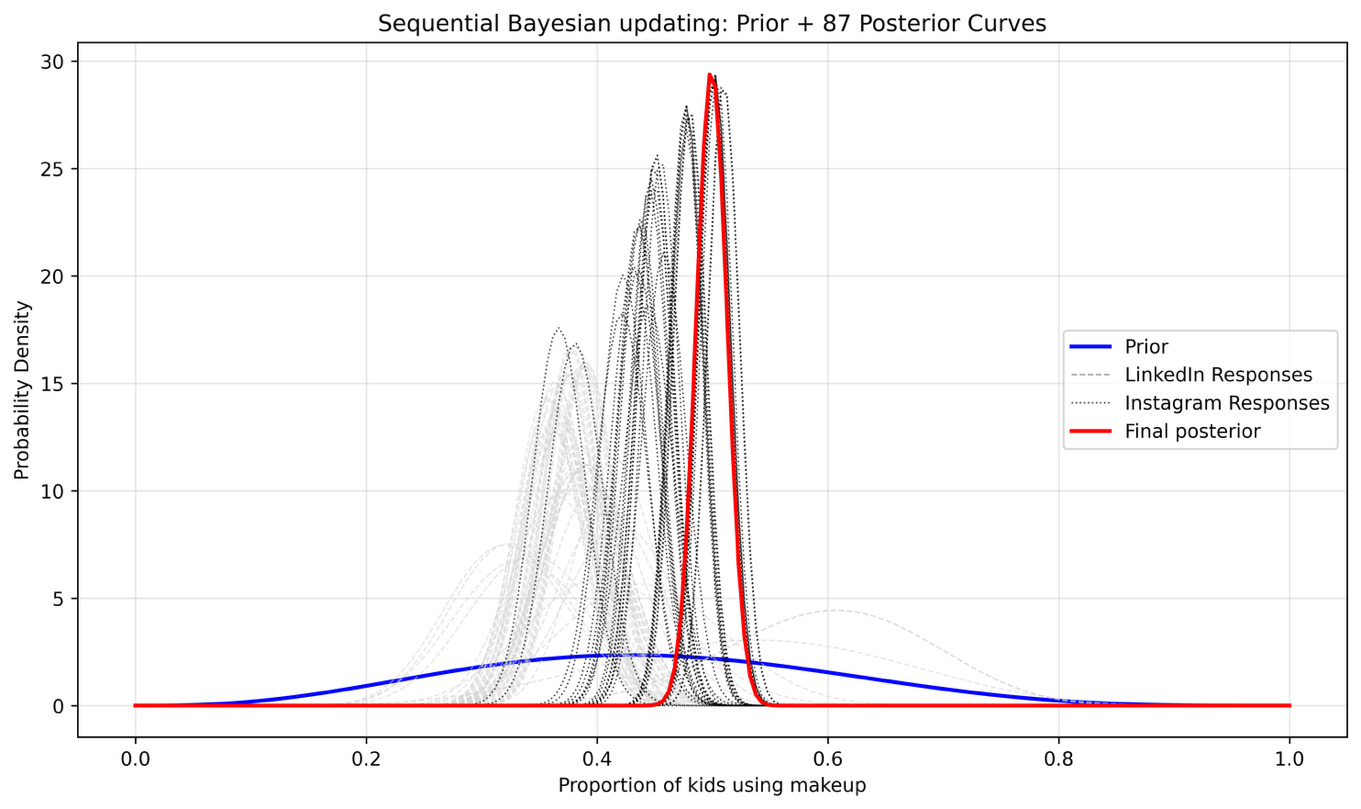
To visualize the belief update with each new response we plotted the prior and posteriors after each individual response (Figure 2). From each response, we noted how many kids they know in the target age range and how many of those use makeup. So with each new response, the “successes” and “failures” counts are updated( α and β parameters). After each update a new posterior distribution was computed. Each of these intermediate steps is shown as a thin grey curve in Figure 2. From a Bayesian viewpoint, this process illustrates “prior → data → posterior,” repeatedly.
The Figure 2 shows this evolution of belief clearly: the blue curve is the initial prior; the grey curves show how posterior shifts and becomes more focused with each new piece of information; and the bold red curve is the final posterior after all 87 responses. The red curve reflects updated best estimate of the true proportion of kids who use makeup, considering both prior belief and the survey data. Its center gives the point estimate, and its width shows how much uncertainty remains.
The solid grey curves in Figure 2 represent LinkedIn and show a steady narrowing of the posterior distribution. The dotted grey curves that represent Instagram appear later in the sequence and contribute a further noticeable shift in the mean and reduction in variance. From a visual perspective, this suggests that the Instagram responses added incremental information that refined the estimate more sharply compared to a more stable LinkedIn updates. This visual pattern supports the idea that younger respondents from Instagram brought fresh and stronger information about makeup use, likely reflecting their higher awareness of the Sephora phenomenon. As we incorporated more data from the LinkedIn and Instagram surveys, our estimated proportion of children aged 9-14 who use makeup shifted upwards, and our uncertainty about this proportion (as measured by the variance) decreased significantly.

Discussion and Ethical Implications
The Bayesian results indicate that cosmetic use is now common among preteens and young adolescents, which confirms the reports by researchers and journalists. The LinkedIn survey was primarily shared through the researcher’s family and community networks, with an estimated average respondent age of about 35. The Instagram survey reached the researcher’s high school peer group, averaging around 16 years old. All respondents were based in the United States. Although detailed demographics like gender were not collected, the differences between Instagram and LinkedIn respondents suggest a generational effect. This study utilized convenience sampling, a non-random approach. This method was effective for capturing distinct generational cohorts but introduces selection bias. Also detailed demographic characteristics were missing in the survey data. Consequently, these limitations restrict the generalizability of the findings to the broader population, and results should be interpreted as a reflection of these specific social platforms. Younger participants reported higher engagement, likely due to direct exposure to peers, whereas older respondents tended to slightly underestimate prevalence of makeup.
Evidence from dermatologists raises concerns too. Active ingredients such as exfoliating acids, peptides, and retinoids can disrupt skin barriers in young users, causing irritation and potential long-term harm. Beyond physical health, the phenomenon bolsters socioeconomic divides as brand name products become markers of social status among youth.
The findings are best explained through Consumer Socialization Models (Ward, 1974). As the literature review indicates, preteen cosmetic engagement is driven by a convergence of ‘influencer culture, peer networks, and algorithm driven content’. Our survey data supports this by demonstrating a generational gap in awareness, suggesting that digital platforms act as the primary socialization agents (Moschis & Churchill, 1978)., teaching ‘Sephora Kids’ to adopt adult consumer behaviors and forming ‘lifelong habits’ before they have full decisional capacity.
Ethically, this tension between empowerment and exploitation can be analyzed through Kantian frameworks and Virtue Ethics. From a Kantian perspective, algorithmic targeting of minors raises concerns about autonomy; if digital platforms nudge adolescents toward purchasing behaviors without their fully informed consent, these risks treating young users as means to a commercial end rather than as persons (Kant, 1785). Furthermore, through the lens of Virtue Ethics, we must evaluate what character traits these platforms cultivate. Prioritizing engagement metrics over well-being may encourage habits of impulsivity and envy rather than moderation, shaping adolescent character development in ethically troubling ways during a critical window of identity formation (Hursthouse, 1999).
Sociologically, the ‘Sephora Kids’ phenomenon illustrates Erving Goffman’s theory of self-presentation. Social media functions as a ‘front stage’ where adolescents curate their appearance to manage impressions, with likes and comments serving as quantifiable feedback that intensifies the pressure to construct an idealized self (Goffman, 1959). Additionally, consistent with Jean Baudrillard’s theory of consumer society, these cosmetic products operate as symbolic goods. For ‘Sephora Kids,’ high-end skincare is not merely functional but acts as a signifier of social value and belonging, reinforcing the belief that identity is constructed primarily through consumption (Baudrillard, 1970). This theoretical framing highlights how algorithmic exposure has accelerated adult beauty norms into pre-adolescence, underscoring the urgent need for digital literacy education to help children navigate these symbolic pressures.
Conclusion
This study examined the “Sephora Kids” phenomenon in two ways. First, by reviewing existing research on youth cosmetic use and its effect on health, social, and ethics, and second, by using survey data and a Bayesian framework to estimate how common makeup use is among preteens in everyday settings. The literature shows that youth cosmetic engagement is shaped by a mix of social media influence, identity exploration and commercial marketing. Building on that foundation, our survey analysis suggests that makeup use among children aged 9-14 is widespread, with results converging toward an estimated prevalence of 50%. The sequential Bayesian updates show how each new observation reduced uncertainty and helped refine this estimate.
These findings support the view that the Sephora Kids trend is not limited to isolated online examples but is connected to how childhood is experienced today. At the same time, studies highlight concerns raised in dermatology and public health research regarding early exposure to active cosmetic ingredients, the role of appearance based social comparison, and the commercialization of self-expression at young ages.
Future research should expand beyond prevalence studies toward applied interventions. First, clinical collaborations with pediatric dermatologists are essential to quantify the physiological impact of adult skincare ingredients on pre-adolescent skin barriers. Second, researchers should evaluate educational policy implications, specifically testing whether integrating ‘consumer media literacy’ into middle school curricula reduces susceptibility to influencer pressure. Finally, algorithmic media studies are needed to audit how platform recommendation engines specifically target youth vulnerabilities, providing the empirical data necessary to inform stricter digital advertising regulations.
Acknowledgements
This study originated from a poster competition organized by the American Statistical Association (ASA), Orange County Chapter. I thank the members for their feedback in refining the analysis. I am grateful to the editor and two reviewers at Critical Debates HSGJ for their comprehensive feedback and mentorship, which were instrumental in improving the clarity and depth of this paper.
Ethical Approval Statement
This study involved an anonymous, voluntary survey regarding general trends in youth cosmetic use. No personally identifiable information (PII) was collected, and no individual participants were identified.
Conflicts of Interest
The author declares no conflicts of interest.