
Introduction
In May of 1930, more than a thousand economists from forty-six states and 179 colleges across the United States signed a letter to President Herbert Hoover, Senator Reed Smoot, and Representative Willis Hawley, expressing their alarm in regard to the proposed Tariff Act of 1930. Unequivocally, they claimed, “the pending bill will raise the cost of living and injure the ‘majority of our citizens’” (Special to The New York Times, 1930). Both the House and the Senate passed the tariff, and the President had the opportunity to veto the bill and heed to the concerns of the American Economic Association. Yet, President Hoover’s conviction that the tariff would benefit Americans and boost the economy encouraged him to approve the Smoot-Hawley Tariff of 1930, an act that still offers important lessons for the entire world. In an attempt to support American farmers and businesses during economic hardships in the 1920s, the Tariff Act of 1930 achieved the antithesis: reaching the apex of a protectionist policy, the tariff worsened the decline of the economy during the Great Depression and harmed U.S. diplomatic relations. In addition to many of the immediate repercussions on domestic people, industries, and international trade partners, this paper argues that the Smoot-Hawley Tariff altered U.S. trade policy by triggering global political changes and strengthening the Executive Branch with commercial power—still visible almost a hundred years later.
Setting the Stage for Protectionism
During the nineteenth century, extensive parts of the northern United States supported taxes on imported goods, simply called tariffs, because manufacturing industries faced foreign competition, whereas cotton and tobacco farmers in the South exported their commodities abroad, making tariffs placed on other countries a barrier to these industries because of lowering exports. The Republican Party became more tied to this protectionist economic framework, especially after the Civil War. After Republican Benjamin Harrison defeated Democrat Grover Cleveland in 1888, President Harrison’s administration endorsed the idea of further protection for American industry. The McKinley Tariff followed, setting the tariff rate to a record high of 48 percent and beginning a pattern of foreign retaliation along with greater U.S. protectionism (Plant, 2004). The Payne-Aldrich Tariff was another major tariff bill enacted in 1909 by a Republican-controlled Congress, but this bill aimed to lower the average tariff rate on imported goods; nevertheless, the act ended up increasing duties on several goods such as iron ore and coal (Plant, 2004). These tariff increases ultimately angered the progressive wing of the Republican party, as President William Howard Taft failed to fulfill his promise of reducing tariff rates.
While nationwide controversy surrounded tariffs, the purpose of tariffs evolved during the early twentieth century. Until 1913, the national government imposed tariffs as a tool for federal revenue and protection of domestic industries; the introduction of income tax in 1913 replaced the need for tariffs to generate federal revenue, so tariffs were passed to focus on protecting U.S. industries (Irwin, 2017). That same year, President Woodrow Wilson asserted his commitment to reforming U.S. trade policies and supported the Underwood-Simmons Tariff of 1913, named after Representative Oscar Underwood and Senator F.M. Simmons, that removed tariff duties on products such as iron, farm equipment, raw materials, linen, and foods.
Unfortunately, these tariff reductions achieved little since World War I was imminent after President Wilson signed this tariff. This global war took a major toll on international trade: military action across the world caused import and export levels to drop considerably. American farmers grew their production dramatically during this period, including exports of food to Europe, but European recovery in the agricultural industry created a “‘surplus’ of productive capacity and the prices for farm commodities plummeted” (Striner, 2018). Thus, during the 1920s, rural America faced the problem of economic depression yet again, and legislators worked on remedies such as inflationism, particularly maintaining a stable and predictable inflation rate to prevent uncertainty and incentivize investment, and other measures to support domestic agricultural businesses. The fragile post-World War I economy provoked Congressman Joseph W. Fordney and Senator Porter J. McCumber to architect the Fordney-McCumber Tariff of 1922 that incorporated higher average taxes on imported goods to protect U.S. manufacturers from European producers (“Fordney-Mccumber Tariff (1922),” 2015). Still, imports of farm goods rose in the United States, and farmers advocated for further legislation: the Smoot-Hawley Tariff answered the call.
People remember the names of Senate Finance Committee chairman Reed Smoot and House Ways and Means Committee chairman Willis Hawley even today, mostly in conjunction with the economic debacle that resulted from their tariff. President Hoover signed this bill in June of 1930 during the Great Depression, a major economic recession that began after the stock market crash of 1929 and subsequent bank failures and widespread panic. Before his presidency and approval of the tariff, President Hoover was known for his civic work. As Commerce Secretary, Hoover became a chief proponent of supporting initiatives to combat the economic downturn, such as advocating for a Department of Public Works, federal investments into construction programs, and public works projects to assist the unemployed (Striner, 2018). Nonetheless, ignoring the concerns of hundreds of economists and passing the Tariff Act of 1930 exacerbated the declining economy—as much of the public predicted—and significantly reduced his popularity for the elections of 1932. Outlined in the bill and confirmed by the Tariff Commission, 93.73 percent of the taxes were upon agricultural commodities (“President Hoover,” 1930). This concentration of import taxes on farm products ended up backfiring because of international outrage and retaliation. First, though, Americans had to face the consequences of this trade policy and decades-long effects.
Exposing the Fragility of the Domestic Economy
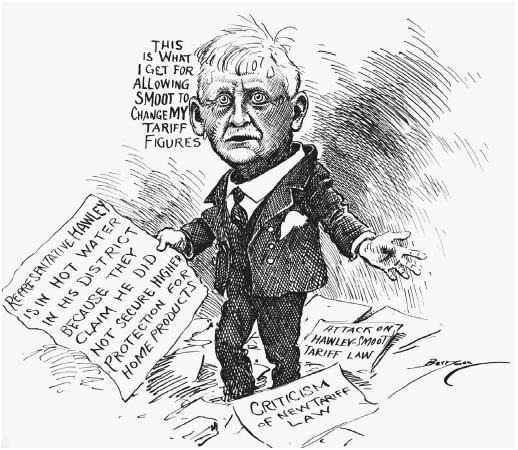
During the Great Depression era, the Smoot-Hawley Tariff plunged the economy deeper into a hole and led to outrage across America. Four months after President Hoover signed the tariff into law, the daily afternoon newspaper Washington Evening Star published a cartoon of Representative Hawley “sweating bullets over heavy criticism of the Smoot-Hawley Tariff” (Image 1) (Plant, 2004).

Although the cartoon portrays the criticism towards Hawley effectively, the artist decided to cast a darker light on Senator Smoot for changing tariff figures, claiming that those modifications exacerbated the financial situation. Indeed, 431 modifications of the House bill took place in the Senate, and most of the increased rates were for agricultural commodities (“The Smoot-Hawley,” 1929). Like the economists from the American Economic Association foretold, the increased tariff duties did “raise prices to consumers, damage export trade, hurt farmers, promote inefficiency and promote foreign reprisals” (Pakko, 1930). A 1939 New York Times article captured this sentiment by emphasizing Secretary of State Cordell Hull’s lament that “within two years after the Smoot-Hawley act was passed, with its guarantee of unmeasured prosperity to farmers and laborers and business men throughout the indefinite future, and especially its guarantee of steady employment with good wages for laborers…about ten or twelve million American wage-earners were out of employment” (Special to The New York Times, 1939). The sheer amount of job losses justified the reactions from the public toward the tariff, particularly targeting Hoover, Smoot, and Hawley, and repeatedly debunked the idea that the tariff would boost the economy. Moreover, from 1929 to 1932, U.S. exports fell from $5.4 billion to $1.6 billion (Barnhill, 2013). World trade plummeted, and the Tariff Act of 1930 influenced much of the drop.
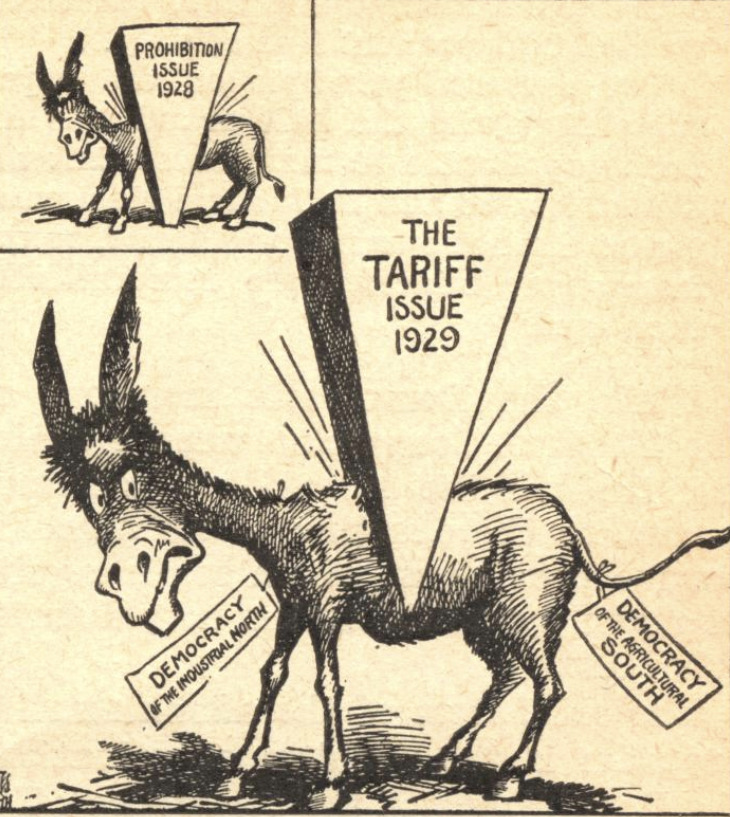
Prior to the enactment of this tariff, the prevalence of public concern unveiled an important feature of U.S. politics at the time: no amount of warning from the public—not even from hundreds of qualified economists across the country—would sway the bill away from being passed. Therefore, Henry Norton’s belief, published just a month before Hoover signed the tariff, that “there is little likelihood that a single vote in either the Senate or the House will be changed from ‘Yea’ to ‘Nay’ out of deference to this mass manifesto from the halls of learning” turned out to be accurate (Norton, 1930). Extending along these lines, the approvers of the tariff overlooked the immediate and long-term economic effects of such policy, and the question of approving the tariff relied on politics rather than economics; however, this act was not passed unanimously. The tariff issue, resurged from previous decades, fueled debate among the Republican and Democratic parties of the United States. The Washington Post published a picture of this polarization that further illustrated the controversy of the tariff before its passage (Image 2) (“The Smoot-Hawley,” 1929).

Senator Borah conveyed this dispute when he cautioned, “The more I read of the bill the less I like it” (“The Smoot-Hawley,” 1929). Additionally, chairman of the Executive Committee of the Democratic National Committee Jouett Shouse brought to attention that “the motivating principle behind the proposed enactment was not protection of American industry…but a simple determination to enable special groups of industrialists to cash in on their last year’s campaign contributions” (“The Smoot-Hawley,” 1929). This claim questioned the intent behind the tariff but continued to emphasize the polarizing nature of the issue.
After the approval of the tariff a month later in June 1930, the economic downfall underscored that “the making of tariffs in this country has always been much more a matter of politics than of economic science” (Norton, 1930). Indeed, the politics of the country and its international relations may have shaped these protectionist measures, but the overlooking of economic science and historical disagreements affected both the United States and its trading partners. Yet days before enacting the tariff, President Hoover maintained “there are certain industries which cannot now successfully compete with foreign producers because of lower foreign wages and a lower cost of living… [a revision] may maintain the standard of living and may count upon steady employment” (“President Hoover,” 1930). This deep conviction of the effectiveness of the tariff proved to be false and impacted business unpredictability. In fact, after Hoover’s approval of the tariff, “firms that relied on export markets would be concerned about how rapidly and how completely other countries would retaliate” and “firms that previously relied on imported inputs would have been concerned about how effectively and at what price domestic suppliers would be able to replace imports” (Archibald & Feldman, 1998). Ultimately, domestic controversy and criticism intensified political divide and uncertainty during this period while people faced drastic economic effects, ranging from immense trade declines to major unemployment. However, the controversy was not limited to the borders of the United States.
Sparking a New Trade War
While harming the domestic economy and the public’s view of the federal government, the Smoot-Hawley Tariff also proved detrimental to many nations who had to reciprocate with more protective measures. U.S. duties plummeted global trade to new all-time lows, and the real gross national product (GNP) dropped by 18 percent with total export volume falling by 35 percent from 1929 to 1933—much of the economic decline due to the protectionist measures during this period (Crucini, 2006). To offset these impacts, the commercial partners of the United States imposed retaliatory measures. This consequence was not surprising, especially when New York Times articles circulated the idea in 1930 that “Foreign retaliation is not merely a possibility of the future…It is a present actuality. It finds expression not only in high tariff walls which increase the difficulty of American competition with foreign manufacturers [but also] various other restrictions which materially reduce the sales of American manufacturers abroad” (Norton, 1930). The conditions of the Great Depression certainly contributed to the urgency of protective measures, but legislators may have overlooked foreign retaliation or believed it to be unlikely.
The Smoot-Hawley Tariff further shifted U.S. foreign policy by provoking new political regimes in other countries, an impact unveiled after countries returned the favor with new taxes on U.S. exports. Under the tariff bill, the increase of sugar taxes on Cuba was a key factor in inciting a revolution on the island and overthrowing the existing leaders (Irwin, 2017). The original government had friendly relations with the United States while the new leaders believed in more protectionist policies to counter American tariffs.
Similarly, Canadian politics also changed after the tariff bill, for a pro-protectionist Conservative party rose to power in Canada after the tariff bill. The Canadian Prime Minister until 1930 was W.L. Mackenzie King, and he felt pressured to adopt policies that Progressives accepted to gain their support for the Liberal Party; despite the U.S. Fordney-McCumber Tariff in 1922 that taxed major Canadian exports such as wheat, cattle, and milk, King pursued tariff reductions (McDonald et al., 1997). However, King upheld an equal trade stance by announcing countervailing duties to the United States at his keynote address in Ontario days after the passage of the Smoot-Hawley Tariff: “We are resolved, in the interests of the Canadian people, that our commercial relations must not be one-sided” (McDonald et al., 1997). King emphasized that U.S. taxes on Canadian exports must be met with Canadian taxes on U.S. exports to counterbalance the inequality of trade and pressure the United States to call down the tariffs. These Canadian taxes would affect more than 25 percent of U.S. exports to Canada, according to analysis from the Department of Commerce in 1930, severely impacting trade relations between these major partners (Norton, 1930).
Meanwhile, R.B. Bennett campaigned in Quebec for the upcoming Canadian elections in July of 1930. Utilizing his strong belief about fighting against injustice of U.S. tariffs, particularly, “I will make [tariffs] fight for you. I will use them to blast a way into markets that have been closed,” and criticizing King’s policy, “Imagine a country sunk so low that the Prime Minister says he will not do his duty by his country because, if he did, he might provoke someone,” he won the role of Prime Minister, and the Conservatives gained the support of a majority of Canadians who moved away from the Liberal Party (Norton, 1930). In addition, the Conservatives secured the only majority in the Canadian Parliament between 1911 and 1958 by gaining 46 seats in 1930 (Norton, 1930). One can attribute many factors to this rare shift to the pro-protectionist Conservative party, but the Smoot-Hawley Tariff stands out as an important catalyst for this change in Canadian politics. For Mackenzie King, his alignment with tariff reductions and limited retaliatory tariffs shaped defensive reactions across Canada, and Bennett capitalized on King’s untenable strategy, became the Prime Minister, and helped Conservatives gain the majority in Parliament to reshape trade policy. Cuba and Canada are a few of many examples of global shifts to different political formations as a consequence of the Smoot-Hawley Tariff; these countries ultimately adopted more retaliatory policies to counter the protectionist American trade policy.
The Tariff Act of 1930 also negatively changed perceptions of the United States internationally, for a trade war with any winners was essentially impossible during this period. First, the American Economic Association highlighted that this increase of tariffs failed to recognize the fabric of world trade in that the “bitterness which a policy of higher tariffs would inevitably inject into our international relations” would be drastic, considering that the World Economics Conference at the League of Nations in 1927 “adopted a resolution announcing that ‘the time has come to put an end to the increase in tariffs and to move in the opposite direction’” (Special to The New York Times, 1930). The fact that the United States chose to draw away from this global commercial agreement incited criticism soon on an international scale.
In 1932, British civil servant Sir Arthur Salter attested that the tariff “‘was a turning point in world history’ for its role in unleashing the protectionism that destroyed world trade in the 1930s” (Irwin, 2017). Such perceptions were common after the passage of the 1930 tariff, especially as people began feeling its effects soon. Harvard economist Richard Cooper claimed in 1987 that “the apparent indifference of the U.S. authorities to the implications of their actions for foreigners and the foreign retaliation that quickly followed, as threatened, helped convert what would have been otherwise a normal economic downturn into a major world depression” (Irwin, 2017). Cooper argued that these U.S. tariff measures exacerbated the Great Depression itself for the United States and economic crises across the world, which other post-Great Depression studies corroborated. The passage of the Smoot-Hawley Tariff led to a set of immense shifts in politics, society, and the economy around the world. These harmful changes created a gap in U.S. diplomatic relations that required novel solutions to fix.
Mending U.S. Foreign Policy
The Tariff Act of 1930 sparked a trade war with no winners and called upon a need to pursue a route of negotiation and import tax reduction to reestablish foreign relations and revive the economy. Two years after President Franklin D. Roosevelt won the presidential election over incumbent President Herbert Hoover, he passed the Reciprocal Trade Agreements Act (RTAA) to mitigate global trade conditions, restore U.S. trade relations, and encourage trade circulation. In fact, tariff reductions and new trade deals following the RTAA with countries like Canada, Britain, and nations in South America and Europe effectively increased American imports to an all-time high by 1940, from a 20-year low between 1932 and 1933 (Fishback, 2010). The RTAA was a crucial step for improving foreign relations and rebuilding global trade.
In the U.S, the RTAA revised the trade policy authority. Considering that the Smoot-Hawley bill was the last Congressional general tariff revision after the RTAA delegated power to the president to negotiate commercial deals, the tariff bill helped set the foundation for evolving governmental trade authorities (Irwin, 2017). This shift resonated with President Hoover’s statement in 1930 that “Congressional revisions are not only disturbing to business but with all their necessary collateral surroundings in lobbies, log rolling, and the activities of group interest, are disturbing to public confidence” (Irwin, 2017). The RTAA began the process of bestowing tariff power to the Executive Branch in hopes of preventing the drastic tariff rate changes that occurred in Congress, especially during the Smoot-Hawley tariff revisions. In addition to the President’s ability to conclude agreements with other nations for the growth of international markets, the amendment of the RTAA also gave the President authority to “proclaim, within strict limitations, such changes in rates of duty or guarantees of continuance of existing customs or excise treatment” (Fleming, 1936). Therefore, the Roosevelt Administration remodeled trade policy authority to mitigate the severe economic crises of the 1930s and prevent future trade debacles; this shift exists as the precursor of unprecedented amounts of trade policy power to the Executive Branch of the United States.
Modern Resurgence
The Smoot-Hawley Tariff exacerbated economic conditions beyond the United States and substantially reshaped social and political frameworks in a multitude of countries. A wide range of condemnations from students, teachers, economists, and politicians beyond North America helped pave the way for reconstructing U.S. trade policy and set the path to strengthening the U.S. President’s trade policy authority. A clear theme from this period was volatility that sparked defensive reactions from the United States, adopting a heavy protectionist economic framework that disregarded existing world trade agreements, diplomatic relations, and the commercial interests of U.S. trade partners, which collectively set consequences for the social, political, and economic state of the world.
Entering the twenty-first century, the fact that economists and politicians still refer to the Smoot-Hawley Tariff demonstrates its significance and the magnitude of its impacts. During the first Trump Administration in 2017, for example, Secretary of Commerce Wilbur Ross underscored the importance of remembering and learning from the lessons from the Great Depression and tariff failures:
Tariffs do have a useful role in correcting inappropriate practices. I am keenly aware of [1930s-era tariff acts] and the effect that it had. If nothing else we can learn from the lesson of history. If it didn’t work very well then it likely wouldn’t work very well now (Donnan, 2017).
From the beginning of the second Trump Administration, a powerful wave of protectionist rebirth and “America First” ideologies struck the United States and hundreds of its allies. Economists agree that no one wins a trade war, but the current whimsical U.S. trade policy causes uncertainty in businesses, stock markets, and the prices of many commodities used daily, even if the President of the United States employs these measures as bargaining chips. The current escalation of an unparalleled trade war led by the United States further disrupts global diplomacy and commercial interests, pressuring businesses to produce domestically and raise federal revenue in exchange for shaking financial markets worldwide (Gamio et al., 2025).
June 17, 1930 marked the passage of the Smoot-Hawley Tariff and a punishing legacy on the world. Learning from the economic history of the United States, particularly the Great Depression and several tariffs, is critical for navigating through the intricacies and fluctuations of current trade policy. Indeed, awareness of the beginnings of Executive Branch control over trade policy in the 1930s and later in the 1974 Trade Act—how the President regulates decisive power over the commercial interests of the United States, even though Article I, Section 8 of the U.S. Constitution reserves Congress the power to impose tariffs—becomes essential for people globally. Indeed, the Trump Administration circumvented Congressional approval and the historic checks and balances by declaring a national emergency on April 2, 2025 (“liberation day”) through the invocation of the International Emergency Economic Powers Act of 1977 (IEEPA) that authorizes the President to regulate U.S. commercial interests in the circumstance of a threat to national security, foreign policy, or the economy (Congress.gov, 2025). Citing this act to impose tariffs is unprecedented but establishes the loopholes available to accumulate excessive power over foreign trade policy and to strong-arm nations to pursue U.S. political and economic interests, such as controlling drug trafficking, illegal immigration, and adhering to fossil fuel usage to “retreat on climate goals” (Friedman, 2025).
Conclusion
This current trade crisis calls for revisiting the Great Depression era and the Tariff Act of 1930 to recognize similar patterns of economic failures in history and create a sustainable trade policy authority framework. The 1930s period of unpredictability caused irreversible decisions that failed to consider public sentiment or even professional standpoints, and such impulsive choices must not be remodeled in the modern day. On August 29, 2025, a federal appeals court ruled that imposing tariffs or taxes on almost every country in the world is overstepping the limits of presidential power, voiding all “liberation day” tariffs until the Supreme Court makes an ultimate decision (Gabbatt & Rushe, 2025). Such checks of power are crucial for a country founded on the rule of law and separation of powers. In order to amend and maintain diplomatic relations with national partners and ensure a resilient future, this regulation of power becomes paramount for the United States of America.